
Key Rules and Mechanisms of a 30 Year VA Cash Out Loan
When exploring options to access the equity built up in your property, The Ultimate Guide to a 100 Cash Out Refi serves as an excellent starting point for understanding how the Department of Veterans Affairs structures equity extraction. Unlike conventional loans that cap equity access at 80% Loan-to-Value (LTV), a VA cash-out refinance allows qualified borrowers to access up to 100% of their home’s appraised value, subject to lender guidelines.
A 30-year term distributes the repayment over 360 monthly installments. This structure keeps your monthly obligations manageable while liquidating accumulated wealth from your primary residence. To protect your financial health, the VA mandates that the property undergo a complete appraisal process to establish its fair market value, ensuring the new loan does not exceed statutory limits.
VA Cash-Out Refinance vs. VA IRRRL
Many borrowers confuse a standard cash-out loan with the VA Interest Rate Reduction Refinance Loan (IRRRL). These two loan programs serve fundamentally different purposes:
- VA IRRRL (Streamline Refinance): Designed strictly to lower your interest rate or move from an adjustable-rate mortgage to a fixed-rate loan. The VA strictly prohibits taking cash out at closing with an IRRRL. It requires no appraisal, minimal underwriting, and only requires certification of prior occupancy.
- VA Cash-Out Refinance: Allows you to take physical cash back at closing from your home equity. It requires full credit underwriting, income verification, an official VA appraisal, and current occupancy of the property. It also allows you to refinance a non-VA mortgage into a VA loan.
For a broader breakdown of refinancing structures, review The Ultimate Guide to VA Home Mortgage Refinancing.
Type I vs. Type II Cash-Out Refinance
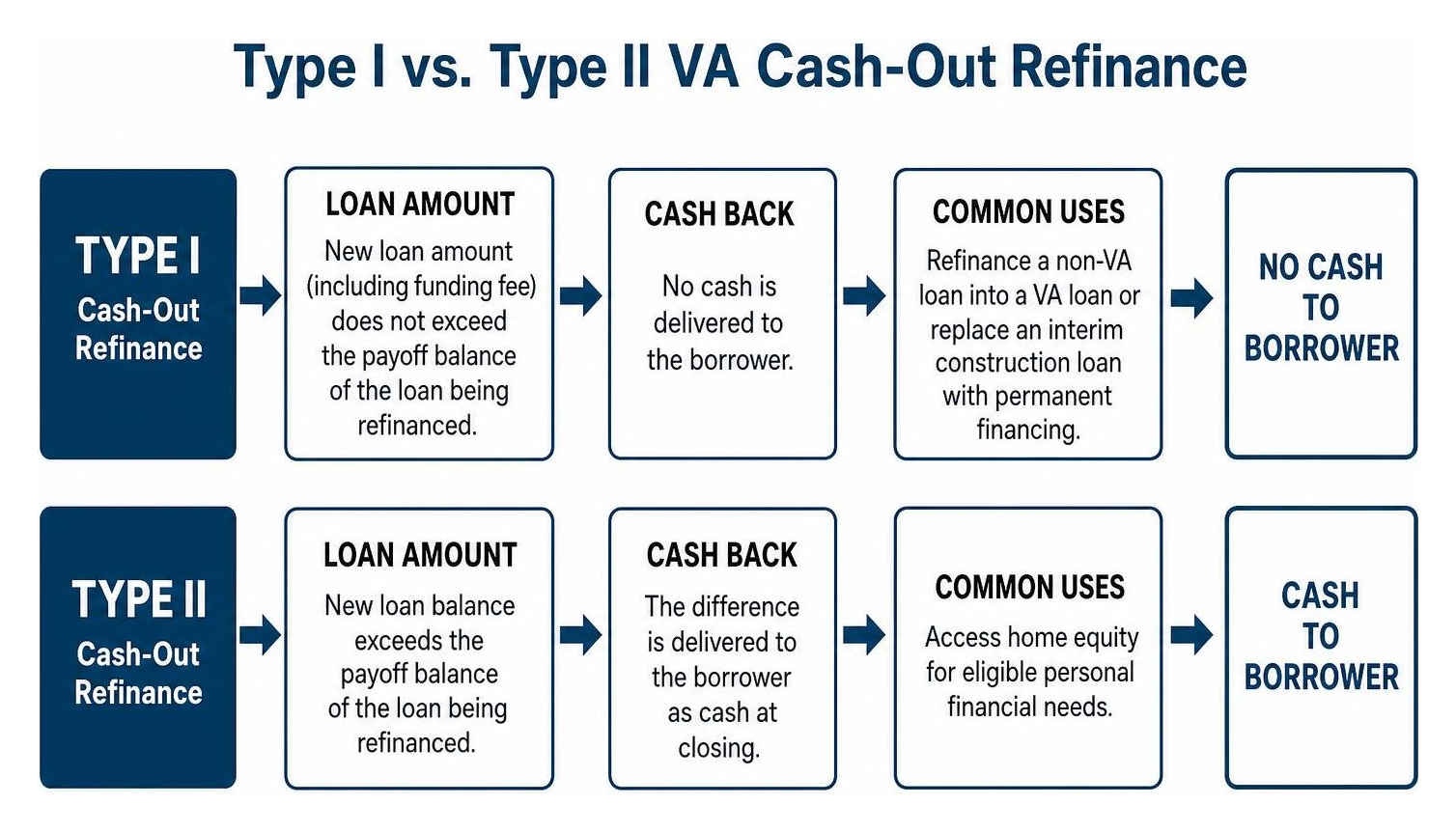
Under statutory guidance outlined in Circular 26-18-30, the VA categorizes cash-out refinances into two distinct classifications:
- Type I Cash-Out Refinance: The new loan amount (including the funding fee) does not exceed the payoff balance of the loan being refinanced. Borrowers often use this path to refinance a non-VA loan into a VA loan or replace an interim construction loan with permanent financing without receiving cash in hand.
- Type II Cash-Out Refinance: The new loan balance exceeds the payoff amount of the existing mortgage, delivering the difference directly to the Veteran as liquid cash at closing.
Underwriting Standards and Qualifications
To secure a 30-year fixed cash-out mortgage, borrowers must satisfy clear federal standards. You can explore how to Get Maximum Equity with a 100 Percent VA Cash Out Refinance while staying fully aligned with VA underwriting requirements.
The VA enforces a hard cap: the total loan amount—including the VA funding fee—cannot exceed 100% of the reasonable value established on the appraiser’s Notice of Value (NOV). If a borrower chooses a loan structure that exceeds 100% LTV, the overage must be paid out of pocket at closing.
Eligibility and Seasoning for a 30 Year VA Cash Out
The VA enforces strict loan seasoning requirements to safeguard Veterans from rapid loan churning. Before refinancing an existing VA-backed mortgage, your loan must meet the seasoning test:
- At least 210 calendar days must have passed from the date your first monthly payment was due on the existing mortgage.
- You must have made at least six consecutive monthly payments on the loan being refinanced.
You must also present an updated Certificate of Eligibility (COE) and certify that you intend to occupy the home as your primary residence. For a comprehensive review of service thresholds and documentation, consult The Complete Guide to VA Refinance Eligibility.
Passing the Net Tangible Benefit (NTB) Test
To ensure the new loan provides a genuine financial advantage, lenders must verify that your refinance passes the Net Tangible Benefit (NTB) test. The new transaction must satisfy at least one of the following criteria:
- The new loan eliminates private mortgage insurance (PMI) or FHA mortgage insurance premiums (MIP).
- The interest rate on the new loan is lower than the previous rate.
- The term of the new loan is shorter than the remaining term of the old loan.
- The monthly principal and interest payment decreases.
- The borrower converts an adjustable-rate mortgage (ARM) into a predictable fixed-rate mortgage.
- The borrower extracts cash to pay off higher-interest consumer debt or fund major life expenses.
- The new loan amount is equal to or less than 90% LTV of the reasonable value.
- The refinance converts an interim construction loan into permanent financing.
Lenders must provide a written NTB comparison disclosure within three business days of receiving your initial application and again at the closing table.
Costs, Funding Fees, and Financial Comparison

A cash-out refinance involves standard closing costs, such as lender origination fees, title charges, recording fees, and property appraisal costs. When seeking higher loan amounts, check our guide on how to Tap Equity Fast with VA Jumbo Cash Out Refinancing.
| Feature | 30-Year VA Cash-Out | 15-Year VA Cash-Out |
|---|---|---|
| Monthly Payment | Lower, spreads principal over 360 months | Higher, compresses payoff into 180 months |
| Lifetime Interest | Higher due to extended amortization | Lower due to accelerated principal reduction |
| Maximum LTV | 100% of appraised value | 100% of appraised value |
| Cash-Out Access | Identical equity access | Identical equity access |
| Best For | Lower monthly overhead and flexibility | Minimizing long-term interest costs |
VA Funding Fee Rates and Exemption Rules
The VA funding fee is a statutory fee established by Public Law 116-23. The fee is calculated as a percentage of the total loan amount and helps sustain the loan program for future generations:
- First-Time Use: 2.15% of the total loan amount.
- Subsequent Use: 3.30% of the total loan amount.
You are exempt from paying the VA funding fee if you meet any of the following conditions:
- You receive VA disability compensation for a service-connected disability.
- You are an active-duty service member who has been awarded the Purple Heart.
- You are an active-duty service member eligible for disability compensation based on a pre-discharge exam.
- You are a surviving spouse receiving Dependency and Indemnity Compensation (DIC).
Weighing the Pros and Cons of a 30 Year VA Cash Out
Choosing a 30-year fixed amortization offers stability. Before locking in your rate, review our insights on Understanding Current 30 Year VA Mortgage Rates Today and read about How 30 Year Fixed VA Jumbo Mortgage Rates Really Work.
Advantages:
- Lower Monthly Payments: Extending the repayment timeline over 30 years reduces your monthly principal and interest obligation compared to shorter terms.
- Improved Debt-to-Income (DTI) Ratios: Lower monthly payments make it easier to qualify under standard underwriting guidelines.
- Cash Flow Flexibility: Gives you breathing room in your monthly budget to allocate funds toward investments, emergency savings, or daily living costs.
Disadvantages:
- Total Interest Paid: A 30-year amortization schedule results in more total interest paid over the life of the loan than a 15-year or 20-year mortgage.
- Slower Equity Accumulation: Early monthly payments go primarily toward interest rather than principal reduction.
Application Workflow and Closing Timeline

Navigating the application process is straightforward when working with an experienced direct lender. Understanding each milestone helps keep the transaction on schedule. You can read Everything to Expect From Your VA Loan Closing Timeline to prepare for each phase from submission to funding.
For Type I cash-out refinances involving existing VA loans, the VA requires that all closing costs, fees, and expenses be fully recouped through monthly payment savings within 36 months of loan closing.
Documenting Income and Entitlement
Underwriters evaluate your financial profile to ensure the new loan is sustainable. The standard documentation package includes:
- Income Verification: Recent pay stubs covering the last 30 days and W-2 statements from the past two years.
- Tax Documentation: Federal tax returns from the previous two years for self-employed borrowers or those with secondary rental income.
- Asset Statements: Two months of checking, savings, and investment account statements.
- Certificate of Eligibility (COE): Verifies basic entitlement ($36,000) and any available bonus entitlement to support full VA loan backing without a down payment.
Appraisal, Underwriting, and Cash Disbursement
Once your initial documentation is approved, the lender requests an appraisal through the VA portal. An independent, VA-assigned appraiser inspects the home to ensure it meets VA Minimum Property Requirements (MPRs) and determines its fair market value.
After the appraiser issues the Notice of Value and final underwriting conditions are cleared, the loan moves to closing. Following the statutory three-day right of rescission on primary residences, the title company disburses your cash-out proceeds directly into your bank account via wire transfer or cashier’s check.
Frequently Asked Questions About VA Cash-Out Refinancing
Can I do a VA cash-out refinance if I currently have a non-VA loan?
Yes. You can use a VA cash-out refinance to pay off an existing conventional, FHA, USDA, or private mortgage. This allows eligible Veterans to eliminate monthly private mortgage insurance (PMI), access their home’s equity, and secure the benefits of a VA-guaranteed loan.
Are there any restrictions on how I can spend the cash-out proceeds?
No. The VA does not restrict how you use the proceeds from a cash-out refinance. Borrowers commonly use the funds to consolidate high-interest credit cards, finance home renovations, cover medical or educational costs, or build an emergency reserve.
How does taking out a cash-out loan impact my remaining VA loan entitlement?
When you refinance an existing VA loan with a new VA cash-out loan, your previous entitlement tied to that property is replaced by the entitlement used for the new loan. Because the loan amount is backed by your basic and bonus entitlement tiers, eligible borrowers with full entitlement can borrow up to the reasonable appraised value without county loan limit caps.
Conclusion
A 30-year VA cash-out refinance provides a dependable, long-term financing solution for military homeowners seeking to access their home equity while keeping monthly payments manageable. At Capital Home Mortgage, as a direct VA lender with in-house underwriting, we help eligible service members and Veterans navigate the refinance process with confidence.
Explore our full suite of VA home mortgage solutions today to learn how our direct lending team can help you maximize your hard-earned military benefits.


