
What to Expect From VA Closing Costs
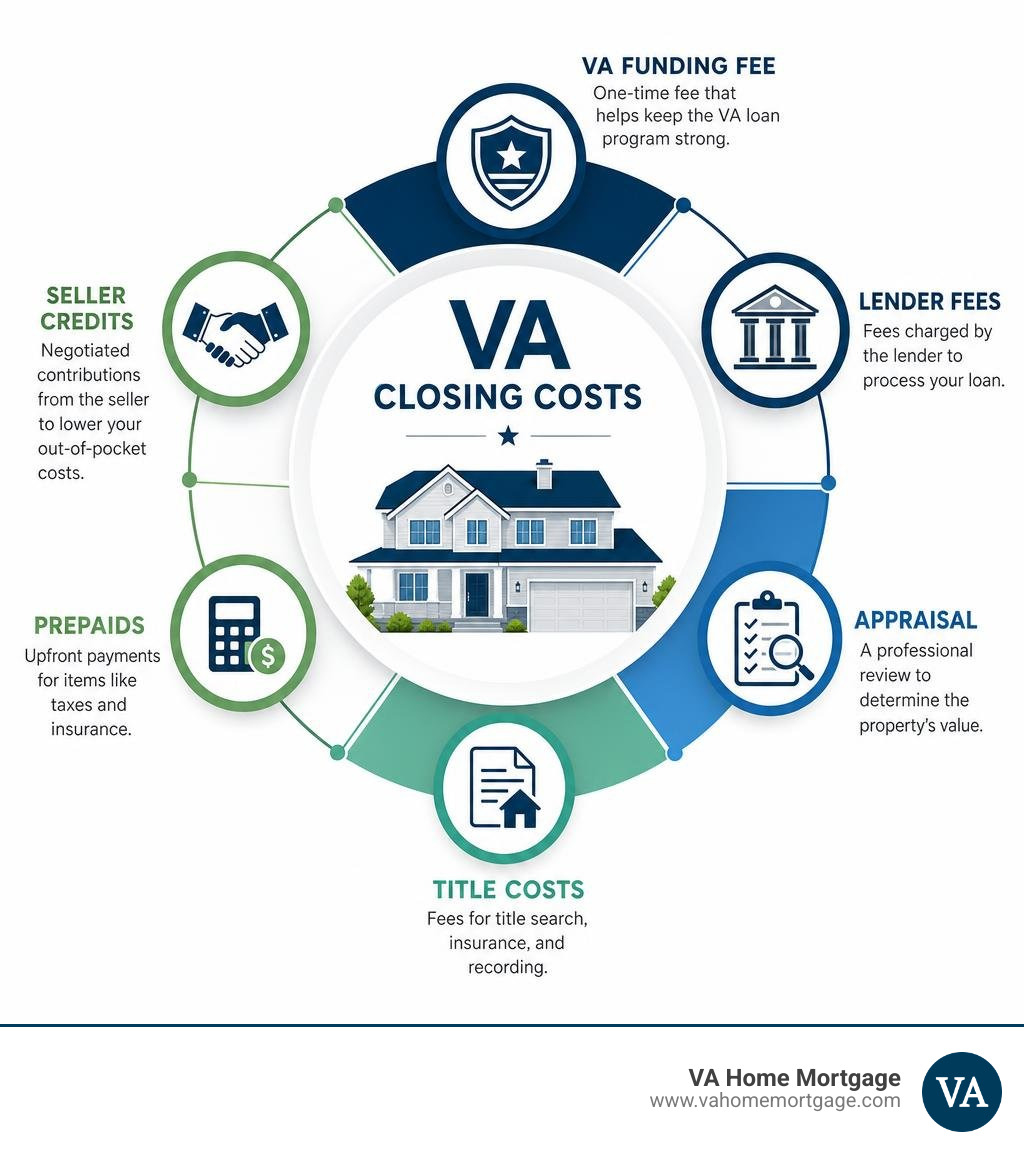
VA closing costs are the fees due to complete a VA home purchase or refinance. They can include lender charges, an appraisal, title and recording fees, prepaid taxes and insurance, and the one-time VA funding fee. You may be able to reduce your cash needed at closing by negotiating seller-paid costs or using lender credits. On a purchase loan, however, you generally cannot roll ordinary closing costs into the loan balance; only the VA funding fee can be financed.
The funding fee is not the same as every other settlement charge. Many eligible borrowers are exempt, including veterans who receive VA disability compensation and certain surviving spouses receiving Dependency and Indemnity Compensation. For borrowers who pay it, the fee depends on the loan type, down payment, and whether the VA benefit has been used before.
A VA loan can offer major savings because it may require no down payment and no monthly private mortgage insurance. Still, review your Loan Estimate early, ask which fees are lender-set versus third-party charges, and negotiate credits before signing a purchase contract.
I am Dale Gremillion, a Senior Loan Officer and Producing Branch Manager with more than 25 years in residential lending, including VA purchase, refinance, and cash-out loans. I help military borrowers understand VA closing costs, weigh their options, and prepare for a smoother closing.
What Is the VA Funding Fee and How Is It Calculated?

The VA funding fee is a mandatory, one-time governmental charge applied to VA-backed and VA direct home loans. The primary purpose of this fee is to reduce the overall burden on U.S. taxpayers by offsetting the administrative expenses and potential default losses of the VA loan program. Because VA mortgages do not require monthly private mortgage insurance (PMI) or a mandatory down payment, this upfront charge helps keep the program self-sustaining for future generations of service members.
Borrowers have two options when settling the funding fee: pay the full amount upfront at the closing table, or finance it directly into the total loan balance. Financing the fee is the most common approach for military buyers who want to minimize upfront cash requirements, though doing so slightly increases the monthly mortgage payment and total interest paid over the life of the loan.
Your eligibility status, prior loan usage, and exemption details are documented on your VA Certificate of Eligibility (COE). We pull this document directly during pre-approval to determine your precise funding fee requirements before you begin home shopping.
Funding Fee Rates for Purchase and Construction Loans
For standard home purchases and construction loans, the funding fee rate is determined by two main factors: whether you have used your VA home loan benefit before and how much money you put down at closing.
- First-Time Use with Less Than 5% Down: The fee is 2.15% of the base loan amount.
- Subsequent Use with Less Than 5% Down: The fee rises to 3.3% of the base loan amount.
- Down Payment of 5% or More (First or Subsequent Use): The fee drops to 1.5% of the loan amount.
- Down Payment of 10% or More (First or Subsequent Use): The fee decreases further to 1.25% of the loan amount.
| Down Payment Tier | First-Time Use Fee | Subsequent Use Fee |
|---|---|---|
| Less than 5% down | 2.15% | 3.30% |
| 5% to 9.99% down | 1.50% | 1.50% |
| 10% or more down | 1.25% | 1.25% |
For detailed regulatory guidelines, review the official VA Funding Fee and Closing Cost Guidelines.
Refinance, Native American Direct, and Assumption Rates
Different loan structures and specialized VA programs follow their own statutory fee schedules:
- Interest Rate Reduction Refinance Loan (IRRRL): Often called a VA streamline refinance, this program carries a reduced funding fee of 0.5%, regardless of prior usage. Explore our streamline refinancing options to evaluate how an IRRRL can lower your monthly payments.
- Cash-Out Refinancing: Cash-out transactions require a 2.15% funding fee for first-time use and 3.3% for subsequent use.
- Native American Direct Loans (NADL): Set at 1.25% for purchase transactions and 0.5% for refinance loans.
- Loan Assumptions: When another eligible buyer assumes an existing VA mortgage, the funding fee is 0.5%.
- Manufactured Home Loans (Not Permanently Affixed): Carry a 1.0% funding fee.
- Vendee Loans (Purchasing VA-Acquired Property): Assessed at 2.25%.
Exemptions and Circumstances for Retroactive Refunds
Certain military borrowers are completely exempt from paying the VA funding fee. You qualify for an exemption if you meet any of the following criteria:
- You receive VA compensation for a service-connected disability.
- You are entitled to receive VA disability compensation but receive active-duty or retirement pay instead.
- You are a surviving spouse receiving Dependency and Indemnity Compensation (DIC).
- You are an active-duty service member who has been awarded the Purple Heart.
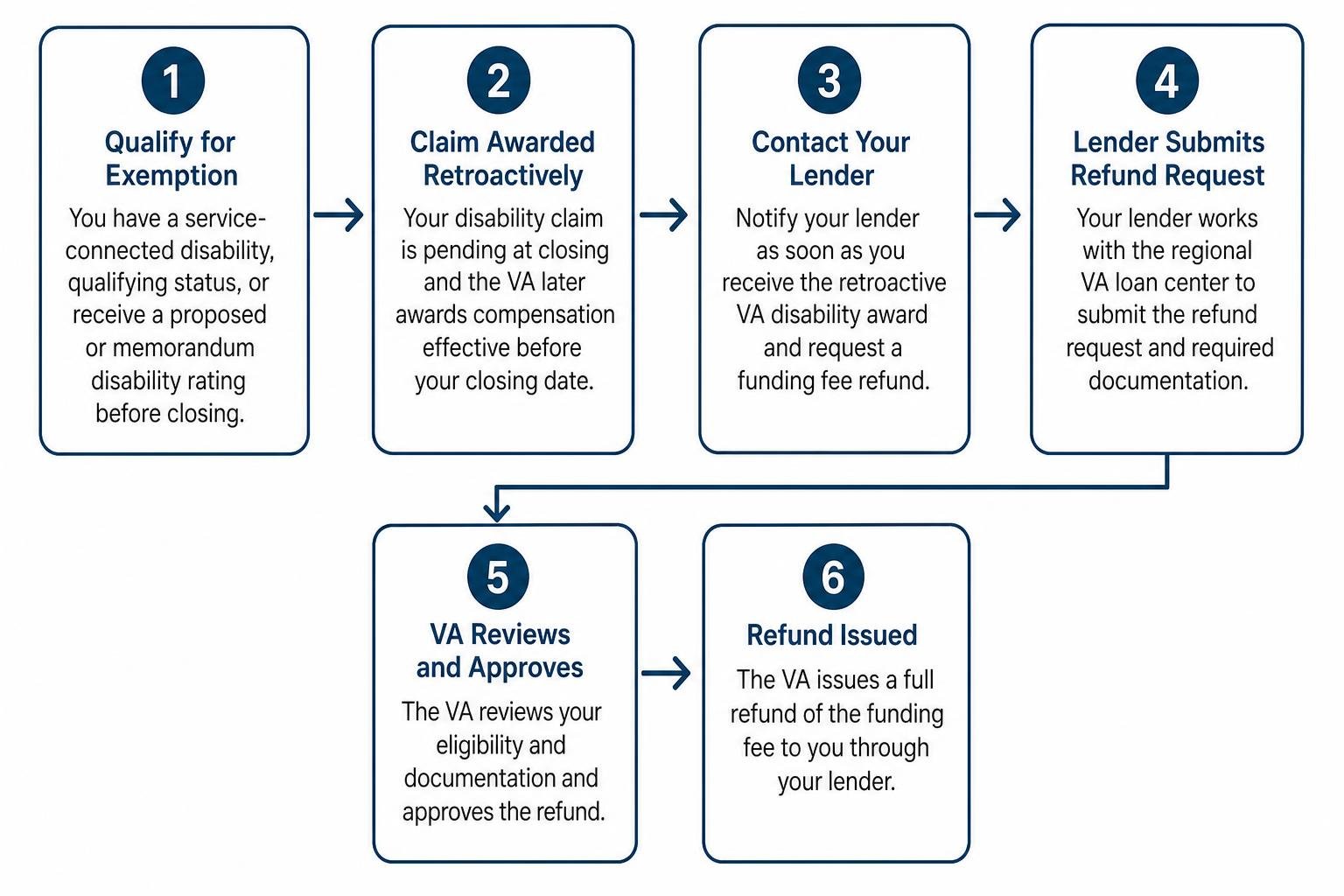
- You have received a proposed or memorandum disability rating from the VA prior to your loan closing date.
If your disability claim is pending while your loan closes and the VA later awards you retroactive disability compensation effective before your closing date, you may be entitled to a complete refund of the funding fee. Navigating this refund claim requires working closely with your lender and regional VA loan center. For personalized assistance with eligibility paperwork, working with a veteran loan specialist ensures your exemptions are properly verified on your COE before settlement.
Breakdown of Standard VA Closing Costs and Associated Fees

Beyond the funding fee, buyers must account for routine settlement expenses charged by lenders, title companies, municipal offices, and third-party service providers.
Primary Fee Categories Included in VA Closing Costs
- Lender Origination Charges: Covers administrative processing, underwriting, and loan preparation. Lenders may charge a flat 1% origination fee or an itemized breakdown of equivalent costs.
- Discount Points: Optional upfront fees paid to permanently lower your interest rate. Check our analysis of understanding current 30-year VA mortgage rates to calculate the breakeven period for buying points.
- VA Appraisal Fee: Pays for an independent VA-assigned appraiser to verify market value and check that the home meets VA Minimum Property Requirements (MPRs).
- Credit Report Fee: The actual cost incurred by the lender to pull your multi-bureau credit profile.
- Title Insurance and Settlement Fees: Covers lender’s title insurance, title search, and closing settlement agent fees.
- Government Recording Fees: Municipal charges to record the deed and mortgage into public land records.
- Prepaid Escrows: Funds collected in advance to establish your escrow cushion for property taxes, homeowners insurance, and flood insurance (if applicable).
Allowable vs. Non-Allowable Fees for VA Borrowers
The VA enforces rules regarding which fees veterans can be charged to prevent predatory lending practices:
- Allowable Fees: Appraisals, credit reports, origination charges (up to 1%), title examination, recording fees, and survey fees.
- Non-Allowable Fees: The VA explicitly prohibits lenders from charging veterans separate line-item fees for document preparation, underwriting, processing, escrow management, attorney fees where the attorney represents the lender, or loan application fees if a full 1% origination fee is already being charged.
Understanding these protections helps you keep tabs on every item while navigating the VA loan closing timeline from initial application to final funding.
Strategies to Minimize Out-of-Pocket Expenses at Settlement
Military borrowers have several effective options to significantly reduce settlement charges at closing.
Seller Concessions and the 4% Cap Rule
Under VA loan guidelines, sellers are permitted to contribute toward the buyer’s closing costs. Standard closing costs—such as discount points, title fees, and appraisal charges—do not count toward the VA’s seller concession cap.
However, additional incentives known as seller concessions are strictly capped at 4% of the home’s established reasonable value (appraised value or sales price, whichever is lower). Items subject to the 4% concession cap include:
- Prepayment of property taxes and homeowners insurance.
- Payment of the buyer’s VA funding fee.
- Payoff of the buyer’s existing credit card or installment debts at closing.
- Gifts or personal property incentives included in the transaction.
- Temporary interest rate buydown fees.
Strategically structuring your purchase contract with your real estate agent can allow the seller to pay standard closing costs plus up to 4% in concessions, effectively bringing your upfront cash requirements down to zero. Read our detailed guide on minimizing closing costs for military buyers for practical contract negotiation tips.
Can You Finance VA Closing Costs into Your Loan Amount?
On a VA purchase transaction, you cannot finance standard closing costs into your mortgage balance. The only settlement charge that can be rolled into a purchase loan is the VA funding fee. All other costs—such as title fees, lender charges, and prepaid escrows—must be paid in cash at settlement, covered by seller concessions, or offset by lender credits.
The primary exception is a cash-out refinance. If your home has sufficient equity, you can roll all standard closing costs, taxes, and fees directly into the new loan balance. You can read more about leveraging 100 percent VA cash-out refinancing to see how existing equity eliminates out-of-pocket costs during a refinance.
Frequently Asked Questions About VA Loan Settlement
Who is exempt from paying the VA funding fee?
Borrowers exempt from the VA funding fee include veterans receiving VA disability compensation for a service-connected disability, service members eligible for disability compensation who receive active-duty or retirement pay, Purple Heart recipients serving on active duty, surviving spouses receiving Dependency and Indemnity Compensation (DIC), and service members with an official memorandum rating issued prior to loan closing.
Can seller concessions pay for discount points?
Yes. Sellers can pay for discount points to lower the buyer’s interest rate. If the seller pays standard discount points that bring the interest rate down to normal market levels, these do not count against the 4% concession limit. However, if the funds are used for temporary interest rate buydowns (such as a 2-1 buydown), that contribution is classified as a seller concession and counts toward the 4% cap.
How do lender credits offset out-of-pocket settlement charges?
Lender credits work through premium pricing: you agree to accept a slightly higher mortgage interest rate, and in return, the lender provides a cash credit on your Closing Disclosure to offset some or all of your closing costs. This eliminates out-of-pocket cash needs at closing in exchange for a modest increase in your recurring monthly payment.
Conclusion
Understanding your settlement obligations ensures you can take full advantage of your military housing benefits without unexpected surprises at the closing table. At Capital Home Mortgage, as a direct VA mortgage lender with in-house underwriting, we walk you through every line item on your Loan Estimate and Closing Disclosure to help you structure concessions, evaluate lender credits, and maximize your savings.
Ready to begin your journey toward homeownership? Take the next step today and start your VA home loan pre-approval with our dedicated lending team.


