
Choose the Right VA Home Loan Refinance Path
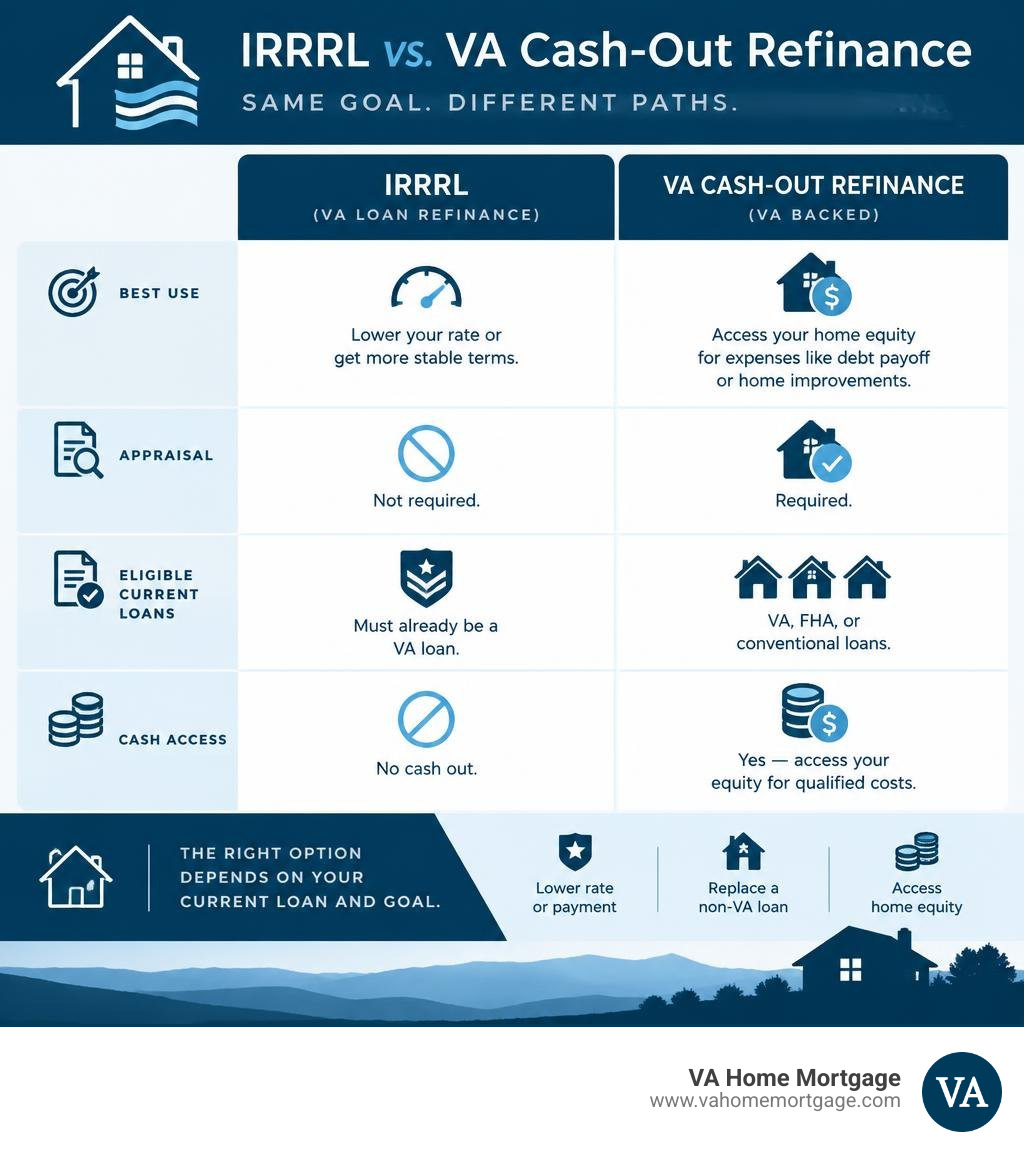
A VA home loan refinance can help you lower your rate, reduce your payment, replace a non-VA mortgage, or use eligible home equity for cash. The right option depends on your current loan and goal:
- Choose an IRRRL if you already have a VA loan and want a simpler refinance focused on a lower rate or more stable loan terms.
- Choose a VA cash-out refinance if you want to refinance a VA, FHA, or conventional mortgage into a VA-backed loan and access equity for expenses such as debt payoff or home improvements.
- Compare the full cost and benefit before signing. Cash-out loans generally require an appraisal and must pass the VA’s net tangible benefit test, which helps show the new loan provides a real financial advantage.
VA refinancing can also remove monthly mortgage insurance from an FHA or conventional loan. Eligibility, income, credit, occupancy, available entitlement, closing costs, and the home’s appraised value still matter. A VA funding fee may apply, but borrowers receiving qualifying VA disability compensation and certain eligible surviving spouses may be exempt.
I am Dale Gremillion, a Senior Loan Officer and Producing Branch Manager with more than 25 years in residential lending, including VA purchase, refinance, and cash-out loans. I help borrowers evaluate each VA home loan refinance option with clear numbers, realistic timelines, and a focus on a predictable closing.
Va home loan refinance helpful reading:
- 100 cash out refi
- 30 year va cash out
- va home refinance rate
Exploring Your Core VA Home Loan Refinance Programs
When managing your home financing, having the backing of the Department of Veterans Affairs gives you a distinct advantage. The federal guarantee minimizes risk for lenders, allowing us to offer competitive interest rates, flexible underwriting, and options that avoid private mortgage insurance (PMI). To make the most of these benefits, you must understand how each path works and how it fits into the ultimate guide to VA home mortgage refinancing.
Both major VA refinancing programs require that the property serves (or previously served, in specific streamline cases) as your primary residence. Beyond that baseline, the two loan types solve completely different financial needs.
The VA Interest Rate Reduction Refinance Loan (IRRRL)
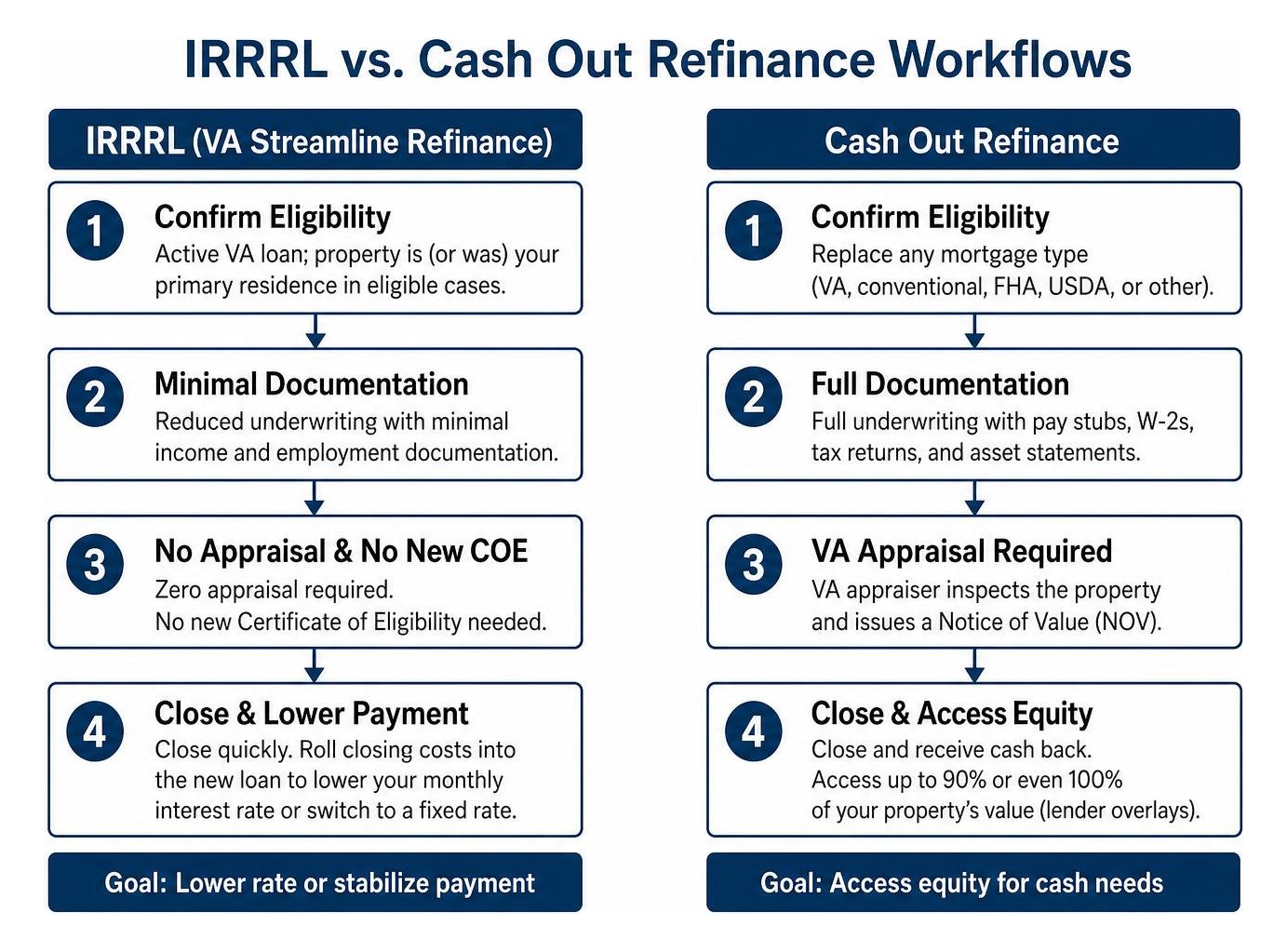
The VA Interest Rate Reduction Refinance Loan, commonly referred to as the VA Streamline refinance, is designed for speed and simplicity. If you currently have an active VA loan and want to lower your monthly interest rate or transition from an adjustable-rate mortgage (ARM) to a predictable fixed rate, this program is typically your best choice.
Because the VA has already guaranteed your initial mortgage, the administrative hurdle is low. In most standard scenarios:
- Zero appraisal is required: You do not have to pay for an appraiser to assess your home’s current market value.
- Minimal underwriting documentation: Income and employment verification steps are significantly reduced compared to standard purchases or cash-out loans.
- No new Certificate of Eligibility (COE): Lenders can verify your existing VA loan status directly through internal systems.
Choosing to streamline your mortgage using a 30 year VA IRRRL allows you to roll closing costs directly into the new principal balance, meaning you can lower your monthly payments without significant upfront cash out of pocket.
VA Cash-Out Refinance Guidelines and Loan-to-Value Rules
A VA cash-out refinance is a full-underwriting mortgage replacement that lets you pull equity out of your home as liquid funds. Unlike the IRRRL, which only refinances an existing VA loan, a cash-out transaction can replace any mortgage type—including conventional, FHA, USDA, or private liens.
When you apply for a cash-out refinance:
- A certified VA appraiser must inspect the property and issue a formal Notice of Value (NOV) to establish fair market value.
- You must supply full documentation, including pay stubs, W-2s, tax returns, and asset statements.
- Depending on lender overlays, you can access up to 90% or even 100% of your property’s value to pay off high-interest debt, fund significant home renovations, or build cash reserves.
Veterans looking to get maximum equity with a 100 percent VA cash out refinance find this program transformative because conventional lenders strictly cap cash-out transactions at 80% Loan-to-Value (LTV) while demanding expensive mortgage insurance when equity margins are thin.
Understanding Eligibility, Equity, and Net Tangible Benefit Rules
The VA home loan program is one of the most generous earned benefits available to military members, but it operates under strict consumer-protection guardrails.
Qualifying for a VA Home Loan Refinance With Existing or Non-VA Mortgages
To qualify for any VA refinance, you must establish military eligibility. You can verify your standing by reviewing the complete guide to VA refinance eligibility or by retrieving your Certificate of Eligibility through the official VA Home Loans portal.
Key eligibility requirements include:
- Qualifying Military Service: Active duty service members, honorably discharged veterans with qualifying service lengths documented on DD Form 214, and National Guard or Reserve members with at least six years of service.
- Surviving Spouses: Unmarried surviving spouses of service members who died in the line of duty or as a result of a service-connected disability retain full access to VA home financing.
- Refinancing Non-VA Debt: Thanks to the Veterans’ Benefit Improvement Act of 2008, veterans currently carrying conventional or FHA loans can refinance into a VA-backed mortgage to permanently eliminate monthly mortgage insurance fees.
Passing the Mandatory Net Tangible Benefit Test
To protect veterans from predatory loan churn and unnecessary refinancing fees, the VA requires all cash-out refinances to pass a strict “Net Tangible Benefit” (NTB) evaluation. Lenders must provide a side-by-side disclosure at both initial application and final closing to demonstrate that the new loan leaves you in a verifiable, advantageous financial position.
According to official VA guidelines outlined in Circular 26-19-5 – Exhibit A, the new mortgage must satisfy at least one of the following criteria:
- The new loan eliminates monthly private mortgage insurance (PMI) or FHA mortgage insurance premiums (MIP).
- The interest rate on the new loan is lower than the interest rate on the existing mortgage.
- The monthly principal and interest payment is lower than the current payment.
- The loan term is shortened (e.g., refinancing from a 30-year term to a 15-year term).
- The new loan replaces an interim construction, bridge, or short-term loan.
- The new loan replaces an adjustable-rate mortgage (ARM) with a stable fixed-rate mortgage.
- The cash proceeds provide a documented increase in the borrower’s monthly residual income.
- The new loan amount is equal to or less than 90 percent of the home’s reasonable value.

Costs, Funding Fees, and Financial Impact of Refinancing
Refinancing involves third-party closing costs, lender origination expenses, and government guarantee fees. Factoring these line items into your long-term plan ensures you achieve a true financial gain.

Calculating VA Funding Fees and Disability Exemptions
The VA funding fee is a one-time federal charge that sustains the loan program for future generations of service members. It can be paid in cash at closing or financed directly into your total loan balance:
- IRRRL Streamline: The funding fee is fixed at a flat 0.50% of the loan amount, regardless of how many times you have used your VA loan benefit.
- Cash-Out Refinance (First Use): The funding fee is 2.15% of the loan balance.
- Cash-Out Refinance (Subsequent Use): The funding fee increases to 3.30% of the loan balance.
Funding Fee Waivers: You do not pay the VA funding fee if you meet specific exemption standards. Veterans receiving VA compensation for a service-connected disability (including those with an 80% or higher disability rating), veterans eligible for disability compensation who are receiving active retirement pay, and surviving spouses receiving Dependency and Indemnity Compensation (DIC) are exempt from this fee.
Managing Closing Costs and Loan Terms for Your VA Home Loan Refinance
Beyond the funding fee, standard closing costs include appraisal fees, title insurance, escrow reserves for property taxes, and recording fees. Reviewing a practical guide to understanding VA loan closing costs can help you identify legitimate lender fees versus avoidable junk charges.
When structuring your new terms, evaluate your long-term payoff goals:
- 30-Year Fixed Mortgages: Keep monthly obligations low and manageable. Check understanding current 30 year VA mortgage rates today to assess current rate trends.
- 15-Year Fixed Mortgages: Accelerate equity growth and dramatically cut total lifetime interest payments if your monthly budget comfortably allows for a higher principal payment.
Evaluating VA Refinance Benefits
A VA refinance delivers several major advantages over traditional financing:
- No Ongoing Mortgage Insurance: Unlike FHA loans (which charge annual MIP for the life of the loan) or conventional mortgages with less than 20% equity (which charge private mortgage insurance), VA loans carry zero monthly mortgage insurance premiums.
- Unmatched Equity Access: Conventional loans cap cash-out access at 80% LTV. The VA cash-out program allows eligible veterans to tap significantly higher equity thresholds.
- Forgiving Underwriting Standards: Because we hold direct VA lending authority with in-house underwriting, credit score requirements and debt-to-income thresholds remain much more accessible than conventional guidelines.
Frequently Asked Questions About VA Loan Refinancing
Can I refinance a non-VA mortgage into a VA loan?
Yes. Under VA guidelines, refinancing a non-VA mortgage (such as an FHA, USDA, or conventional loan) is structured as a VA Cash-Out Refinance. Even if you do not take any cash in hand and simply want to pay off the existing principal balance to eliminate mortgage insurance, it is processed under the cash-out framework, requiring a standard appraisal and full income documentation.
Do surviving spouses qualify for VA refinancing programs?
Yes. An un-remarried surviving spouse of a veteran who died in service or from a service-connected disability is eligible for both IRRRL and Cash-Out refinance programs. Surviving spouses also receive a complete waiver of the VA funding fee.
Is an appraisal always required when refinancing a VA loan?
An appraisal is not required for a standard VA IRRRL (Streamline Refinance). However, an appraisal is mandatory for all VA Cash-Out refinances to establish the current market value and confirm that the loan meets safe loan-to-value parameters.
Conclusion
Refinancing your home is one of the most effective ways to restructure debt, reduce monthly expenses, or leverage your hard-earned equity. As a direct VA mortgage lender with in-house underwriting, our mission is to ensure you receive clear terms, rapid turnarounds, and maximum financial value from your military service benefits. When you are ready to evaluate your numbers, explore your mortgage options to get started with an experienced team dedicated to military homeowners.


