
Apply for a VA COE Before You Start Home Shopping
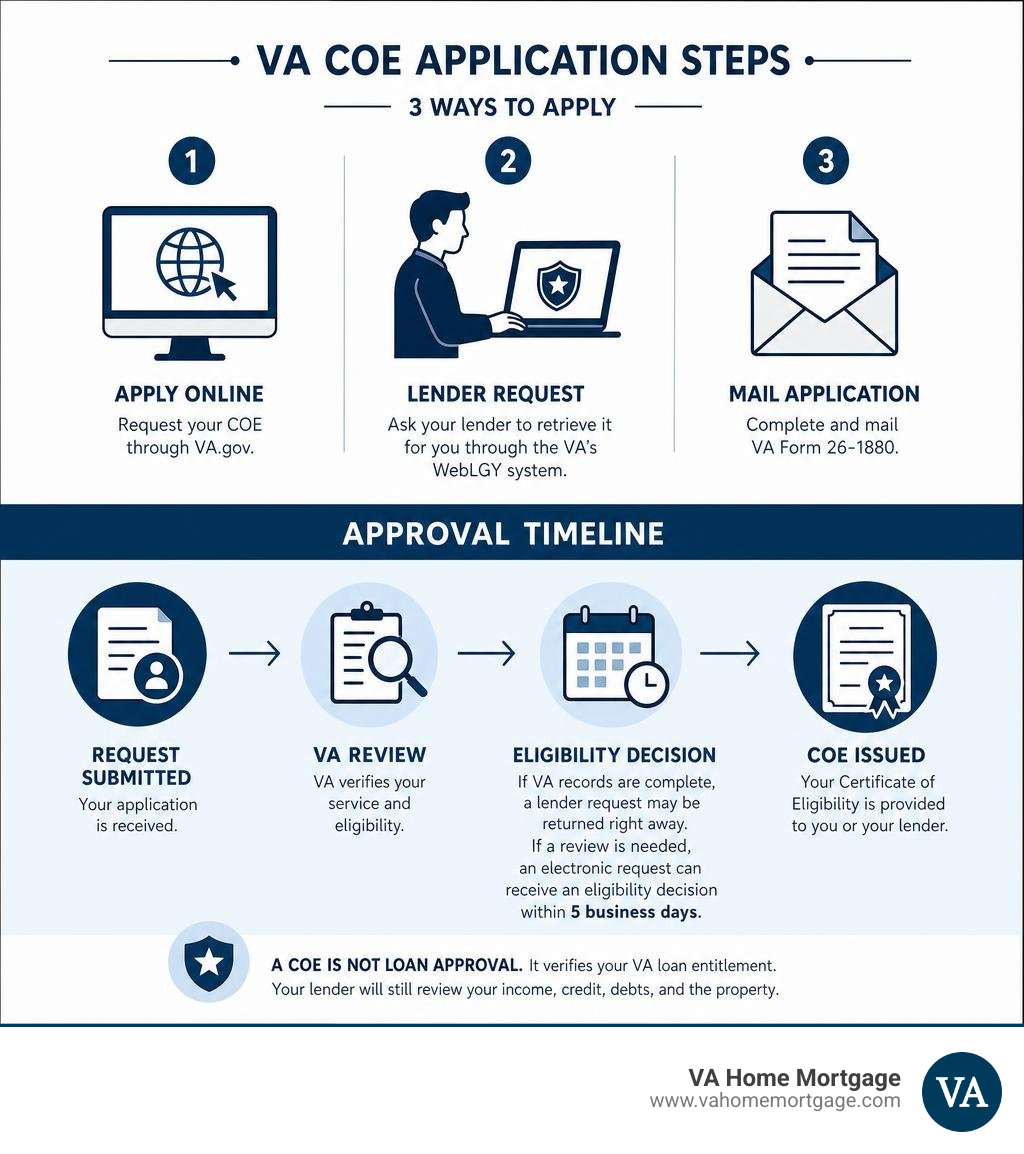
To apply for a VA COE, first gather your proof of service, then choose one of three routes: request it online through VA.gov, ask a VA-approved lender to retrieve it through the VA’s WebLGY system, or mail VA Form 26-1880. Your Certificate of Eligibility (COE) tells a lender that you qualify to use the VA home loan benefit.
For many buyers, having a lender request the COE is the simplest path. If VA records are complete, the system may return it right away. If the VA needs to review documents, an electronic request can receive an eligibility decision within 5 business days.
A COE is not loan approval. It verifies your VA loan entitlement. Your lender still reviews your income, credit, debts, and the home you plan to buy or refinance. But getting this document early can prevent paperwork delays when you are ready to make an offer.
Since 1944, VA-backed loans have helped eligible Veterans, service members, and surviving spouses pursue homeownership, often with no down payment. This guide shows what to gather, how to submit your request, and what to do if your service record or prior VA loan creates a complication.
I am Dale Gremillion, a Senior Loan Officer and Producing Branch Manager with more than 25 years in residential lending, including VA purchase, refinance, and cash-out loans. I help borrowers apply for VA COE documentation and work through the details that can otherwise slow a closing.
Understanding VA Loan Eligibility and Service Requirements
Qualifying for a VA home loan depends primarily on when you served, the length of your active service, and your character of discharge. The Department of Veterans Affairs sets specific service baselines depending on whether your time in uniform occurred during wartime or peacetime periods.
Before you begin assembling your application, review the core standards outlined in the How To Request A VA Home Loan Certificate Of Eligibility (COE) | Veterans Affairs resource to verify where your military history fits.
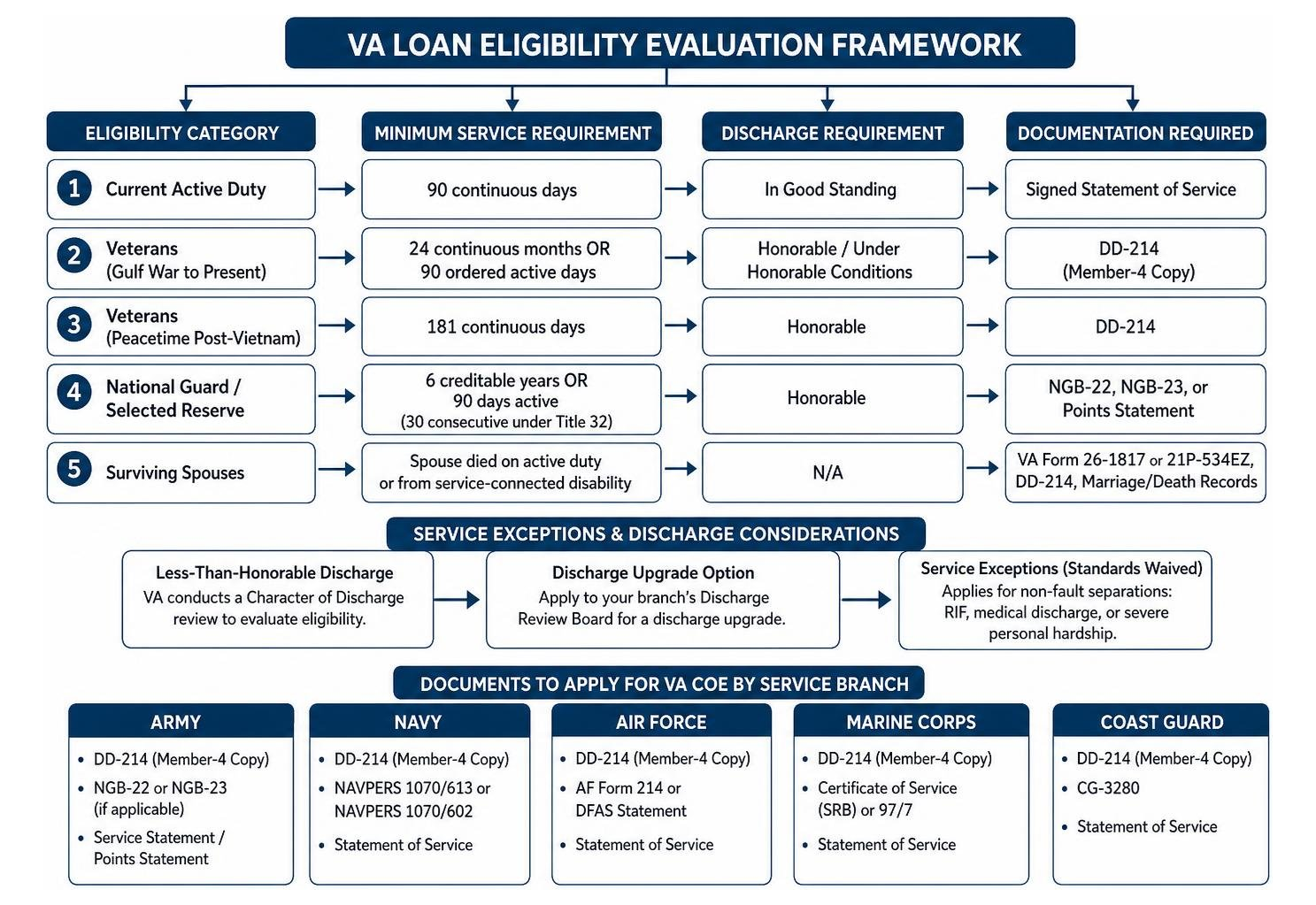
| Service Category | Minimum Active Duty / Qualifying Service | Discharge Requirement | Key Documentation Needed |
|---|---|---|---|
| Current Active Duty | 90 continuous days | In Good Standing | Signed Statement of Service |
| Veterans (Gulf War to Present) | 24 continuous months OR 90 ordered active days | Honorable / Under Honorable Conditions | DD-214 (Member-4 Copy) |
| Veterans (Peacetime Post-Vietnam) | 181 continuous days | Honorable | DD-214 |
| National Guard / Selected Reserve | 6 creditable years OR 90 days active (30 consecutive under Title 32) | Honorable | NGB-22, NGB-23, or Points Statement |
| Surviving Spouses | Spouse died on active duty or from service-connected disability | N/A | VA Form 26-1817 or 21P-534EZ, DD-214, Marriage/Death Records |
Active Duty and Veteran Minimum Service Standards
For active-duty personnel currently serving, the requirement is straightforward: you become eligible after serving 90 continuous days without a break in service.
For separated Veterans, the benchmark depends on your era:
- Gulf War (August 2, 1990, to Present): You must have completed 24 continuous months of active duty, or the full period (at least 90 days) for which you were called or ordered to active duty.
- Peacetime Post-Vietnam Periods: You generally need at least 181 continuous days of active-duty service.
- Wartime Eras (WWII, Korea, Vietnam): Minimum requirements drop to 90 total days of active duty.
Discharges must be categorized as honorable or general under honorable conditions. If you served less than the minimum period but were discharged due to a service-connected disability, an early out (after serving at least 21 months of a 2-year enlistment), or the convenience of the government (after serving at least 20 months of a 2-year enlistment), you may still qualify.
National Guard and Reserve Member Requirements
Members of the National Guard and Selected Reserve have multiple avenues to establish eligibility:
- Title 10 or Title 32 Active Service: Serving at least 90 days of non-training active-duty service qualifies you. Under Title 32 orders (specifically sections 316, 502, 503, 504, or 505), at least 30 of those 90 days must be consecutive.
- Traditional 6-Year Service: If you were never activated for federal duty, you qualify after completing 6 creditable years in the Selected Reserve or National Guard. A creditable year means you earned at least 16 retirement points through drill weekends and annual training.
Handling Less-Than-Honorable Discharges and Service Exceptions
A discharge characterized as other than honorable (OTH), bad conduct, or dishonorable does not automatically close the door forever, but it does require extra steps. In these cases, the VA will conduct a Character of Discharge review to evaluate whether your service can be considered honorable for VA benefit purposes.
You can also submit an application to your branch’s Discharge Review Board to seek a formal discharge upgrade. If you were separated early under specific non-fault conditions—such as an involuntary reduction in force (RIF), medical discharge, or severe personal hardship—the standard duration thresholds are waived. Be sure to provide all separation orders and medical discharge summaries alongside your request.
Required Documents to Request a Certificate of Eligibility
Submitting the correct paperwork upfront is the single best way to avoid processing delays. The VA must confirm your identity, your total creditable time, and your official character of discharge before issuing your entitlement certificate.
Documents You Need to Apply for VA COE by Service Branch
Depending on your status, you will need the following records:
- Veterans: Your DD-214 (specifically the Member-4 or Service-2 copy). The copy must clearly display Item 24 (Character of Service) and Item 28 (Narrative Reason for Separation).
- Active-Duty Service Members: A formal Statement of Service written on official military letterhead. It must be signed by your commander, adjutant, or personnel officer and include your full legal name, Social Security number, date of birth, entry date into active duty, duration of any lost time, and the unit/command name.
- Current Non-Activated National Guard / Reserve Members: A Statement of Service signed by your unit leadership showing creditable years, plus your most recent annual retirement points statement.
- Discharged National Guard Members: Both NGB Form 22 (Report of Separation and Record of Service) and NGB Form 23 (Retirement Points Accounting Statement).
- Discharged Reserve Members: A copy of your official discharge orders along with your final annual retirement points statement.
How Surviving Spouses Apply for VA COE Approval
Surviving spouses of Veterans who died while on active duty, died as a result of a service-connected disability, or were declared missing in action (MIA) or prisoners of war (POW) are eligible for the VA home loan benefit.
The required forms depend on your current benefit status:
- If You Currently Receive Dependency and Indemnity Compensation (DIC): Complete VA Form 26-1817 and provide the Veteran’s DD-214. You can send these directly to your VA Regional Loan Center.
- If You Do Not Currently Receive DIC: Complete VA Form 21P-534EZ and attach a copy of the Veteran’s DD-214, your official marriage certificate, and the Veteran’s death certificate (or DD Form 1300 if the death occurred on active duty).
How to Apply for VA COE: Online, Lender, and Mail Methods

You can obtain your certificate through three primary avenues. If you need personalized guidance before starting, learning how to contact a local VA home loan representative can save you considerable time.
Option 1: Instant Retrieval Through a VA-Approved Lender
The fastest method is working directly with a VA-approved mortgage lender. Lenders have direct access to the VA’s WebLGY portal through the Automated Certificate of Eligibility (ACE) system.
When your service records are already fully updated in the VA database, our VA Home Mortgage team can pull your COE in seconds. If the system flags your file for manual review, we can upload your supporting documents directly through WebLGY, which typically yields a formal decision from the VA Regional Loan Center within 3 to 5 business days. You can see how lenders handle this backend process in the official guide on How To Order a Certificate of Eligibility Using the VA Portal, Lender User Guide.
Option 2: Submitting an Application Online via VA.gov
You can submit your own request directly through VA.gov:
- Log in to VA.gov using your verified Login.gov or ID.me credentials.
- Navigate to the housing assistance section and locate the Certificate of Eligibility tool.
- Complete the online questionnaire detailing your service history and previous VA loan usage.
- Upload clear, single-file PDF copies of your DD-214, Statement of Service, or NGB forms.
- Submit the application and record your confirmation reference number.
You can monitor your application status online, and once approved, your COE will be available for immediate download.
Option 3: Mailing VA Form 26-1880 to a Regional Loan Center
If you prefer paper submissions, you can complete and mail VA Form 26-1880: REQUEST FOR A CERTIFICATE OF ELIGIBILITY.
The form carries an estimated public respondent burden of 15 minutes and is active under OMB Control No. 2900-0086 (expiring 12/31/2028). Once completed, mail the form along with photocopies of your military records (never send original separation papers) to your jurisdictional VA Regional Loan Center. Postal applications typically take several weeks to process compared to electronic submissions.
Next Steps After Receiving Your COE: Loan Underwriting and Entitlement Rules

Once your COE is in hand, your lender will use it to structure your mortgage financing. While your COE proves your entitlement to the government backing, you must still qualify financially based on credit history, debt-to-income (DTI) ratio, and residual income standards. A mandatory VA appraisal will also be ordered to verify that the home meets VA Minimum Property Requirements (MPRs) and reflects fair market value.
Understanding Basic, Bonus, and Restoring Entitlement
Every eligible Veteran receives a basic entitlement of $36,000, which the VA uses to guaranty loans up to $144,000. For loans exceeding this amount, the VA provides secondary (bonus) entitlement. For buyers with full entitlement, there is no maximum loan limit, meaning you can purchase a home with zero down payment regardless of the loan size, provided you meet lender credit and income standards.
If you have used a VA loan before and still own the property or sold the home without paying off the VA loan, part of your entitlement remains tied up. However, you can explore refinancing your existing balance using The Ultimate Guide to VA Home Mortgage Refinancing or extract equity using The Ultimate Guide to a 100% Cash Out Refi.
One-Time Restoration and Refinancing Guidelines
If you previously bought a home with a VA loan and paid the mortgage off completely, you can restore your entitlement to purchase a new home.
- Standard Restoration: Occurs when you sell the previous property and pay off the VA loan in full. You can restore your entitlement an unlimited number of times under this rule.
- One-Time Restoration (OTR): If you paid off your VA loan in full but decided to keep the original home (for example, as a rental property), the VA allows you a single, one-time exception to restore your full entitlement to buy a new primary residence.
- VA Funding Fee Exemptions: Your COE will indicate whether you are exempt from the standard VA funding fee. Veterans with service-connected disability ratings of 10% or higher, active-duty Purple Heart recipients, and qualifying surviving spouses are exempt from paying this fee.
Frequently Asked Questions About VA Certificates of Eligibility
How long does it take to get a VA COE?
If your records are complete in the VA database, a lender using WebLGY can often generate your COE instantaneously. If manual processing is required because the VA needs to review uploaded documents, electronic submissions via VA.gov or a lender typically take 3 to 5 business days. Mailing a paper VA Form 26-1880 can take anywhere from 2 to 6 weeks.
Can I reuse my VA loan COE if I haven’t sold my previous home?
Yes. If you have paid off the prior VA mortgage in full, you can execute a One-Time Restoration to regain full entitlement while retaining ownership of the property. Alternatively, if your prior loan is still active, you may use your remaining second-tier entitlement to purchase another primary residence with little to no down payment.
What should I do if my COE shows zero basic entitlement?
A COE displaying zero basic entitlement usually means the VA’s automated system detected an unclosed prior VA loan or lacks your recent discharge records. To correct this, submit a formal Request for Restoration along with proof of loan payoff—such as a HUD-1 Settlement Statement, Closing Disclosure, or paid-in-full mortgage letter—to your Regional Loan Center.
Conclusion
Securing your Certificate of Eligibility is the essential first step toward taking advantage of your earned military mortgage benefits. Whether you request your certificate independently on VA.gov or let an experienced lender pull it instantly through the WebLGY portal, getting your paperwork in order puts you in the strongest position to buy a home. Explore our comprehensive lending options at VA Home Mortgage to start your journey toward homeownership today.