
Compare VA Mortgage Rates and Terms Before You Apply
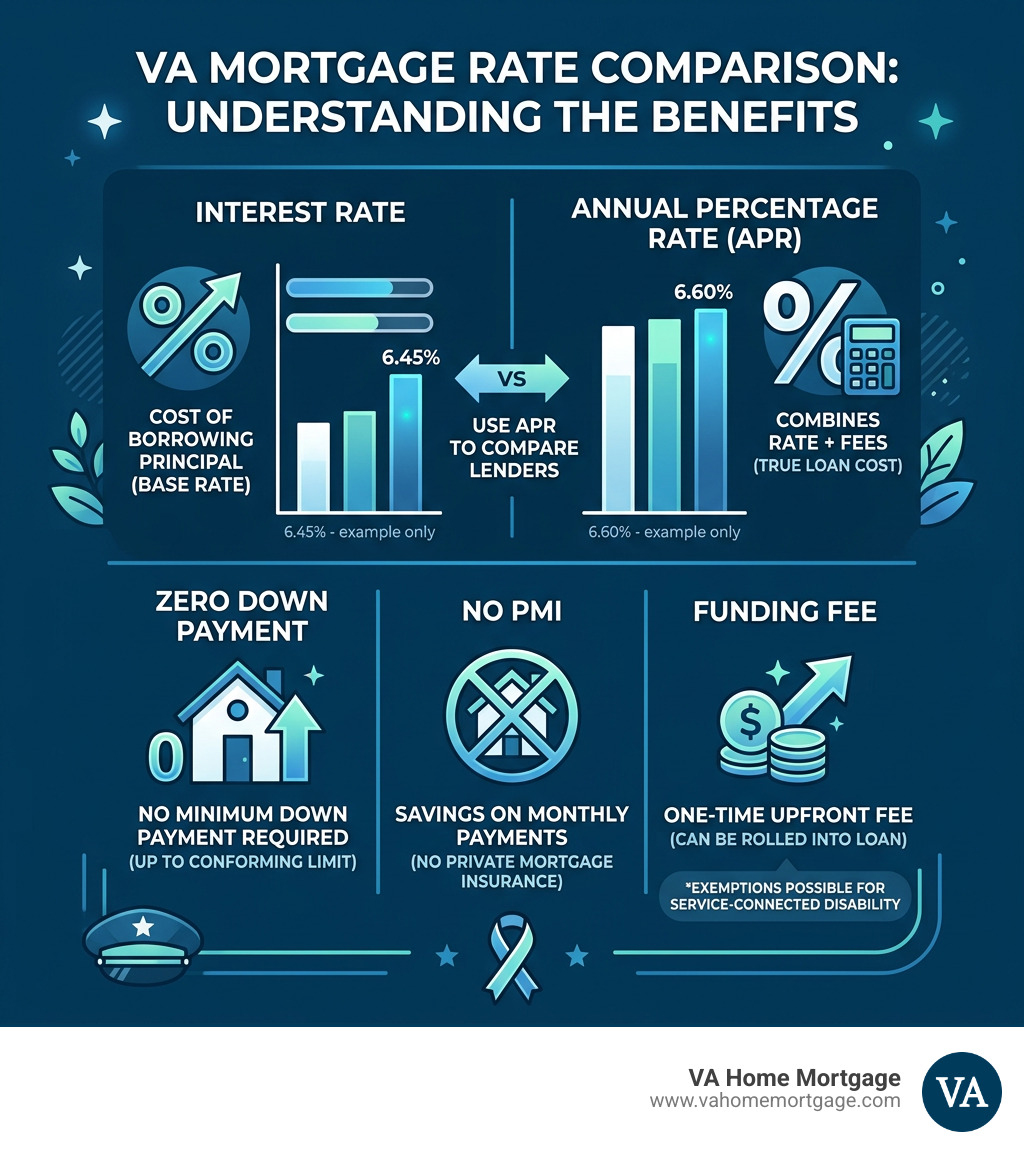
As of early September 2026, average 30-year fixed VA mortgage rates are about 6.4% to 6.5%, though your quote may be lower or higher based on your credit, loan term, points, and lender. VA rates often run below comparable conventional rates, and the program can offer a major cost edge: eligible borrowers may buy with no down payment and no monthly private mortgage insurance (PMI).
Before choosing a loan, compare at least three same-day quotes using the same loan amount, term, rate-lock period, and points. Look at the APR and total closing costs, not the interest rate alone. A VA loan can still include a funding fee and other closing costs, but eligible borrowers with a service-connected disability may qualify for a funding-fee exemption.
VA loans are backed in part by the Department of Veterans Affairs and issued by private lenders. Active-duty service members, eligible veterans, certain Guard and Reserve members, and some surviving spouses may qualify after obtaining a Certificate of Eligibility.
I am Dale Gremillion, a Senior Loan Officer and Producing Branch Manager with more than 25 years of residential lending experience, including VA purchase, refinance, and cash-out loans. I help borrowers understand VA mortgage rates, compare terms clearly, and prepare for a smoother closing.
Current VA Mortgage Rates and 2026 Market Overview

Navigating the mortgage market in September 2026 requires understanding both national benchmark shifts and the specialized benefits built into military financing. As we track daily lender pricing, 30-year fixed VA rates have remained steady in the 6.42% to 6.47% range throughout early September. While this represents a modest year-over-year increase of roughly 0.35% to 0.41% compared to late summer 2025, government-backed loans consistently provide some of the lowest interest rates available across the industry.
When analyzing current market data from VA Loan Rates July 2026: Today’s Mortgage Rates for Veterans, we observe that national average rates softened earlier in the summer to around 6.38% before geopolitical developments, shifting energy prices, and Federal Reserve balance-sheet policies stabilized yields near their current marks.
For buyers actively touring properties, knowing when to execute a rate lock is critical. If your closing date is scheduled within 30 to 45 days, locking in your rate shields your monthly payment from sudden bond market spikes.
What Drives Today’s VA Mortgage Rates
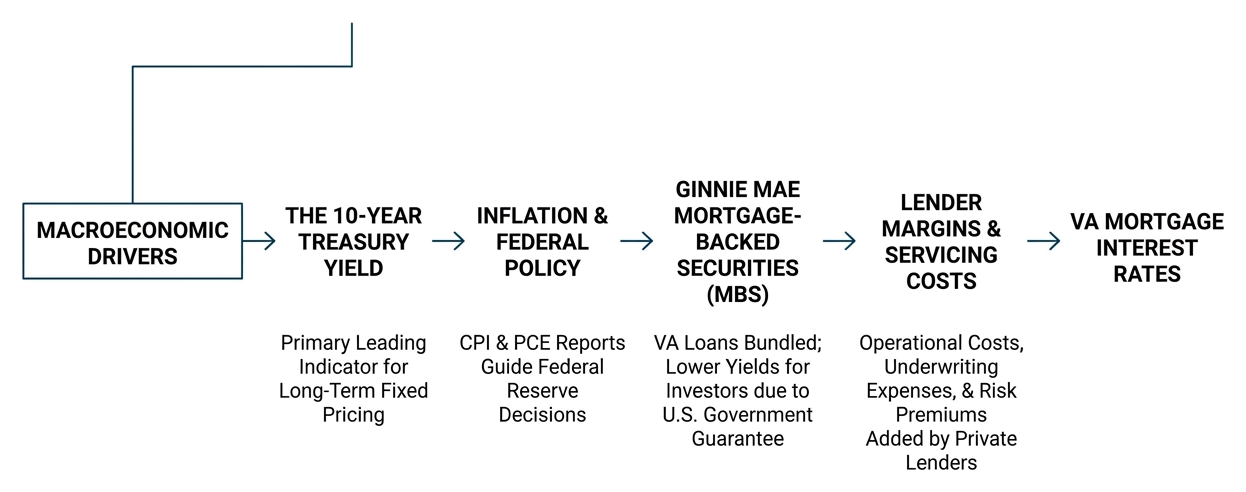
Mortgage interest rates do not simply appear out of thin air; they respond in real time to complex macroeconomic drivers:
- The 10-Year Treasury Yield: The 10-year Treasury note serves as the primary leading indicator for long-term fixed mortgage pricing. When investor demand pushes Treasury yields up, mortgage rates follow suit.
- Inflation and Federal Policy: Monthly reports like the Consumer Price Index (CPI) and Personal Consumption Expenditures (PCE) index guide the Federal Reserve’s monetary decisions. Persistent inflation keeps pressure on yields.
- Ginnie Mae Mortgage-Backed Securities (MBS): VA loans are bundled into Ginnie Mae MBS pools. Because Ginnie Mae bonds carry the full faith and credit guarantee of the U.S. government, institutional investors accept lower yields, directly lowering borrowing costs for veterans.
- Lender Margins and Servicing Costs: Individual private lenders layer their operational costs, underwriting expenses, and risk premiums on top of secondary market rates.
Comparing VA Rates to Standard Market Benchmarks
To understand the real financial benefit of military service, prospective buyers should Compare Current VA Loan Rates directly against conventional and FHA alternatives. Conventional loans often demand substantial down payments to secure top-tier pricing, and any equity below 20% incurs costly monthly Private Mortgage Insurance (PMI). In contrast, the VA loan eliminates monthly mortgage insurance entirely.
| Loan Program | Average Rate (Sept 2026) | Typical Down Payment | Monthly Mortgage Insurance | Upfront Guarantee Fee |
|---|---|---|---|---|
| 30-Year Fixed VA | 6.45% | 0% | None ($0) | 1.25% – 3.3% (Waived for disabled) |
| 30-Year Conventional | 6.85% | 3% – 20% | PMI required under 20% down | None |
| 30-Year FHA | 6.55% | 3.5% | Annual MIP for loan life | 1.75% Upfront MIP |
This rate spread, paired with zero monthly insurance, routinely saves our military families hundreds of dollars each month compared to standard financing.
Key Factors and Eligibility That Determine Your Rate
Securing an optimal rate offer involves more than just checking national averages. Your individual borrowing profile determines the exact pricing tier a lender can extend. When reviewing top VA mortgage lenders, ensure you work with dedicated VA specialists who provide upfront pricing transparency and in-house underwriting.
VA Loan Eligibility Criteria and Service Requirements
Before applying for financing, you must establish baseline entitlement by securing your Certificate of Eligibility (COE). As direct lenders, we can instantly pull this document through the VA’s automated portal in most cases. Qualifying categories include:
- Active-Duty Members: At least 90 continuous days of active service during wartime, or 181 continuous days during peacetime.
- Veterans: Honorable discharge meeting specific minimum service durations detailed on your DD Form 214.
- National Guard and Reserve Members: Typically 6 years of honorable service, or 90 days of active-duty Title 10 mobilization.
- Surviving Spouses: Unmarried surviving spouses of service members who died in the line of duty or from a service-connected disability.
Every VA purchase also requires that you intend to occupy the property as your primary residence within a reasonable timeframe (typically 60 days from closing).
Impact of Credit Score and Debt-to-Income on VA Mortgage Rates
While the Department of Veterans Affairs sets no statutory minimum credit score, private lenders establish their own credit overlays. Borrowers with FICO scores above 720 consistently secure the most aggressive rates. Lower scores may still qualify under flexible underwriting rules, but they often carry higher interest rate margins or require additional discount points.
Lenders also examine your Debt-to-Income (DTI) ratio. While conventional guidelines often cap total recurring monthly obligations near 43% to 45% of gross monthly income, the VA program allows higher DTIs when accompanied by strong compensating factors—most notably robust residual income (the cash remaining each month after all major family living expenses and debt service are covered).
Loan Term Options: Fixed vs. Adjustable-Rate VA Mortgages

Choosing the structure of your loan is just as critical as finding the lowest headline rate. By understanding current 30-year VA mortgage rates today, you can tailor your amortization schedule to fit both immediate monthly cash flow and long-term wealth goals.
Evaluating 15-Year and 30-Year Fixed VA Options
The 30-year fixed mortgage remains the gold standard for home financing due to its payment predictability and manageable monthly budget demands. However, if your financial standing supports higher monthly commitments, choosing a 15-year VA fixed-rate loan allows you to capture a lower interest rate, build equity at double the speed, and save tens of thousands of dollars in total interest over the life of the mortgage.
Understanding Adjustable-Rate Mortgages and Jumbo Financing
For service members who anticipate Permanent Change of Station (PCS) orders within three to five years, a hybrid Adjustable-Rate Mortgage (such as a 5/1 VA ARM) can offer a lower introductory interest rate during the initial fixed period.
Furthermore, if you are purchasing in higher-cost real estate markets, understanding how 30-year fixed VA jumbo mortgage rates really work is essential. Thanks to the Blue Water Navy Vietnam Veterans Act, qualified borrowers with full entitlement can utilize their zero-down VA benefit well above standard conforming limits without paying punitive jumbo rate markups.
Refinancing Options: IRRRL and Cash-Out Programs
Existing homeowners holding a VA mortgage can use government refinancing avenues to optimize monthly payments or access their accrued home equity.
Streamline Refinance with the VA IRRRL
The Interest Rate Reduction Refinance Loan (IRRRL), commonly referred to as the VA Streamline refinance, allows veterans to swap an existing VA loan for a lower interest rate with minimal friction. Reviewing the complete guide to VA refinance eligibility highlights its key advantages:
- No Home Appraisal Required: Avoids property valuation delays and appraisal fees.
- Minimal Income Documentation: Streamlined underwriting focused on verified mortgage payment history.
- Tangible Net Benefit Standard: Clear VA rules ensuring the refinance genuinely lowers your rate, reduces monthly payments, or moves you from an adjustable to a stable fixed rate.
- Reduced Funding Fee: The standard funding fee for an IRRRL is only 0.5%, which can be rolled into the loan balance.
Tapping Home Equity Through a Cash-Out Refinance
If you want to consolidate high-interest debt, fund significant home remodels, or tap your home equity for other life goals, a cash-out transaction allows you to refinance up to 90% or 100% of your home’s appraised value (depending on specific investor limits). Our detailed 30-year VA cash out guide explains how this program can also be used by eligible veterans to refinance non-VA mortgages into the government-guaranteed system.
Frequently Asked Questions About VA Home Loans
What is the current average interest rate for a VA home loan?
In September 2026, average 30-year fixed VA loan rates hover between 6.40% and 6.50%. Daily movements depend on 10-year Treasury fluctuations, economic data releases, and individual borrower credit qualifications.
How do VA home loans avoid private mortgage insurance?
Because the Department of Veterans Affairs guarantees a minimum of 25% of the loan amount against default, lenders face significantly reduced credit risk. This federal backing eliminates the need for private mortgage insurance (PMI), saving borrowers substantial recurring monthly costs.
What is the maximum debt-to-income ratio allowed for a VA mortgage?
The standard benchmark is 41% DTI, but automated underwriting systems can approve DTIs exceeding 50% when supported by strong residual income, excellent credit history, or verified cash reserves.
Conclusion
Maximizing your hard-earned military benefits starts with securing transparent loan pricing and the right repayment structure. Rather than working with retail brokers who add third-party markups and processing delays, partnering with a direct lender with in-house underwriting authority ensures fast pre-approvals, clear rate comparisons, and smooth closings.
When you are ready to explore your purchase or refinancing options, explore competitive loan options with VA Home Mortgage to speak with a seasoned lending professional and lock in the best terms for your home.


