
Can You Buy a Second Home With a VA Loan?
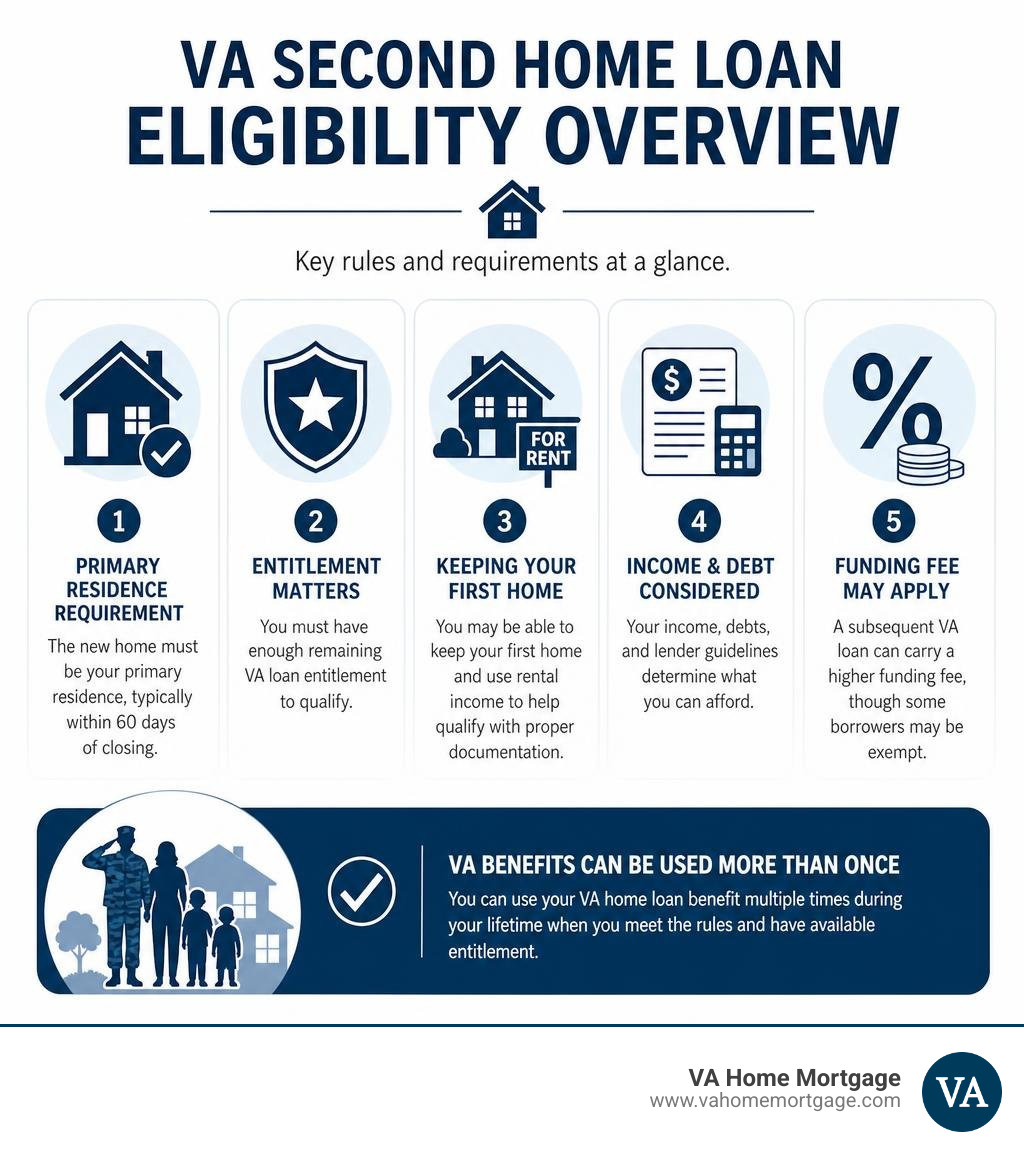
Buying a second home with VA loan benefits is possible when the new property will become your primary residence and you have enough remaining VA loan entitlement. You cannot use a VA purchase loan for a vacation home or a purely investment property, but you may be able to keep your first home and use your benefit again after a PCS move, civilian job relocation, or a growing household.
Quick answer:
- VA home loan benefits can be used more than once during your lifetime.
- The new home generally must be occupied as your primary residence, often within 60 days of closing.
- Your first VA loan does not automatically prevent a second one. Your remaining entitlement, income, debts, and lender guidelines determine what you can afford.
- You may be able to use rental income from the first home to help qualify, with proper lease and income documentation.
- A subsequent VA loan can carry a higher funding fee, though some eligible borrowers are exempt.
The rules can feel complicated because a “second home” in everyday language is not necessarily a second home under VA rules. This guide explains how occupancy, entitlement, rental income, property type, funding fees, and entitlement restoration fit together before you apply.
I am Dale Gremillion, a Senior Loan Officer and Producing Branch Manager with more than 25 years of residential lending experience, including helping borrowers navigate complex scenarios involving buying a second home with VA loan entitlement. Next, we will start with the rule that matters most: where you intend to live.
Occupancy Rules for Buying a Second Home with VA Loan
When non-veterans talk about purchasing a “second home,” they usually picture a cozy weekend cabin in the mountains or a beachfront condo where they spend a few weeks every summer. However, in the realm of VA mortgages, the Department of Veterans Affairs operates under very strict statutory definitions. A VA home loan is strictly designed to finance a borrower’s primary residence.
Because of this foundation, you cannot use a VA loan to purchase a seasonal vacation home or a pure investment property that you never intend to live in. Every time you utilize a VA mortgage, you must certify that you intend to personally move into and occupy the property as your main home.
The cornerstone of this requirement is the 60-day rule. Under standard VA guidelines, you are expected to move into the new home within 60 days after closing. While there are narrow exceptions for active-duty service members nearing retirement or undergoing deployment, the primary occupancy intent must be clear and verifiable. Attempting to purchase a home using a VA loan with the intent of using it purely as a rental or vacation property without satisfying the primary residence requirement is considered mortgage fraud and carries severe legal penalties.
If you want to read more about the detailed legal frameworks governing entitlement and occupancy, you can review the official VA home loan eligibility guidelines. To see what types of purchase options fit your current goals, explore current mortgage options at VA Home Mortgage.
Valid Reasons for Buying a Second Home with VA Loan
So, how can you legally own two homes at once with VA financing? The key is that the new property will become your new primary residence, while valid life circumstances justify keeping your first property. Here are the most common valid circumstances accepted by lenders and the VA:
- Permanent Change of Station (PCS) Orders: Active-duty military members frequently receive military transfer orders to a new installation. If you are relocated to a base outside reasonable commuting distance, you can buy a new primary home at your new duty station while keeping your original home (and renting it out or keeping it for family use).
- Civilian Job Relocation: If you have transitioned out of the military and accept a new civilian job or corporate transfer in a different city or state, the physical relocation gives you a clear, legitimate reason to buy a new primary home.
- Expanding Household Size: Families grow! If you purchased a starter townhouse or a cozy two-bedroom bungalow years ago, and you now have three kids and two dogs, your current home may no longer meet your basic living needs. Documenting that your expanding household requires a larger primary residence provides a sound justification for purchasing a second primary home.
- Excessive Commuting Distance: If your current job location changes or traffic patterns make your daily drive unreasonable (typically exceeding a reasonable commute distance or duration), lenders recognize the necessity of moving closer to work.
Property Types Allowed and Multi-Unit Options
When buying a second home with va loan entitlement, you have access to various property types, provided the property meets VA Minimum Property Requirements (MPRs) and serves as your primary home:
- Single-Family Detached Homes: The most traditional choice for buyers needing space and privacy.
- Approved Condominiums: Condos are eligible, provided the condominium complex is on the VA-approved project list (or gets spot approval).
- Townhomes and Planned Unit Developments (PUDs): Great options for low-maintenance primary living.
- Multi-Unit Properties (Duplexes, Triplexes, Fourplexes): You can actually purchase up to a 4-unit residential property using a VA loan! The critical caveat is that you must occupy one of the units as your primary residence. You can then rent out the remaining 2, 3, or 4 units to generate rental income, making multi-unit properties an incredible wealth-building tool for veterans.
How Entitlement Works for Subsequent VA Loans
To understand how you can have two VA loans active simultaneously, you need to understand how VA entitlement functions. Think of entitlement as the insurance policy the VA gives to private mortgage lenders. The VA guarantees up to 25% of the loan amount to protect the lender if a borrower defaults.
Every eligible veteran receives basic entitlement (often listed as $36,000 on your Certificate of Eligibility, or COE). In addition, the VA provides “secondary entitlement” (also known as bonus entitlement or tier two entitlement).
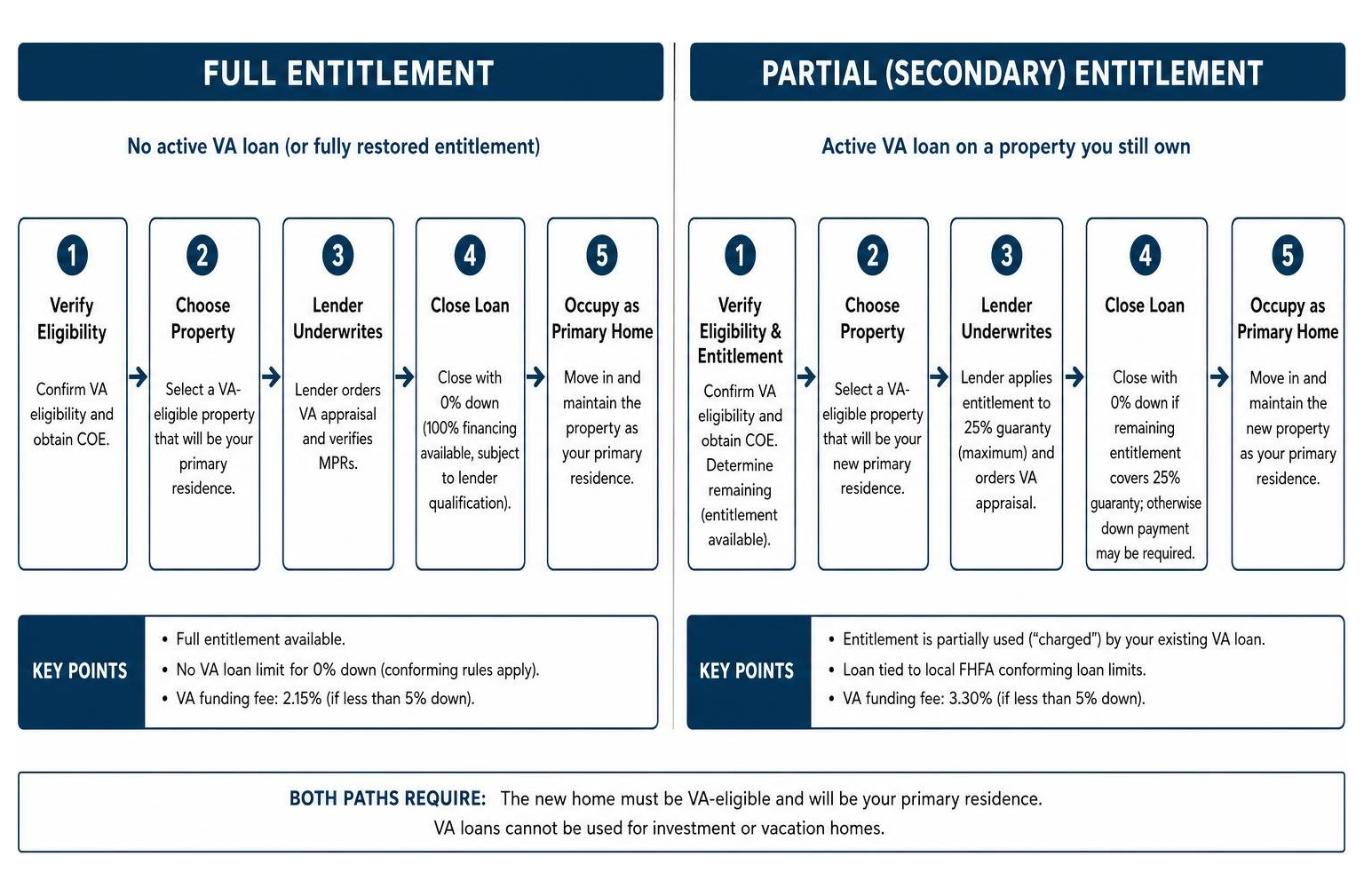
- Full Entitlement: If you have never used your VA loan benefit, or if you previously used it but paid off the loan and sold the property, you have full entitlement. With full entitlement, there are no loan limits for zero-down financing (subject to lender qualification).
- Partial Entitlement: If you currently have an active VA loan on a property you still own, a portion of your entitlement is tied up (“charged”) on that initial mortgage. You are left with partial entitlement to purchase another primary home.
Here is a quick direct comparison between full and partial entitlement benefits:
| Feature | Full VA Entitlement | Partial / Secondary Entitlement |
|---|---|---|
| Existing Active VA Loan? | No (or fully restored) | Yes (first VA loan remains active) |
| VA Loan Limits | No limit for 0% down (conforming rules apply) | Tied to local FHFA conforming loan limits |
| 0% Down Payment Possible? | Yes, 100% financing available | Yes, if remaining entitlement covers 25% guaranty |
| Primary Residence Required? | Yes | Yes |
| VA Funding Fee (if <5% down) | 2.15% (first use) | 3.30% (subsequent use) |
Calculating Entitlement when Buying a Second Home with VA Loan
Calculating your remaining entitlement determines whether you can buy a second primary home with 0% down payment or if a small down payment will be required.
The VA calculates secondary entitlement based on the Federal Housing Finance Agency (FHFA) conforming loan limit for the county where the new home is located. Here is the step-by-step formula:
- Find the County Conforming Limit: Determine the standard FHFA limit for the county where you are buying your new home (for instance, $766,550 in many standard-cost counties).
- Calculate Maximum Total Guarantee: Multiply the county limit by 25% ($766,550 × 0.25 = $191,637.50).
- Subtract Charged Entitlement: Look at your Certificate of Eligibility (COE) to see how much entitlement is currently tied up in your first loan. (For example, if your first VA loan was $200,000, 25% of that was $50,000, so $50,000 is charged).
- Determine Remaining Guarantee: Subtract the charged entitlement from the maximum total guarantee ($191,637.50 – $50,000 = $141,637.50 remaining guaranty).
- Calculate Zero-Down Threshold: Multiply your remaining guarantee by 4 ($141,637.50 × 4 = $566,550).
In this example, you could purchase a second home up to $566,550 with zero down payment using your secondary entitlement! If the new home costs more than $566,550, you would simply need a down payment equal to 25% of the difference between the purchase price and $566,550.
Restoring Your Entitlement Options
What if you want to clear your entitlement completely so you can buy your next home with zero constraints? You have two primary paths to restore your entitlement:
- Standard Restoration (Un-capped Re-use): You pay off the original VA loan in full AND sell the property that was financed with that loan. Once both conditions are met, you submit VA Form 26-1880 to restore 100% of your basic and secondary entitlement. You can do this an unlimited number of times throughout your life.
- One-Time Entitlement Restoration: What if you pay off your original VA mortgage (perhaps refinancing it into a conventional mortgage or paying it off in cash), but you do not sell the home? The VA allows a special one-time entitlement restoration. You can restore your full entitlement while keeping the property, provided the original loan is paid in full. As the name implies, you can only use this specific provision once.
If you are interested in exploring refinancing strategies to manage existing debt or reset your loans, take a look at The Ultimate Guide to VA Home Mortgage Refinancing.
Qualification Requirements, Rental Income, and Documentation

Qualifying for a second VA mortgage involves standard underwriting criteria: proving stable income, meeting debt-to-income (DTI) requirements, maintaining satisfactory credit history, and presenting proper documentation. However, holding two mortgages simultaneously means underwriters will take a much closer look at your capacity to manage both monthly obligations.
Key documents you must collect prior to applying include:
- Certificate of Eligibility (COE): This official document outlines your entitlement status and charged amounts.
- DD-214 or Statement of Service: Proves your military service history or active duty status.
- Income Verification: 2 years of W-2s, 30 days of pay stubs, and tax returns if self-employed.
- Current Mortgage Statement: Documentation detailing the principal, interest, taxes, and insurance (PITI) on your existing home.
If you are considering tapping into your current home’s equity prior to purchasing, check out The Ultimate Guide to a 100% Cash Out Refi.
Using Rental Income from Your First Home to Qualify
Holding two mortgage payments on a single income can strain your debt-to-income ratio. Fortunately, if you plan to convert your first home into a rental property when you move into your new primary residence, you can often use the rental income to offset your existing mortgage debt!
To use prospective rental income from your departure residence, mortgage underwriters generally require:
- A Executed Lease Agreement: A signed 12-month lease agreement from a prospective tenant.
- Security Deposit Verification: Proof that the tenant’s security deposit has been deposited into your bank account (or a copy of the cleared check).
- 75% Rental Income Credit: Underwriters typically apply a 25% vacancy factor. This means if you lease your first home for $2,000 per month, the lender will count 75% ($1,500) as qualifying income to offset your existing monthly mortgage payment.
- Equity Requirement or Property Management Experience: Some lender guidelines require you to have at least 25% equity in the departure residence or documented history as a landlord to count 100% of the net rental income.
Joint Loans with Non-Veterans
Can you purchase a second home jointly with someone else using a VA loan? Yes, but the structure depends on who your co-borrower is:
- Spouses: If your co-borrower is your legal spouse, the VA treats the loan as a standard single-veteran transaction. 100% of the loan amount is backed by the VA guaranty.
- Non-Veteran, Non-Spouse Co-Borrowers: If you are purchasing with a non-veteran who is not your spouse (such as a sibling, business partner, or unmarried partner), it becomes a joint VA loan. The VA will only guarantee the veteran’s portion of the loan (usually 50%). Because the non-veteran’s half is not guaranteed by the VA, the lender will typically require a 12.5% down payment to cover the un-guaranteed portion of the loan.
Funding Fees, Appraisals, and Closing Process

When buying a second home with va loan benefits, you should anticipate a few key operational differences during the application and closing phases compared to your first home purchase.
First, the VA funding fee differs for subsequent use. The funding fee is a statutory fee mandated by Congress that helps offset the administrative costs of the VA loan program so taxpayers don’t have to fund it.
Here are the current VA funding fee rates for subsequent purchase loans:
- Less than 5% Down Payment: 3.30% of the total loan amount (compared to 2.15% for first-time use).
- 5% to 9.99% Down Payment: 1.50% of the total loan amount.
- 10% or More Down Payment: 1.25% of the total loan amount.
- Funding Fee Exemptions: You pay $0 in VA funding fees if you receive VA disability compensation for a service-connected disability, are a surviving spouse of a veteran who died in service or from a service-connected disability, or are an active-duty service member who has received the Purple Heart.
If you are considering higher loan amounts or jumbo threshold financing, learn more about How 30 Year Fixed VA Jumbo Mortgage Rates Really Work.
The appraisal and closing timelines remain efficient. A VA appraisal is ordered through the VA portal, and the appraiser evaluates both market value and compliance with VA Minimum Property Requirements (MPRs). The appraisal typically takes 1 to 2 weeks, and overall loan closing usually takes 30 to 45 days from application to funding.
Frequently Asked Questions About VA Second Home Loans
Can I buy a vacation home with a VA loan if I still have remaining entitlement?
No. The VA home loan program is legally restricted to financing primary residences. You cannot use a VA loan to purchase a seasonal vacation cabin, second-home getaway, or investment property that you do not intend to occupy as your main residence within 60 days of closing.
What is the VA funding fee for a second VA loan?
For subsequent use of a VA purchase loan, the funding fee is 3.3% of the loan amount if you make a down payment of less than 5%. However, making a down payment lowers the fee: 5% down drops the fee to 1.5%, and 10% down drops it to 1.25%. Borrowers with a service-connected disability rating are completely exempt from the fee.
How does rental income help me qualify for a second VA mortgage?
If you rent out your current home when moving into a new primary home, 75% of the gross monthly rental income from a signed 12-month lease can be credited toward your income. This offsets your existing mortgage payment, helping keep your Debt-to-Income (DTI) ratio within underwriting guidelines.
Conclusion
Buying a second home with va loan entitlement is one of the single most powerful wealth-building strategies available to military service members and veterans. By understanding primary residence certification, secondary entitlement math, rental income offsets, and subsequent funding fee rules, you can make confident, strategic real estate moves throughout your military career and civilian life.
At Capital Home Mortgage, we are a direct VA mortgage lender offering direct authority and in-house underwriting. Whether you are dealing with complex partial entitlement calculations or coordinating a quick 30-day closing on your next primary residence, our expert team is ready to deliver personalized, reliable service every step of the way.
Start your journey with VA Home Mortgage today and make the absolute most of your hard-earned VA home loan benefits!