
How Buying a House Using a VA Loan Works — And Why It’s One of the Best Deals in Real Estate
Buying a house using a VA loan gives eligible veterans, service members, and surviving spouses access to one of the most powerful mortgage benefits available — often with zero down payment, no private mortgage insurance, and competitive interest rates.
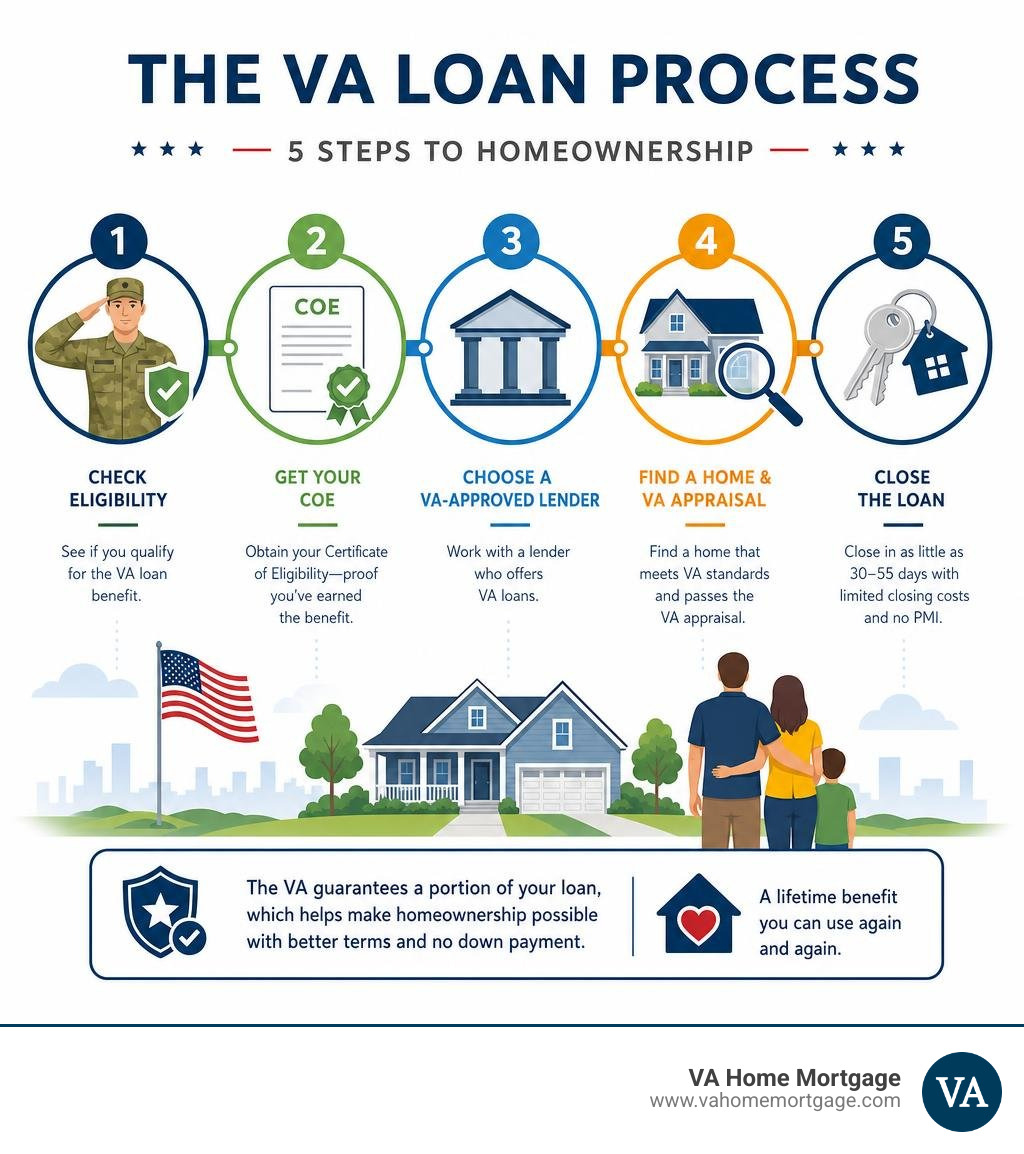
Here’s a quick snapshot of how it works:
- Check eligibility — Active duty, veterans, National Guard, Reserves, and some surviving spouses qualify
- Get your Certificate of Eligibility (COE) — Proof that you’ve earned the benefit
- Choose a VA-approved lender — The VA doesn’t lend directly; private lenders do
- Find a home that meets VA standards — The property must be your primary residence and pass a VA appraisal
- Close the loan — Typically 30–55 days, with limited closing costs and no PMI ever
The VA guarantees about 25% of your loan to the lender. That guarantee is what makes lenders willing to offer you better terms — even without a down payment.
This benefit isn’t a one-time deal either. It’s a lifetime benefit you can use again and again.
I’m Dale Gremillion, a Senior Loan Officer and Producing Branch Manager with over 25 years of experience helping veterans and military families navigate the process of buying a house using a VA loan. I’ll walk you through everything you need to know — from eligibility to closing day — so you can move forward with confidence.
Understanding the Basics of Buying a House Using VA Loan

Understanding how the program works is the first step toward getting the key to your new home. Created in 1944 under the Servicemen’s Readjustment Act (the original G.I. Bill), the program was designed to help military members build wealth and achieve homeownership upon returning to civilian life. Decades later, it remains one of the single best residential financing options in the United States.
Before jumping into listings and open houses, let’s establish how this government guaranty functions and who can take advantage of it under standard Eligibility Guidelines.
What Is a VA Purchase Loan?
A VA purchase loan is a specialized mortgage guaranteed by the U.S. Department of Veterans Affairs and issued by approved private lenders, such as mortgage companies, banks, and credit unions.
It is important to clear up a common misconception right away: the Department of Veterans Affairs does not directly loan you the money for a standard purchase loan. Instead, the VA provides a government guaranty — usually backing about 25% of the total loan amount.
This 25% backing acts as a safety net for private lenders. Because the federal government absorbs a significant portion of the financial risk if a borrower defaults, lenders are able to extend remarkably flexible terms to buyers. These terms include zero down payment requirements, competitive interest rates, and relaxed credit standards compared to conventional or FHA mortgages. Explore our resources in the VA Home Mortgage Category to learn more about these specific loan structures.
Who Is Eligible for a VA Home Loan?
Eligibility for a VA home loan is rooted in your military service record, duty status, and discharge conditions. The primary qualifying groups include:
- Active Duty Service Members: Generally eligible after serving 90 continuous active-duty days.
- Veterans: Required service length depends on when you served:
- Wartime service: 90 continuous days.
- Peacetime service: 181 continuous days.
- Post-September 1980 (enlisted) or Post-October 1981 (officers): 24 continuous months, or the full period for which you were called to active duty.
- National Guard Members: Qualify after 6 years of service in the Selected Reserve, or after 90 days of active service that includes at least 30 consecutive days under Title 32 orders (Sections 316, 502, 503, 504, or 505).
- Military Reserve Members: Qualify after 6 credible service years in the Selected Reserve, or after 90 days of active duty under Title 10.
- Surviving Spouses: Unremarried spouses of service members who died in the line of duty or as a result of a service-connected disability are eligible. Spouses who remarry on or after age 57 (and on or after December 16, 2003) may also maintain eligibility.
In all cases, veterans must have been separated under conditions other than dishonorable to utilize their benefit.
Key Benefits: No Down Payment and Zero PMI
When comparing a VA mortgage to standard conventional loans, two massive cost-saving advantages immediately stand out:
- Zero Down Payment: Conventional loans typically demand 3% to 20% down, and FHA loans require at least 3.5%. For a $400,000 home, a 5% down payment means coming up with $20,000 out-of-pocket before adding closing costs. Buying a house using a VA loan allows qualified buyers to finance up to 100% of the purchase price without dropping a single dollar toward a down payment.
- No Private Mortgage Insurance (PMI): On conventional loans, putting down less than 20% forces you to pay monthly PMI to protect the lender. On FHA loans, you pay monthly Mortgage Insurance Premiums (MIP) for the lifetime of the loan in most cases. The VA loan guaranty eliminates PMI and MIP completely, saving borrowers hundreds of dollars every single month.
Additional perks include capped lender closing fees, no prepayment penalties, and competitive fixed interest rates. Furthermore, since the removal of conforming loan limits for borrowers holding full entitlement under the Blue Water Navy Vietnam Veterans Act, there is no maximum limit on how much you can borrow with zero down, provided your income and credit support the monthly payments.
Primary Residence Rules and Application Process

VA home loans were created specifically to help service members secure safe primary residences for themselves and their immediate families. Because of this mission, strict occupancy rules apply, though the Department of Veterans Affairs understands military life and builds in practical flexibilities.
Primary Residence Rules when Buying a House Using VA Loan
When buying a house using a VA loan, you must certify that you intend to personally occupy the property as your primary home. Here are the core occupancy rules and exceptions you need to know:
- The 60-Day Rule: Standard policy requires you to move into the home within 60 days after loan closing.
- Deployment and Active Duty Exceptions: Active-duty members deployed overseas or stationed away on official duty satisfy the occupancy requirement if an eligible spouse moves into the property within the standard timeframe.
- PCS Orders: If you receive Permanent Change of Station (PCS) orders requiring relocation, you are not penalized for leaving a previously purchased VA home, provided it met primary residency requirements when acquired.
- Delayed Occupancy for Retirement: Service members planning to retire within 12 months of closing can request delayed occupancy, allowing them to purchase their retirement home prior to official separation.
- Dependent Child Occupancy: If an active-duty parent is deployed and no spouse is present, a dependent child’s legal guardian or attorney can certify occupancy on behalf of the child living in the home.
VA loans cannot be used to buy investment properties, second homes, or vacation cabins that you only visit occasionally.
Key Steps to Buying a House Using VA Loan from COE to Closing
The journey from initial idea to receiving your house keys follows a clear sequence. Reviewing the official Buying Process Guide gives you a high-level view, but here is how the step-by-step application workflow looks in practice:
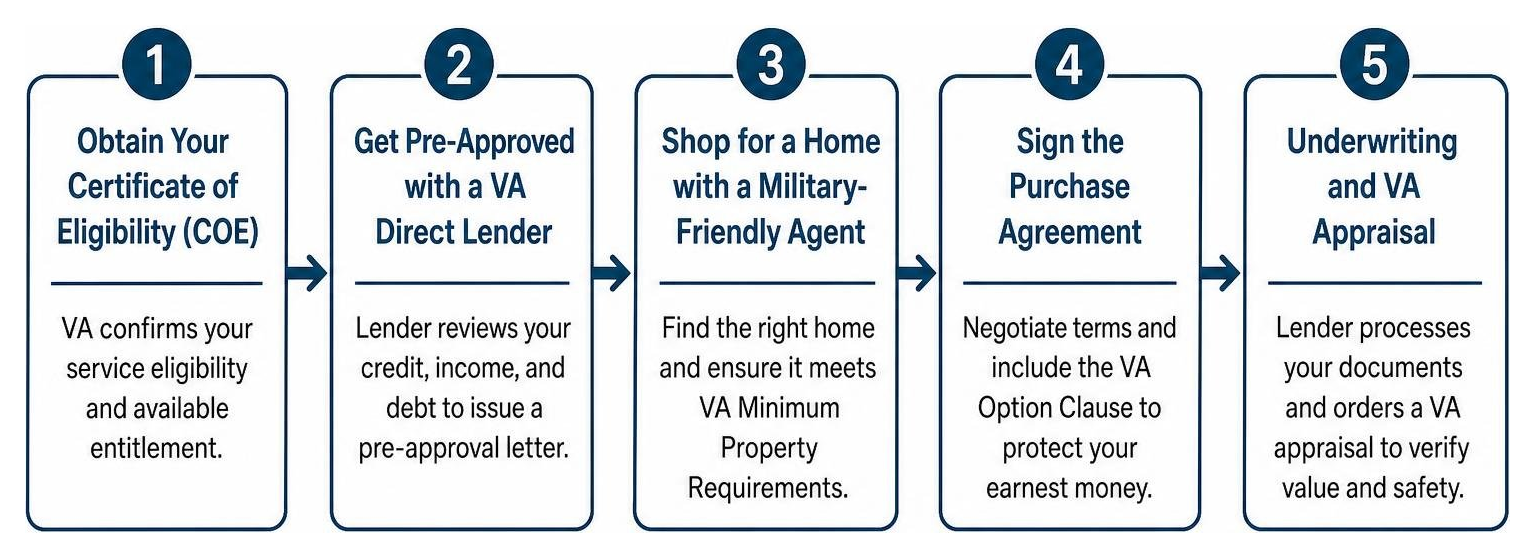
- Obtain Your Certificate of Eligibility (COE): The COE is official documentation from the VA confirming you meet service criteria and stating your available entitlement. We can retrieve your COE online in minutes using the VA Loan Guaranty System, or you can request it directly at VA.gov using VA Form 26-1880.
- Get Pre-Approved with a VA Direct Lender: Partner with an experienced lender to review your credit profile, monthly income, and existing debt obligations. Pre-approval gives you a concrete budget and a solid pre-approval letter for seller negotiations.
- Shop for a Home with a Military-Friendly Real Estate Agent: Work with an agent who understands VA Minimum Property Requirements (MPRs) and knows how to write VA-compliant purchase offers.
- Sign the Purchase Agreement (with VA Escape Clause): Negotiate contract terms, ensuring the mandatory VA Option Clause is written into the offer to protect your earnest money deposit.
- Underwriting and VA Appraisal: Once under contract, your lender processes pay stubs, tax returns, and bank statements while ordering an independent VA appraisal to verify property value and safety standards.
- Closing and Key Hand-off: Review your Closing Disclosure at least 3 business days before closing. Sign your final loan documents, pay any remaining closing costs, and take ownership of your home.
For more deep-dive strategy guides on navigating underwriters, visit our main Blog.
Property Requirements, Appraisal, and Contract Protections
Because the VA guarantees a quarter of your loan, it maintains property standards designed to protect you from purchasing a home riddled with major structural hazards or hidden repair traps.
Minimum Property Requirements and the VA Appraisal Process
Every home purchased with a VA loan must meet Minimum Property Requirements (MPRs). MPRs mandate that the home must be safe, sound, and structurally secure. Essential items inspected by the appraiser include:
- A functioning, reliable heating system capable of maintaining comfortable temperatures.
- Sound roofing with adequate remaining useful life and no active leaks.
- Working plumbing, safe drinking water, and safe sewage disposal.
- Clean electrical wiring without exposed hazards or unsafe panel configurations.
- Absence of wood-destroying insects (termites) or active dry rot.
- Proper drainage directing surface water away from foundation walls.
It is critical to distinguish a VA appraisal from a home inspection. A VA appraiser estimates market value and checks basic health and safety MPRs on behalf of the lender. A home inspector works strictly for you, conducting an exhaustive top-to-bottom evaluation of mechanical, electrical, and structural components.
| Feature / Aspect | VA Appraisal | Independent Home Inspection |
|---|---|---|
| Primary Purpose | Estimate market value & verify minimum safety (MPRs) | Deep structural, mechanical, & system diagnosis |
| Who It Benefits | Lender & VA Loan Guaranty Program | Buyer (You) |
| Mandatory? | Yes, required for loan approval | Optional, but heavily recommended |
| Appraiser/Inspector Selection | Assigned randomly via VA rotation system | Chosen independently by the buyer |
| Contract Rights | Triggers VA Escape Clause if valuation fails | Triggers inspection repair contingencies |
What Happens During Low Appraisals and the VA Escape Clause
Sometimes, an appraiser evaluates a property and concludes that its reasonable market value is lower than the sales price you agreed to pay in the contract. Under standard VA Purchase Loan Guidelines, you are never forced to overpay or lose your hard-earned deposit.
This protection comes from the VA Escape Clause (or VA Option Clause), a mandatory contract amendment stating that if the appraised value comes in lower than the purchase price:
- You can walk away from the deal cleanly with 100% of your earnest money refunded without penalty.
- You can request a Reconsideration of Value (ROV) by submitting recent comparable sales (comps) through your lender to challenge the appraisal figure.
- You can renegotiate with the seller to lower the purchase price to match the appraised value.
- You can choose to pay the cash difference out of pocket at closing if you are determined to buy the property at the higher price.
Purchasing Multi-Family Homes, Condos, and Existing Homes
VA loans are surprisingly flexible when it comes to eligible property types:
- Single-Family Existing Homes: The most common property purchased, including detached houses and townhomes.
- Multi-Family Homes (2 to 4 Units): You can use a single VA loan to purchase a duplex, triplex, or fourplex property, provided you occupy one unit as your primary residence. You can even use prospective rental income from the remaining units to help qualify for the loan!
- VA-Approved Condominiums: Condos are eligible, provided the condominium complex is on the VA’s official approved project list. If the complex is not yet approved, your lender can submit an approval request package to the regional loan center.
- Manufactured Homes and Modular Housing: Allowed under VA rules, provided the unit is permanently affixed to a foundation on land you own and meets local building codes.
VA Funding Fees and Restoring Entitlement
To keep the VA loan program self-sustaining for future generations without relying heavily on taxpayer dollars, Congress established the VA Funding Fee. This one-time fee is paid directly to the Department of Veterans Affairs at closing.
VA Funding Fee Breakdown and Disability Exemptions
The exact funding fee percentage depends on your down payment amount and whether you have used your VA loan benefit previously. Check the official VA Home Loan Buyer’s Guide for full details, but here is a typical standard buyer snapshot:
- First-Time Use (Zero Down): Typically 2.15% of the loan amount.
- Subsequent Use (Zero Down): Typically 3.3% of the loan amount.
- Down Payment of 5% to 9.9%: Drops to 1.5% for both first and subsequent uses.
- Down Payment of 10% or More: Drops to 1.25% for both first and subsequent uses.
You do not have to pay the funding fee in cash out of pocket; almost all buyers choose to roll the fee into their total loan balance at closing.
Exemptions: You are 100% exempt from paying the VA funding fee if:
- You receive VA compensation for a service-connected disability.
- You are eligible to receive VA disability compensation but receive retirement/active pay instead.
- You are a surviving spouse receiving Dependency and Indemnity Compensation (DIC).
- You are an active-duty service member who has been awarded the Purple Heart.
Reusing Benefit and Restoring Entitlement
Your VA loan entitlement is a lifetime benefit. You do not lose it after using it once.
- Full Entitlement: If you have never used a VA loan, or if you paid off a prior VA loan and sold the property, you possess full entitlement. This allows you to buy a home with no down payment regardless of local conforming loan limits.
- Restoring Entitlement: To fully restore your entitlement, you must sell the home that was financed with the VA loan and pay off the mortgage balance in full. You then submit VA Form 26-1880 to restore your full benefit capacity.
- One-Time Entitlement Restoration: The VA allows a special one-time restoration rule. If you pay off your existing VA mortgage balance in full but retain ownership of the property (for example, paying off the loan or refinancing into a non-VA loan), you can restore your entitlement to purchase a new primary residence.
- Loan Assumption: If another eligible veteran assumes your existing VA mortgage and substitutes their entitlement for yours, your original entitlement is completely released and restored back to you.
Frequently Asked Questions About VA Home Loans
What credit score is needed to qualify for a VA loan?
Officially, the Department of Veterans Affairs does not set a minimum credit score requirement. Instead, the VA requires lenders to review the overall credit profile, payment history, and residual income of the applicant.
However, private mortgage lenders establish their own internal guidelines, known as “lender overlays.” Most lenders look for a benchmark credit score between 580 and 660. At Capital Home Mortgage, our direct authority allows us to evaluate low credit scores and non-traditional credit profiles holistically.
How long does it take to close on a VA purchase loan?
Under optimal conditions, a VA purchase loan can close in about 30 days. On average across the industry, closing timelines typically span between 40 and 55 days from the moment your purchase offer is accepted.
Timelines depend largely on how quickly documentation (pay stubs, tax records, bank statements) is supplied, appraiser turn times in your local market, and underwriting efficiency.
Can I use a VA loan to buy an investment property or second home?
No, you cannot use a VA purchase loan exclusively to acquire an investment property, rental home, or seasonal vacation residence. The program requires the home to serve as your primary residence.
The only exception to generating rental income is purchasing a multi-family property (up to 4 residential units) where you personally live in one of the units while renting out the remaining units to tenants.
Conclusion
Buying a home is one of the most rewarding financial milestones of your life, and as a military service member, veteran, or eligible spouse, you have earned access to the single best mortgage loan product on the market. From zero down payments and zero monthly private mortgage insurance to built-in contract protections like the VA Escape Clause, buying a house using a VA loan sets you up for long-term financial success.
Navigating loan requirements, entitlement calculations, and appraisal guidelines is seamless when you have experienced professionals in your corner. The team at VA Home Mortgage Team offers in-house underwriting and direct authority, providing fast, clear answers and streamlined closings without unnecessary red tape.
Ready to take the first step toward opening the front door of your new home? Get started with your VA purchase loan today and let us help you maximize your hard-earned benefits!