
VA Purchase Loans: Who Qualifies and What to Expect
A VA purchase loan helps eligible veterans, service members, and some surviving spouses buy a primary home. It is backed by the Department of Veterans Affairs and often requires no down payment or monthly mortgage insurance. You will need a Certificate of Eligibility (COE), lender approval, and a home that meets VA standards. You may still owe closing costs and a one-time VA funding fee unless you qualify for an exemption.
Start by requesting your COE and comparing VA lenders. Then get pre-approved, choose a home, and ask your lender for an estimate of the cash you will need at closing.
I’m Dale Gremillion, a Senior Loan Officer and Producing Branch Manager with more than 25 years in residential lending. I’ve helped borrowers navigate VA purchase loan eligibility, paperwork, and complex financing needs.
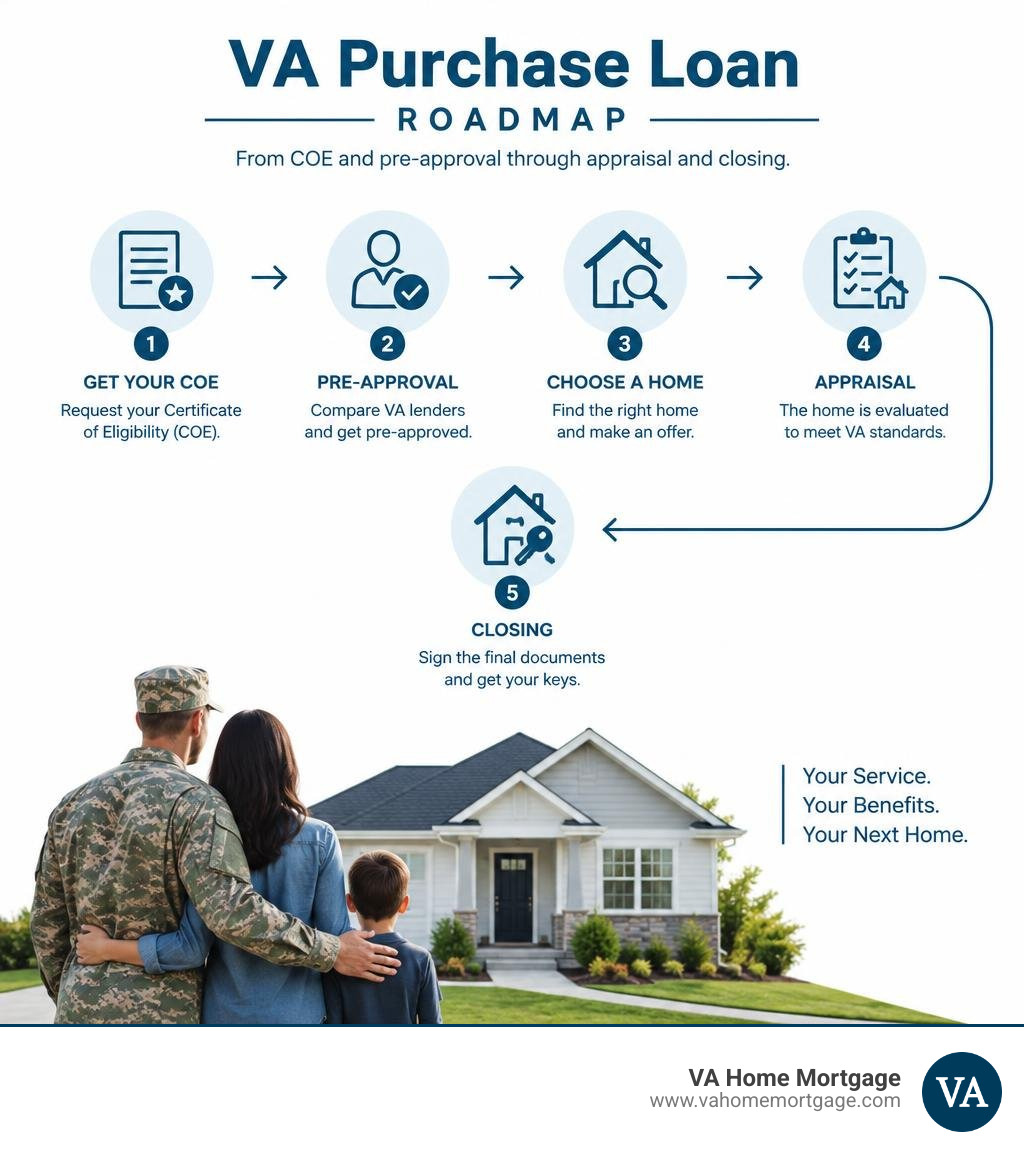
VA purchase loan terminology:
What Is a VA Purchase Loan and How Does It Work?
A VA purchase loan is a mortgage guaranteed by the U.S. Department of Veterans Affairs (VA) and issued by private approved lenders. Rather than lending money directly to buyers (outside of specialized direct programs), the federal government provides a financial guarantee covering at least 25% of the loan amount against default. This federal safety net reduces risk for mortgage lenders, enabling us to offer terms that civilian loan programs simply cannot match.
Unlike standard home loans that demand significant cash reserves, the VA loan program is built to support long-term stability by unlocking your military housing benefits with Home Loans VA. Eligible borrowers can finance 100% of a home’s purchase price without paying monthly private mortgage insurance (PMI).
It is important to distinguish purchase financing from other VA loan options:
- VA Purchase Loans: Designed specifically to finance the acquisition of a primary residence.
- Interest Rate Reduction Refinance Loans (IRRRL): Also known as VA streamline refinances, these help existing VA loan holders lower their interest rates with minimal documentation.
- VA Cash-Out Refinance Loans: These permit borrowers to tap into home equity or refinance a non-VA loan into a VA mortgage.
As of 2026, competitive market conditions make fixed-rate terms an attractive path for homebuyers. VA 30-year fixed rates consistently average 0.25 to 0.50 percentage points below comparable standard financing options, providing substantial monthly interest savings over the life of the mortgage.
Who Qualifies for VA Purchase Loan Financing?
Qualifying for a VA purchase loan requires meeting specific service benchmarks established by Congress. The VA guarantees loans for active-duty personnel, veterans, members of the National Guard and Reserve, and certain eligible surviving spouses.
Review the VA loan eligibility guide 2026 to evaluate how specific service eras determine your baseline qualification:
- Wartime Active Duty: At least 90 consecutive days of active military service during designated periods (including World War II, the Korean Conflict, the Vietnam Era, and the ongoing Gulf War era from August 1990 forward).
- Peacetime Active Duty: At least 181 continuous days of active military service.
- The 24-Month Rule: For enlisted service members separated after September 7, 1980 (or officers separated after October 16, 1981), eligibility typically requires 24 continuous months of service or the full period for which you were called or ordered to active duty (at least 181 days).
- National Guard and Selected Reserve: A minimum of 6 years of honorable service, or 90 days of non-training active-duty service under Title 10 or Title 32 orders (with at least 30 consecutive days).
- Surviving Spouses: Unremarried spouses of service members who died in the line of duty, died from a service-connected disability, or are listed as missing in action (MIA) or prisoners of war (POW). Spouses who remarry after age 57 (and after December 16, 2003) may also retain eligibility.
Discharge characterization matters. An honorable discharge satisfies VA requirements, while general discharges under honorable conditions are often acceptable. Other-than-honorable discharges may require formal administrative review by the VA.
Obtaining Your Certificate of Eligibility (COE)
The Certificate of Eligibility (COE) is the official federal document confirming you meet the statutory service requirements for a VA loan. Lenders cannot issue a final loan approval without an active COE.
You can streamline this step by consulting a veteran’s practical guide to applying for a VA COE. The documentation you will need depends on your military status:
- Veterans: Copy of DD Form 214 showing character of service and separation reason (Member-4 copy preferred).
- Active-Duty Members: A current Statement of Service signed by your commander, adjutant, or personnel officer detailing your full legal name, Social Security number, date of birth, date of entry, lost time, and command name.
- National Guard / Reserve: NGB Form 22/23 or formal retirement points statements, alongside your discharge papers or current Statement of Service.
- Surviving Spouses: VA Form 26-1817 along with the veteran’s DD214 and marriage certificate.
While you can submit VA Form 26-1880 through the mail or request your COE directly through the VA eBenefits portal, working through our automated Web LGY portal allows us to pull your electronic COE in just seconds during your initial pre-approval.
Entitlement Rules and 2026 Loan Limits
Your entitlement represents the dollar amount the Department of Veterans Affairs guarantees to your lender.
- Basic Entitlement: Listed on your COE as $36,000, which historically covered 25% of loans up to $144,000.
- Bonus (Secondary) Entitlement: Covers 25% of loan amounts exceeding $144,000 up to the local conforming limit.
Under the Blue Water Navy Vietnam Veterans Act, borrowers with full entitlement (meaning first-time users or those who have paid off and restored prior VA loans) have no statutory loan limits. As long as you have full entitlement, you can borrow as much as an underwriter approves based on your income and credit, with zero down payment required.
If you have partial entitlement (because you have an active VA loan on another property or previously experienced a compromise claim without full restoration), county limits apply to determine your maximum zero-down purchasing power. For 2026, the baseline Federal Housing Finance Agency (FHFA) conforming loan limit is $832,750 in standard counties and reaches up to $1,249,125 in high-cost counties.
To verify your specific county benchmarks, check the VA Home Loan Entitlement And Limits guidelines.
| Entitlement Status | Loan Limit Restrictions | Down Payment Requirement |
|---|---|---|
| Full Entitlement | No limit (Subject to lender credit/income approval) | $0 Down Payment |
| Partial Entitlement (Standard County) | Up to $832,750 (2026 Conforming Limit) | $0 down up to remaining limit; 25% of excess |
| Partial Entitlement (High-Cost County) | Up to $1,249,125 (2026 Ceiling) | $0 down up to remaining limit; 25% of excess |
If you purchase a property priced above your available entitlement limit, you simply provide a down payment equal to 25% of the difference between the sales price and your maximum entitlement ceiling.
Core Benefits, Funding Fees, and Closing Costs
The structural savings provided by VA mortgages outpace standard civilian financing options across several areas:
- Zero Down Payment: Roughly 90% of all VA purchase loans close with no down payment, preserving liquid savings for the homebuyer.
- No Ongoing Mortgage Insurance: Standard mortgages with less than 20% down demand monthly mortgage insurance premiums. VA loans eliminate ongoing monthly mortgage insurance, saving buyers hundreds of dollars every month.
- Competitive Pricing: Lower interest margins mean less money spent on cumulative finance charges.
- Generous Seller Concessions: Sellers can pay up to 4% of the total purchase price in concessions, covering items like prepaid property taxes, homeowner’s insurance, and even paying down buyer debts or funding fees.
Review comprehensive veterans homebuying guide resources to see how these structural advantages compound over a standard 30-year amortization schedule.

VA Funding Fee Schedule and Disability Exemptions
The VA loan program operates without ongoing taxpayer subsidies by charging a one-time VA funding fee. This fee is paid directly to the Department of Veterans Affairs at closing and can be paid in cash or financed into the loan balance.
The fee percentage varies based on down payment amount and whether you have used your VA home loan benefit before:
| Down Payment Tier | First-Time Use Fee | Subsequent Use Fee |
|---|---|---|
| 0% Down Payment | 2.15% | 3.30% |
| 5.0% to 9.99% Down | 1.50% | 1.50% |
| 10.0% or Greater Down | 1.25% | 1.25% |
Certain buyers are completely exempt from paying the VA funding fee:
- Veterans receiving VA disability compensation for a service-connected disability (rated at 10% or higher).
- Veterans entitled to receive disability pay who are receiving active-duty or retirement pay instead.
- Surviving spouses receiving Dependency and Indemnity Compensation (DIC).
- Active-duty service members who provide documentation of receiving the Purple Heart prior to or at loan closing.
Allowable Closing Costs and Buyer Protections
While down payments can be waived, standard third-party closing costs still apply to VA purchase loans. Generally, total closing costs run between 3% and 5% of the loan amount, covering appraisal fees, title searches, settlement services, origination charges, and recording fees.
The VA strictly protects military buyers by limiting what lenders can charge. Non-allowable fees—such as lender document preparation charges, underwriting processing add-ons, or attorney fees not directly tied to title clearance—cannot be charged directly to the veteran. Lenders may instead charge a single, flat 1% origination fee to cover administrative overhead.
Explore the resources within our VA Home Mortgage hub for deeper breakdowns on allowable and non-allowable fees.
Crucially, every VA purchase agreement must include the mandatory VA Option Clause (or Escape Clause). This contractual safeguard guarantees that if the property appraises for less than the agreed-upon purchase price, you can cancel the contract without losing your earnest money deposit.
The Home Buying and Approval Process
Purchasing a home with military financing is straightforward when you work with experienced professionals who understand VA underwriting guidelines.
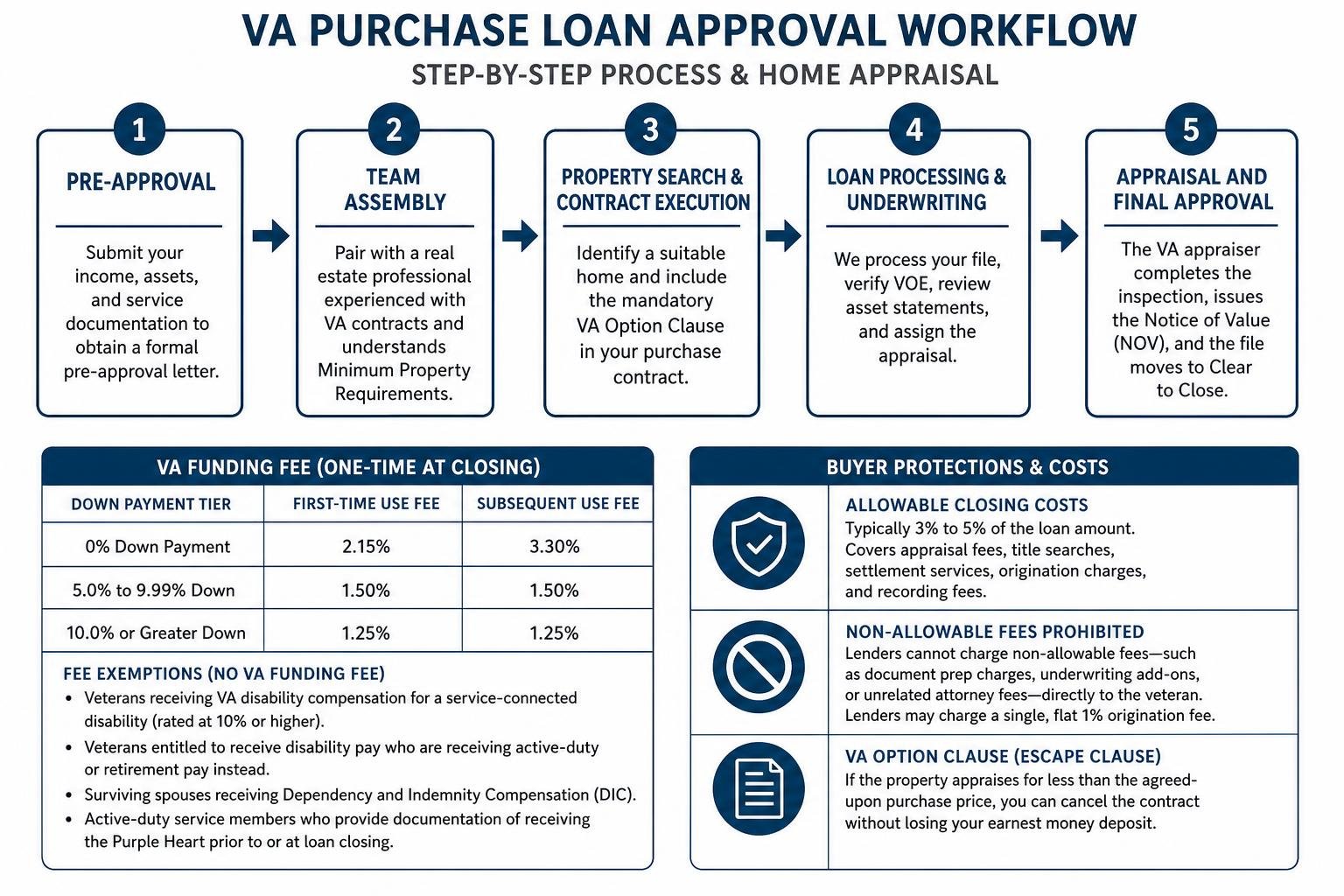
- Pre-Approval: Submit your income, assets, and service documentation to obtain a formal pre-approval letter.
- Team Assembly: Pair with a real estate professional who has direct experience handling VA contracts and understands Minimum Property Requirements. Learn why every military buyer needs an experienced veteran loan specialist to protect your contract timelines.
- Property Search & Contract Execution: Identify a suitable home and include the mandatory VA Option Clause in your purchase contract.
- Loan Processing & Underwriting: We process your file, verify verifications of employment (VOE), review asset statements, and assign the appraisal. Following our step-by-step guide to finding a qualified VA loan officer ensures you work with direct underwriting teams who make prompt lending decisions.
- Appraisal and Final Approval: The assigned VA appraiser completes the inspection, issues the Notice of Value (NOV), and the file moves to Clear to Close.
Step-by-Step Guide to Applying for a VA Purchase Loan
Underwriting a VA loan involves evaluating credit history, income stability, and debt obligations.
Review our step-by-step plan on how to start your VA home loan application in 7 days to organize your financial records efficiently.
Underwriters focus on three primary approval criteria:
- Credit Evaluation: Although the VA does not establish a statutory minimum credit score, underwriters assess your past 12 to 24 months of payment history to verify reliable credit management.
- Debt-to-Income (DTI) Ratio: While a 41% DTI is standard for manual underwriting, automated underwriting systems (AUS) frequently approve higher ratios when supported by strong compensating factors.
- Residual Income: The VA requires borrowers to retain a specific amount of net cash each month after paying their mortgage, taxes, insurance, and recurring debts. Residual income benchmarks depend on family size and geographic region, ensuring you have enough cushion for food, healthcare, and daily living expenses.
When you are ready to make an offer, reference our walkthrough on how to buy your dream home with a VA purchase loan for negotiation strategies.
Navigating the VA Appraisal and Minimum Property Requirements (MPRs)
Every home purchased with a VA mortgage must undergo an appraisal performed by an independent, VA-assigned appraiser. The appraiser is assigned on a rotating basis through the VA’s regional portal, ensuring an objective valuation.
The VA appraisal serves two functions:
- Fair Market Valuation: Establishes that the home’s value justifies the contracted purchase price.
- Minimum Property Requirements (MPRs): Confirms the home is safe, structurally sound, and sanitary.
Appraisers check essential systems, including adequate heating, clean drinking water, functional roofing with remaining economic life, proper ventilation, and the absence of dry rot or wood-destroying insects.
An appraisal is not a replacement for a comprehensive private home inspection. An appraisal provides a general overview for valuation and baseline safety, whereas an independent home inspector evaluates plumbing lines, electrical panels, appliances, and underlying mechanical components in detail.
Once complete, the VA staff appraisal reviewer (SAR) issues a formal Notice of Value (NOV) establishing the property’s approved valuation.
Eligible Property Types and Occupancy Rules
The VA home loan program is designed exclusively for owner-occupied primary residences. Borrowers must certify that they intend to move into the home within 60 days of closing. Exceptions exist for active-duty service members deployed overseas, in which case a spouse can satisfy the occupancy requirement.
If you have unique property considerations, learn how to contact a local VA home loan representative to discuss property guidelines before submitting an offer.

Property Types You Can Buy with a VA Purchase Loan
You can finance several types of properties with a VA purchase loan:
- Single-Family Detached Homes: The standard property type for VA financing.
- Multi-Unit Properties (2 to 4 Units): You can purchase a multi-unit property using a VA loan, provided you occupy one of the units as your primary residence. You can rent out the remaining units to generate rental income.
- VA-Approved Condominiums: Condominium communities must appear on the VA’s active approved condo list to ensure the development meets financial reserve and owner-occupancy standards.
- Manufactured Homes: Eligible if permanently affixed to a foundation, classified as real property under local law, and compliant with HUD building codes.
- New Construction: You can buy newly constructed homes with VA purchase financing once construction is completed and the home is ready for occupancy.
Frequently Asked Questions About VA Purchase Loans
What is the minimum credit score required for a VA purchase loan?
The VA does not set a mandatory minimum credit score. Instead, individual lenders establish their own underwriting guidelines, known as lender overlays. While many lenders set minimum benchmarks around 580 to 620, automated underwriting approvals can accommodate various credit profiles when backed by stable residual income and on-time housing payments over the preceding 12 months.
Can I use a VA purchase loan more than once?
Yes. Your VA loan benefit is fully reusable throughout your lifetime. Once you sell a previously financed home and pay off the associated VA mortgage, your full entitlement is restored. You can also restore entitlement if an eligible military buyer assumes your loan and agrees to substitute their own entitlement. Additionally, remaining bonus entitlement allows you to purchase a second primary residence using a VA loan if you relocate due to Permanent Change of Station (PCS) orders or changing family needs.
How long does it typically take to close on a VA purchase loan?
A VA purchase loan generally closes within 30 to 45 days from contract execution, matching standard mortgage turnaround times. Delays typically stem from appraiser turnaround schedules or required property repairs under VA Minimum Property Requirements (MPRs). Working with a direct lender with in-house underwriting authority helps keep your loan on schedule and avoids unexpected closing delays.
Conclusion
A VA purchase loan remains one of the most accessible and cost-effective home financing options available today. Eligible military borrowers can achieve homeownership with zero down payment, no monthly private mortgage insurance, limited closing costs, and competitive fixed interest rates.
Capital Home Mortgage is a direct VA mortgage lender providing dedicated financing options to active service members and veterans. Our in-house underwriting team and direct VA authority allow us to deliver quick approvals and a smooth closing process from start to finish.
Connect with our VA Home Mortgage Team to confirm your eligibility, or get pre-approved for your home purchase with VA Home Mortgage and begin your homeownership journey today.