
What Is a VA Fixed-Rate Loan and How Does It Work?
A VA loan fixed rate mortgage is a home loan backed by the U.S. Department of Veterans Affairs where the interest rate stays constant throughout the entire term of the loan. Whether you choose a 15-year or a 30-year option, the interest rate locked on day one is the exact same rate you pay on day 10,000.
Unlike Adjustable-Rate Mortgages (ARMs), which feature rates that shift periodically based on market indices, a fixed-rate mortgage protects your household budget from unexpected spikes in monthly housing costs. The Department of Veterans Affairs does not directly lend you the money or set the interest rate. Instead, private lenders like us issue the loan, while the federal government guarantees a portion of it (typically 25%). This government backing reduces our risk as a direct lender, enabling us to pass along lower interest rates and flexible underwriting criteria to military families.
For an in-depth breakdown of program rules, entitlement formulas, and federal guidelines, you can review the official VA Home Loan Guaranty Buyer’s Guide.
Below is a comparison of common fixed-rate terms available through the VA home loan program:
| Loan Term | Primary Advantage | Best Suited For | Payment Profile |
|---|---|---|---|
| 30-Year Fixed | Lower monthly payments, maximized cash flow | Buyers looking for budget flexibility and purchasing power | Consistent, lowest mandatory payment |
| 15-Year Fixed | Rapid equity buildup, massive lifetime interest savings | Buyers aiming to pay off their home quickly before retirement | Higher monthly payment, lower interest rate |
How Fixed-Rate VA Loans Protect Against Market Volatility
financial markets fluctuate based on inflation reports, Federal Reserve policy decisions, and global market forces. If you carry an adjustable-rate mortgage, shifting economic conditions can cause your monthly mortgage payment to increase by hundreds of dollars overnight once your initial fixed period expires.
Selecting a VA loan fixed rate acts as a permanent shield against market volatility. When interest rates rise across the nation, your rate stays untouched. Even better, if overall market rates drop significantly down the road, you are never trapped in your current rate—you can easily take advantage of a streamlined refinancing process to lower your rate even further.
Available Terms: 15-Year vs. 30-Year VA Loans
Choosing the right loan term comes down to balancing your monthly cash flow against long-term interest costs:
- 30-Year Fixed-Rate VA Loan: This remains the most popular choice for military buyers. By spreading repayment across 360 monthly payments, you secure the lowest possible mandatory monthly obligation. This lower payment preserves monthly liquidity for operational savings, emergency funds, or family investments.
- 15-Year Fixed-Rate VA Loan: If your priority is burning the mortgage and building wealth fast, a 15-year term delivers lower nominal interest rates. Because you compress 30 years of repayment into 180 months, your monthly principal payment is higher, but you save tens (or even hundreds) of thousands of dollars in total interest expense over the lifetime of the loan.
Key Benefits of a VA Loan Fixed Rate Option
When you pair the military benefit of zero down payment with a locked interest rate, you create one of the most powerful wealth-building tools in American real estate. At VA Home Mortgage, we specialize in helping service members maximize these benefits.
Zero Down Payment and No PMI
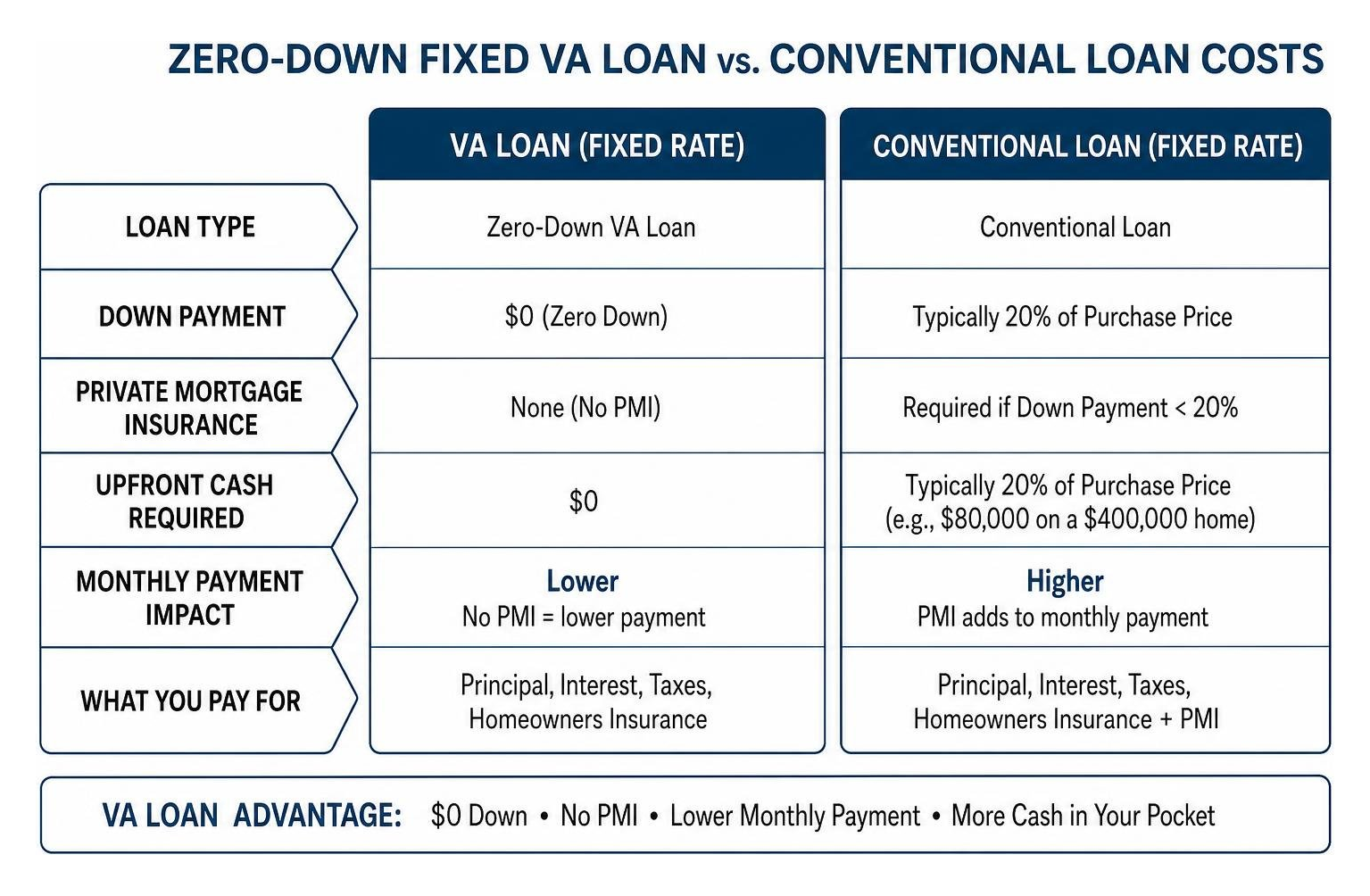
Standard conventional loans typically require a 20% down payment to avoid Private Mortgage Insurance (PMI). On a $400,000 home purchase, that forces home buyers to hand over $80,000 in cash at the closing table just to avoid paying an extra monthly insurance fee.
With a fixed-rate VA loan, qualifying buyers with full entitlement do not have to put down a single dollar upfront. Furthermore, the VA program completely eliminates ongoing monthly mortgage insurance. Unlike conventional loans with less than 20% down (which charge PMI) or FHA loans (which charge monthly Mortgage Insurance Premiums for the life of the loan), a VA loan keeps your payment lean and dedicated strictly to principal, interest, taxes, and homeowners insurance.
Keeping tens of thousands of dollars in your liquid emergency fund rather than tying it up in home equity gives military families remarkable financial flexibility. To see how current rate trends affect overall lifetime savings across various loan types, read our detailed analysis on VA Home Loan Interest Rates 2026: Today’s Best Rates and Lender Comparison | Veterans Disability Guide.
Predictable Monthly Payments and Rate Stability
Financial peace comes from predictability. When your core housing payment is fixed for 15 to 30 years, budgeting becomes simple:
- Fixed Principal and Interest: While local property taxes and homeowners insurance premiums may shift slightly over time, your core loan payment never moves.
- Protection Against Inflation: As wages and the general cost of living rise over time due to inflation, your fixed mortgage payment effectively becomes cheaper in real dollars every year.
- Reusable Entitlement: The VA loan benefit is not a one-time grant. Once you sell your home or pay off the mortgage, your full entitlement is restored for your next home purchase.
Qualification, COE, and Funding Fees for Fixed-Rate VA Loans
Qualifying for a fixed-rate VA loan requires meeting military service guidelines, obtaining official documentation, and clearing standard underwriting requirements.

Obtaining Your Certificate of Eligibility (COE)
Before you can formally apply for a mortgage, we must verify your military service through a Certificate of Eligibility (COE). Service requirements generally include:
- Active Duty: 90 continuous days of active service during wartime or 181 continuous days during peacetime.
- National Guard & Reserves: Typically 6 years of creditable service, or 90 days of active service including at least 30 consecutive days under Title 32 orders.
- Surviving Spouses: Unremarried spouses of service members who died in the line of duty or as a result of a service-connected disability.
You can pull your COE directly through the official eBenefits portal, mail in VA Form 26-1880 alongside your DD-214 discharge papers, or let our team handle it for you. As an authorized lender, we can pull your official COE electronically in minutes.
Understanding VA Funding Fees and Exemptions
To help keep the program running for future generations without requiring taxpayer bailouts, the VA charges a one-time fee known as the VA funding fee. This fee can be paid upfront at closing or rolled directly into your total fixed-rate loan balance.
The fee percentage varies based on your loan purpose, down payment amount, and whether you have used a VA loan before:
- First-Time Use (0% Down): 2.15% of the total loan balance.
- Subsequent Use (0% Down): 3.30% of the total loan balance.
- First-Time or Subsequent Use (5% Down or More): Reduced to 1.50%.
- First-Time or Subsequent Use (10% Down or More): Reduced to 1.25%.
Funding Fee Exemptions: You are completely exempt from paying the VA funding fee if you:
- Receive VA compensation for a service-connected disability (even a 10% rating qualifies you).
- Are eligible to receive disability compensation but receive active duty retirement pay instead.
- Are a surviving spouse receiving Dependency and Indemnity Compensation (DIC).
Check out our complete financial guides on our Blog to see how funding fee exemptions can save you thousands.
VA Appraisals, Closing Costs, and the Escape Clause
Every property financed with a VA loan fixed rate must undergo a specialized VA appraisal. The appraisal serves two distinct purposes: establishing fair market value and confirming that the home meets the VA’s Minimum Property Requirements (MPRs) for safety, sanitation, and structural soundness.
To protect military buyers, every purchase contract must include the official VA Escape Clause. This clause states that if the property appraises for less than your agreed-upon purchase price, you can back out of the contract without penalty and receive a full refund of your earnest money deposit.
Standard closing costs—such as title insurance, recording fees, credit reports, and escrow deposits—still apply to VA loans. However, the VA strictly limits what fees lenders can charge, capping total origination charges and prohibiting extra admin fees. Sellers are also permitted to contribute up to 4% of the purchase price toward your closing costs and prepayments.
Purchase and Refinance Options
Whether buying a new home or managing an existing mortgage, fixed-rate VA loans offer tailored financing options.

Understanding the 30-Year VA Loan Fixed Rate
When you take out a 30-year fixed-rate VA purchase loan, your loan is amortized over 360 equal monthly payments. In the early years of your loan, the majority of your payment goes toward covering interest costs, while a smaller portion reduces your principal balance. As time goes on, that ratio flips:
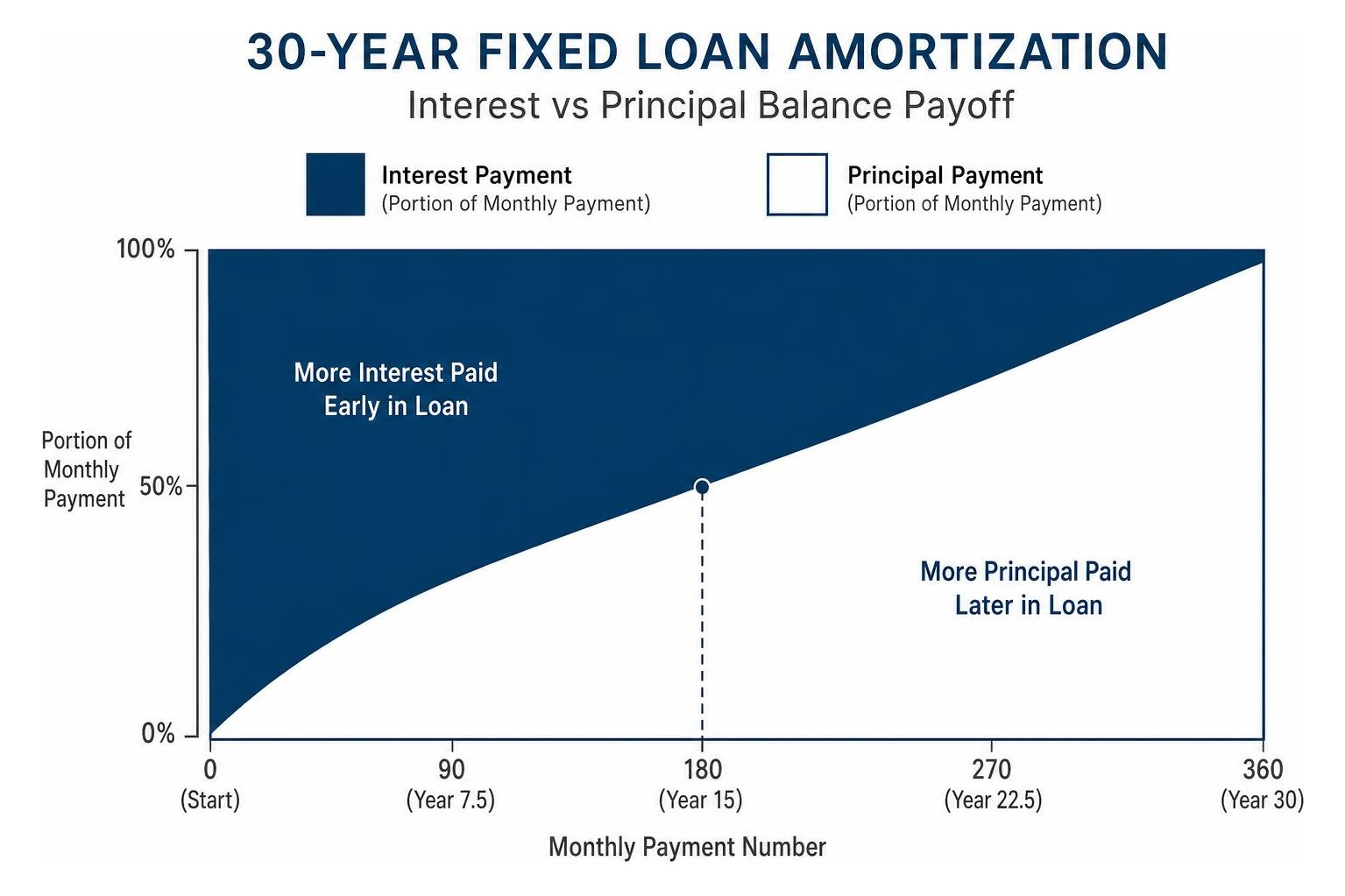
This predictable amortization structure makes the 30-year fixed rate an ideal long-term wealth strategy, giving you low monthly payments while steadily building home equity. You can explore more strategies on home financing under our general Blog Category.
How to Secure the Best VA Loan Fixed Rate in 2026
Interest rates fluctuate daily based on broader macroeconomic trends. To make sure you lock in the best possible rate, follow these strategic steps:
- Step 1: Check and Optimize Your Credit: While the VA program doesn’t set a hard minimum credit score, most lenders look for a 620 or higher. Keeping credit card balances below 30% of their limit and paying bills on time in the 12 months leading up to your purchase boosts your score into top-tier pricing brackets.
- Step 2: Evaluate Discount Points: You can pay mortgage discount points upfront (where 1 point equals 1% of the loan amount) to permanently buy down your interest rate. If you plan to remain in the property past the breakeven point (usually 3 to 5 years), paying points can lower your lifetime borrowing costs.
- Step 3: Compare APRs, Not Just Base Rates: Always review the official Loan Estimate form to compare the Annual Percentage Rate (APR). The APR factors in loan origination costs, discount points, and funding fees, revealing the true total cost of borrowing.
- Step 4: Lock Your Rate Promptly: Once you identify a competitive rate that fits comfortably inside your monthly housing budget, lock it in. Trying to time market lows can be risky; securing a comfortable rate early keeps your transaction smooth and predictable.
Frequently Asked Questions About VA Fixed-Rate Loans

What credit score is required for a VA fixed-rate mortgage?
The Department of Veterans Affairs does not establish a statutory minimum credit score requirement. Instead, the VA requires lenders to review a borrower’s complete credit profile and conduct a residual income analysis to ensure long-term affordability.
However, individual mortgage companies establish their own underwriting guidelines (known as lender overlays). Most lenders require a minimum credit score of 620, though options are often available down to 580 for borrowers with strong compensating factors like solid residual income and steady job stability.
Can I refinance an existing mortgage into a fixed-rate VA loan?
Yes! You have two primary fixed-rate refinancing pathways:
- Interest Rate Reduction Refinance Loan (IRRRL): Often called a VA Streamline Refinance, this fast program lets you refinance an existing VA loan into a new fixed-rate VA loan at a lower interest rate. It usually requires no income verification, no credit underwriting, and no home appraisal.
- VA Cash-Out Refinance: This program allows you to replace either a non-VA loan (like a conventional or FHA loan) or an existing VA loan with a new fixed-rate VA mortgage, while tapping into your accumulated home equity to pay off higher-interest debt, fund home improvements, or manage family expenses.
How does a VA loan compare to standard mortgage options?
When put side-by-side with conventional or FHA mortgages, fixed-rate VA loans regularly outperform standard options:
- Rates: VA loans consistently deliver average interest rates 0.5% to 1.0% lower than standard conventional financing because of government backing.
- Down Payment: Standard conventional loans demand 3% to 20% down, whereas eligible VA loans require $0 down payment.
- Mortgage Insurance: Conventional loans with less than 20% down mandate monthly PMI fees. FHA loans require both upfront and monthly MIP fees. VA loans never charge monthly mortgage insurance premiums, saving you money every month.
Conclusion
Your military service earned you access to one of the most powerful, flexible home financing tools available in the mortgage market today. A VA loan fixed rate offers unmatched financial stability, zero required down payment, complete elimination of monthly PMI, and competitive interest rates locked in for the life of your loan.
Whether you are buying your first home, upgrading for a growing family, or refinancing an existing mortgage, having an experienced team on your side makes all the difference. As a direct lender with in-house underwriting authority, our specialists at Capital Home Mortgage streamline the process to help you lock in competitive terms quickly.
Ready to see how much home you qualify for or lock in today’s rates? Reach out directly to the VA Home Mortgage Team today, and let us put your military benefits to work for you.