
Use Texas Grants to Reduce Your VA Loan Closing Costs
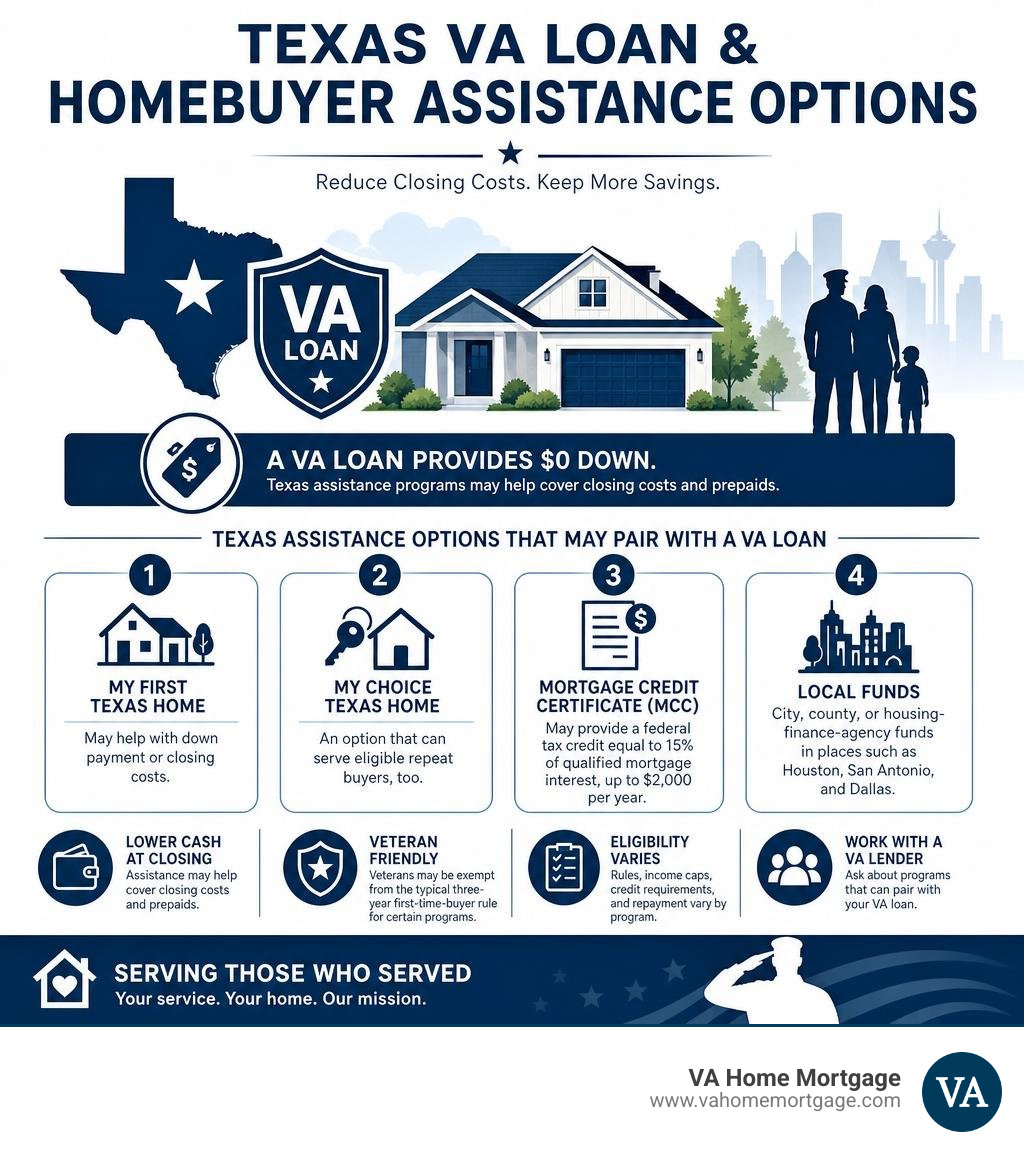
A VA loan can already provide $0 down, but Texas homebuyer assistance may help cover the costs that remain, such as lender fees, title charges, prepaid taxes, and insurance. For a first time home buyer grants Texas VA loan strategy, start by working with a VA lender that participates in Texas Department of Housing and Community Affairs (TDHCA) programs and ask about:
- My First Texas Home, which may pair with a VA loan for down payment or closing-cost assistance.
- My Choice Texas Home, an option that can serve eligible repeat buyers, too.
- A Mortgage Credit Certificate (MCC), which may provide a federal tax credit equal to 15% of qualified mortgage interest, up to $2,000 per year.
- City, county, or housing-finance-agency funds in places such as Houston, San Antonio, and Dallas.
Veterans may be exempt from the usual three-year first-time-buyer rule for certain TDHCA programs. Because a VA loan needs no down payment, approved assistance can often be directed toward closing costs and prepaids, helping reduce cash due at closing. Rules, income caps, credit requirements, and whether assistance must be repaid vary by program, county, and loan structure.
I’m Dale Gremillion, a Senior Loan Officer and Producing Branch Manager with more than 25 years of residential lending experience, including VA purchase, refinance, and complex approval scenarios. In this guide to first time home buyer grants Texas VA loan options, I’ll explain how to check eligibility, coordinate the paperwork, and avoid missing assistance that could lower your upfront cost.
How to Qualify for First Time Home Buyer Grants Texas VA Loan Options
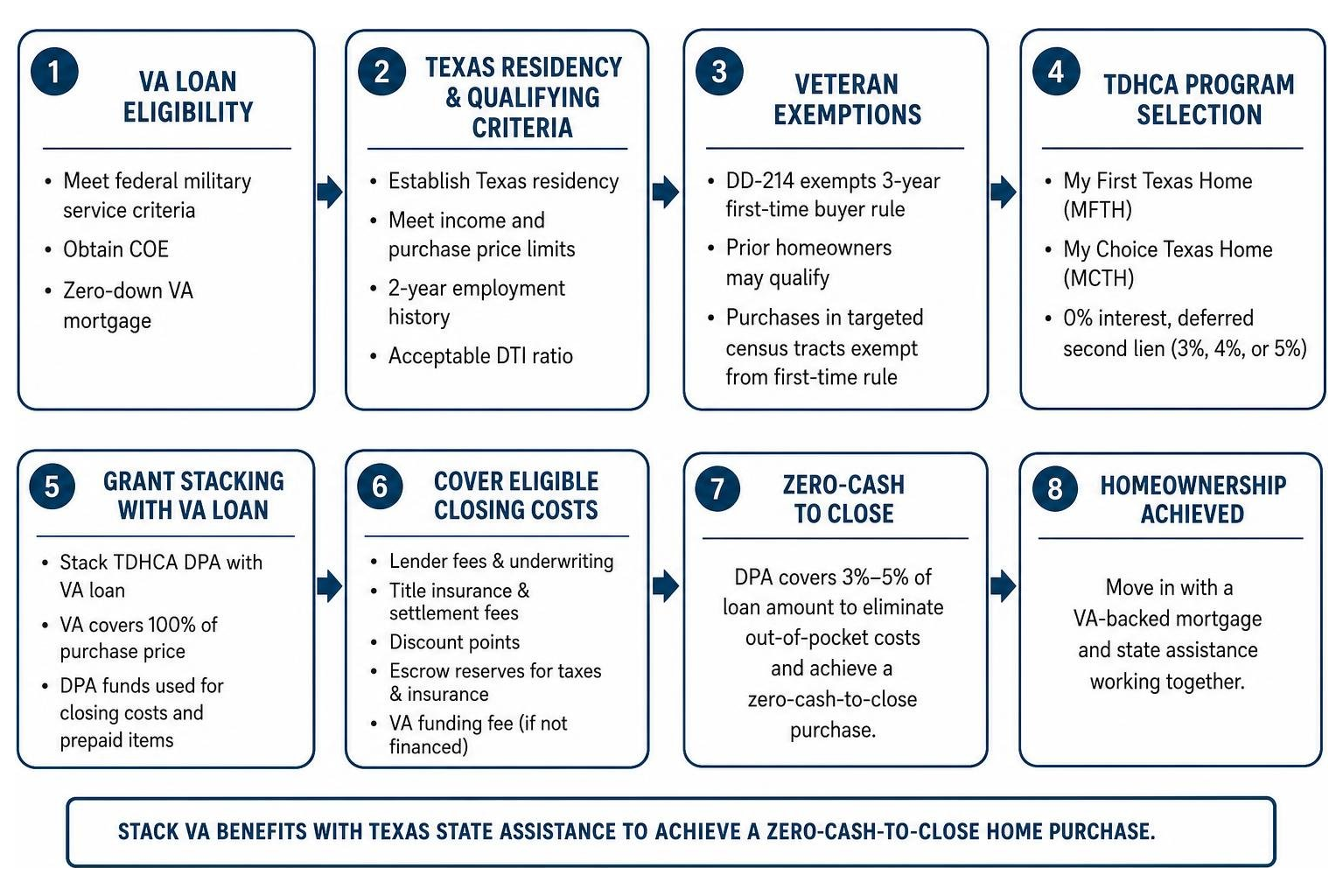
Securing state and local housing assistance alongside military financing requires meeting criteria established by both the U.S. Department of Veterans Affairs and state housing agencies. We begin the pre-approval process by obtaining your VA Certificate of Eligibility (COE), which confirms your entitlement based on active-duty service, National Guard or Reserve duty, or qualifying surviving spouse status.

Beyond federal military criteria, state-administered housing programs impose their own eligibility benchmarks. To qualify for state-level financial backing or discounted financing options—such as a Texas Veterans Home Loan—borrowers must establish bona fide Texas residency. This is typically verified through a valid Texas driver’s license, voter registration, or utility billing statements.
Applicants must also satisfy household income thresholds and purchase price caps, both of which are adjusted by county. Standard underwriting guidelines require a consistent two-year employment history, stable qualifying income, and acceptable debt-to-income (DTI) ratios.
Veteran Exemptions for First Time Home Buyer Grants Texas VA Loan Applicants
Standard state housing agency guidelines define a first-time homebuyer as someone who has not held an ownership interest in a primary residence during the preceding three-year period. However, military service members frequently benefit from statutory exceptions.
Under Texas Department of Housing and Community Affairs (TDHCA) guidelines, honorably discharged military veterans holding an official DD-214 are exempt from the standard three-year waiting rule. This veteran exemption allows prior homeowners transitioning out of service, relocating to Texas bases, or re-entering the housing market to access targeted grant programs without waiting three years.
Furthermore, any homebuyer purchasing a property within designated federal targeted census tracts can bypass the first-time buyer restriction, opening up competitive assistance tiers across growing metropolitan and rural corridors alike.
Covering Closing Costs with State Down Payment Assistance
Because VA financing provides a true zero-down-payment mortgage structure, many buyers wonder how down payment assistance (DPA) applies to their transaction. Rather than reducing the principal balance of an already 100% financed purchase, state DPA funds can be applied directly toward closing costs and mandatory prepaid items.
On Texas’s median home price of approximately $310,000, non-down-payment closing expenses frequently range from 3% to 5% of the total loan balance ($9,300 to $15,500). State assistance steps in to offset these out-of-pocket costs, covering items such as:
- Lender origination fees and underwriting costs
- Title insurance policies, recording fees, and settlement charges
- Discount points purchased to lower long-term note rates
- Initial escrow reserves for county property taxes and homeowners insurance
- VA funding fees that the borrower elects not to finance into the base loan
Applying a 3% to 5% second-lien grant or zero-percent loan eliminates out-of-pocket cash requirements, creating a zero-cash-to-close home purchase.
Top Texas Down Payment Assistance and Tax Credit Programs
Navigating the state housing landscape reveals multiple avenues for grant funding, amortizing down payment loans, and federal tax credits. Exploring customized regional loan solutions in Texas helps military families identify how state and municipal agencies work alongside standard VA loan guidelines.
TDHCA My First Texas Home and My Choice Texas Home
The Texas Department of Housing and Community Affairs manages the primary statewide down payment frameworks:
- My First Texas Home (MFTH): Designed primarily for first-time buyers and exempt veterans, this program pairs a 30-year fixed-rate mortgage with down payment assistance valued at 3%, 4%, or 5% of the loan amount. Assistance is structured as a 0% interest, deferred 30-year second lien that requires no monthly payment until the home is sold, refinanced, or paid in full. Detailed program parameters are outlined in the official TDHCA My First Texas Home matrix.
- My Choice Texas Home (MCTH): This initiative provides similar 3% to 5% assistance tiers but does not enforce first-time homebuyer restrictions, making it an accessible option for repeat military buyers who have utilized their first-time veteran exemption in prior transactions.
Interest rates on the first mortgage adjust based on the percentage of down payment assistance selected. For example, lower assistance levels (such as 2% or 3%) offer lower primary interest rates, whereas higher assistance tiers (5%) trade a slightly higher note rate for maximum upfront cash relief.
Maximizing Savings with the Texas Mortgage Credit Certificate
The Texas Mortgage Credit Certificate (MCC) is an impactful tool for lowering overall housing costs. Unlike a standard tax deduction that simply reduces your taxable income, an MCC provides a direct dollar-for-dollar federal tax credit.
The credit equals 15% of the total mortgage interest paid each calendar year, capped at a maximum annual benefit of $2,000. Because Texas levies no state personal income tax, maximizing federal tax relief is a direct way to expand disposable income.
The remaining 85% of annual mortgage interest can still be claimed as an itemized deduction on federal tax filings. Over a 10-year period, this credit alone can yield up to $20,000 in direct tax savings.
During underwriting, lenders can factor the monthly equivalent of this tax credit (up to $166.66 per month) directly into qualifying income, effectively lowering your qualifying DTI ratio and increasing your total purchasing power. TDHCA also waives the standard MCC issuance fee for eligible military borrowers when paired with qualifying state programs.
Local Grants in Houston, San Antonio, and Dallas
In addition to state-level programs, municipalities throughout Texas offer independent, locally administered grants funded by federal Community Development Block Grants (CDBG) and HOME Investment Partnerships:
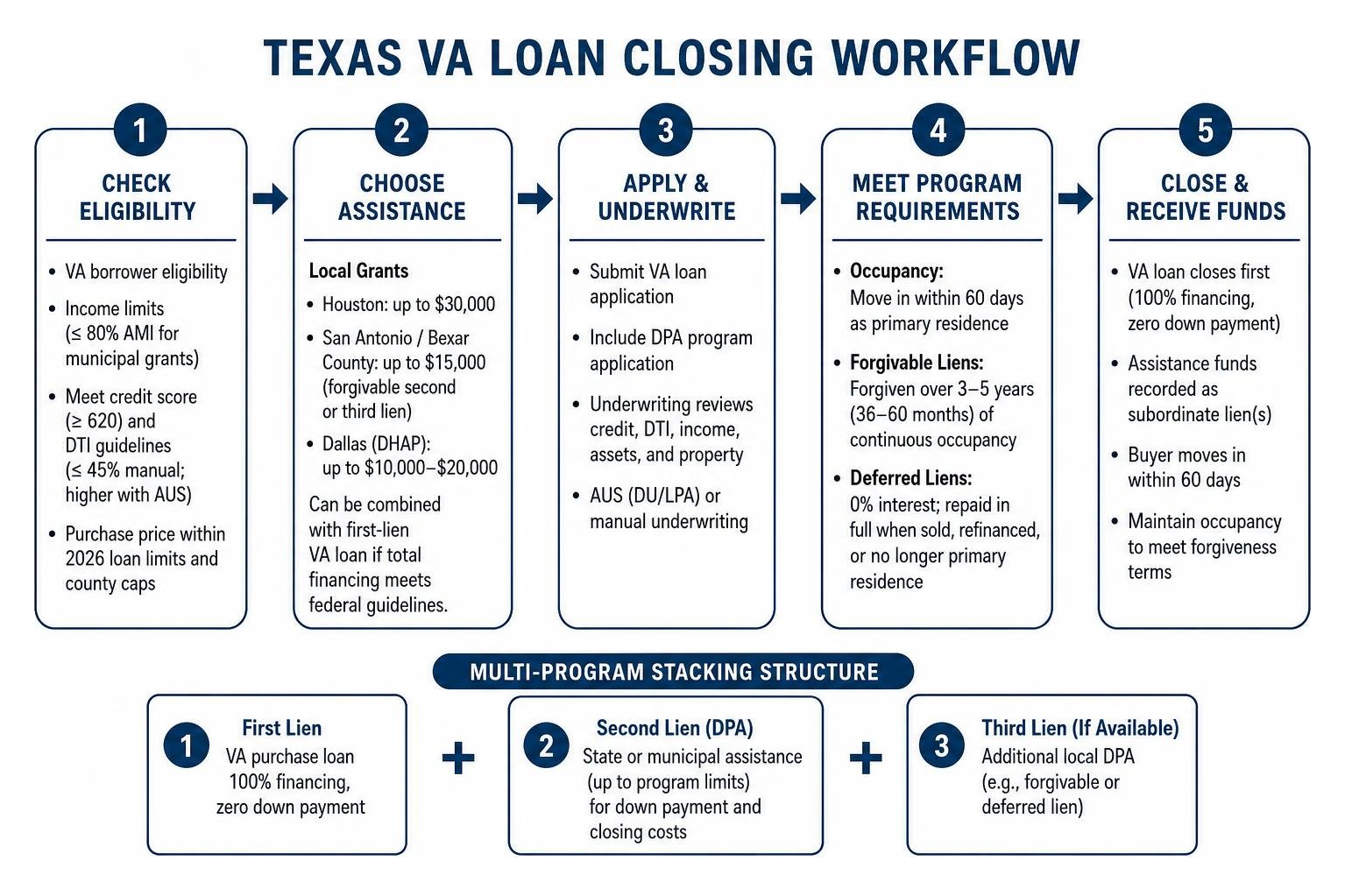
- City of Houston Homebuyer Assistance Program: Offers up to $30,000 in down payment and closing-cost subsidies for income-eligible buyers earning at or below 80% of the Area Median Income (AMI).
- City of San Antonio / Bexar County DPA: Delivers up to $15,000 in assistance structured as forgivable second or third liens, supporting military personnel purchasing near Joint Base San Antonio installations.
- Dallas Homebuyer Assistance Program (DHAP): Provides up to $10,000 to $20,000 in targeted closing subsidies to low- and moderate-income households purchasing within designated city boundaries.
Local municipal grants can often be combined with first-lien VA loans, provided the total combined financing complies with federal secondary market guidelines.
Program Rules, Income Limits, and Repayment Requirements
State down payment assistance programs are subject to clear underwriting standards and compliance rules. For borrowers seeking ground-up construction rather than existing housing, evaluating options such as new build financing with Texas VA One-Time Close Construction Loans provides an alternative zero-down route for custom builds on private land.
Credit Scores, DTI, and Purchase Price Limits
While standard VA guidelines do not impose an arbitrary statutory credit score floor, TDHCA down payment assistance programs enforce established qualification criteria:
- Credit Score Requirements: A minimum middle credit score of 620 is required for most TDHCA and local DPA programs. Higher program tiers and automated underwriting approvals generally favor scores of 660 or above to access optimal interest rates.
- Debt-to-Income (DTI) Thresholds: Program limits generally cap total back-end DTI at 45% for manually underwritten files, though automated approvals through Fannie Mae Desktop Underwriter (DU) or Freddie Mac Loan Product Advisor (LPA) can permit higher ratios when supported by strong compensating factors.
- 2026 Loan Limits and Price Caps: For standard conforming transactions, the one-unit conforming baseline limit is $832,750, with FHA floors at $541,287 and ceilings extending to $1,249,125 in designated high-cost counties. TDHCA county-by-county purchase price caps ensure funds support primary residential purchases rather than luxury real estate.
Occupancy Rules and Forgivable Second Lien Terms
Assistance provided through TDHCA and municipal housing authorities is designed exclusively for owner-occupied properties. Borrowers must agree to the following conditions:
- Primary Residence Rule: The homebuyer must occupy the property as their principal residence within 60 days of loan closing.
- Forgivable Second Lien Terms: Certain second-lien programs forgive the principal balance incrementally over a set period—frequently between 3 and 5 years (36 to 60 months) of continuous owner occupancy. If the homeowner remains in the home through the retention window, the balance is fully discharged.
- Deferred Repayable Liens: Under 0% deferred programs, no interest accrues and no monthly installments are due. However, the full original second-lien balance must be repaid when the home is refinanced, sold, or vacated as a primary residence.
Step-by-Step Application and Stacking Process
Executing a smooth VA purchase involving state assistance requires a clear, step-by-step approach. You can review additional strategies and expert insights on the VA mortgage blog to prepare for each phase of the mortgage transaction.
Multi-Program Stacking for a First Time Home Buyer Grants Texas VA Loan
Program layering—also called grant stacking—combines multiple assistance structures on a single mortgage transaction. An eligible Texas veteran can assemble a high-impact financing structure:
- First Lien: A VA purchase loan securing 100% financing with zero down payment.
- Second Lien Assistance: A TDHCA My First Texas Home 3% to 5% DPA loan to cover upfront closing costs, title fees, and property tax escrows.
- Local Municipal Grant: A city-level grant (such as Houston’s $30,000 or San Antonio’s $15,000 subsidy) to fund discount points or cover required reserves.
- Tax Credit: A Texas Mortgage Credit Certificate to secure up to $2,000 per year in federal tax credits over the life of the loan.
Combining these layers requires advance coordination with an approved lender experienced in multi-agency underwriting submissions.
Navigating the Approval and Closing Timeline
The integration of state grant compliance adds administrative checkpoints that must be factored into your purchase contract timeline:
| Program Component | Primary Benefit | Approval Entity | Estimated Processing Time |
|---|---|---|---|
| VA First Mortgage | 100% financing, $0 down, no monthly PMI | Direct VA Lender Underwriter | 15–30 Days |
| TDHCA DPA (MFTH / MCTH) | 3%–5% assistance for closing expenses | TDHCA Compliance Division | 7–14 Business Days |
| Texas MCC Tax Credit | Up to $2,000 annual federal tax credit | State Housing Authority / IRS | Concurrent with DPA review |
| City / County Grants | $10,000–$30,000 municipal grants | Local Housing Department | 30–45 Days |
- Complete Homebuyer Education: Finish a HUD-approved homeownership course early. Certificates remain valid for 12 to 24 months.
- Secure Combined Pre-Approval: Work with a participating lender to verify household income against TDHCA limits while establishing maximum VA borrowing capacity.
- Property Underwriting and Appraisal: Once under contract, the property undergoes a standard VA appraisal to verify fair market value and VA Minimum Property Requirements (MPRs).
- State Compliance Review: The lender submits the completed compliance file to TDHCA. Most state reviews require 7 to 14 business days.
- Closing and Funding: Loan documents for the primary VA mortgage and secondary grant liens are executed simultaneously at closing, with grant funds disbursed directly to the title company to offset closing costs.
Frequently Asked Questions About Texas VA Loan Grants
Can I get down payment assistance if my VA loan already requires zero down?
Yes. Because VA loans require zero down payment, approved state or local down payment assistance funds are applied directly toward third-party closing costs, lender fees, discount points, and prepaid property taxes and insurance. This structure minimizes the total cash required at closing.
Do Texas veterans have to repay state homebuyer grants?
Repayment depends on the specific program. True municipal grants and forgivable second liens require zero repayment once you satisfy the required owner-occupancy period (typically 3 to 5 years). Programs structured as 0% interest deferred second liens do not require monthly payments, but the original balance must be repaid if the property is sold, refinanced, or transferred.
What credit score is required for Texas VA grant programs?
Most TDHCA-backed assistance programs require a minimum middle credit score of 620. Borrowers with credit scores of 660 and higher generally access more favorable first-mortgage interest rates across tiered assistance programs.
Conclusion

Combining a zero-down VA loan with Texas state and municipal homebuyer grants creates an effective path to homeownership, eliminating large out-of-pocket expenses for qualified military families. By taking advantage of TDHCA down payment assistance, veteran ownership exemptions, local city grants, and the annual $2,000 Texas Mortgage Credit Certificate, you can secure long-term equity with minimal upfront cash.
Capital Home Mortgage provides in-house underwriting and direct VA authority, helping Texas veterans navigate multi-program grant stacking, state compliance, and custom military financing options.
To review your eligibility, structure your grant stacking strategy, or begin a pre-approval, connect with our team for personalized Texas VA loan guidance today.