
Average Closing Costs for a VA Loan: What to Budget
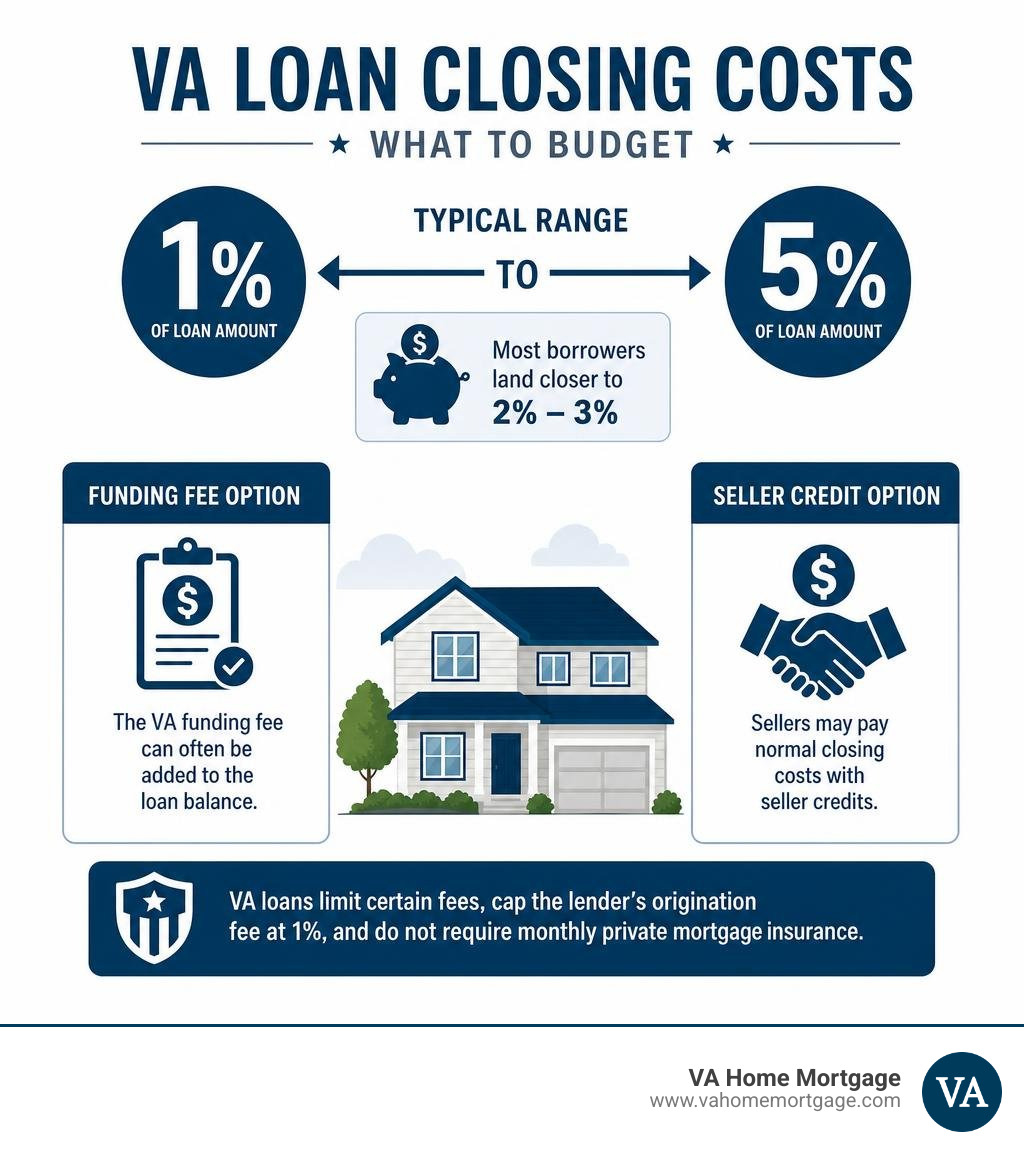
The average closing costs for a VA loan usually fall between 1% and 5% of the loan amount. Most borrowers land closer to 2% to 3%, before seller credits or lender credits. On a $300,000 loan, that can mean roughly $3,000 to $15,000 in total costs.
Your actual cash needed at closing may be far lower because a VA loan requires no down payment, the VA funding fee can often be added to the loan balance, and a seller may pay normal closing costs. To get a useful estimate, review your lender’s Loan Estimate, confirm whether you are exempt from the funding fee, and negotiate credits before signing a purchase contract.
VA loans still have costs such as appraisal, title, recording, prepaid taxes and insurance, and lender fees. But the VA limits some charges, caps the lender’s origination fee at 1%, and does not require monthly private mortgage insurance.
I am Dale Gremillion, a Senior Loan Officer and Producing Branch Manager with more than 25 years in residential lending. I help military buyers understand the average closing costs for a VA loan, identify avoidable fees, and build a clear cash-to-close plan.
Understanding the Average Closing Costs for a VA Loan
When you buy a home with military financing, the promise of $0 down payment is often what gets the most attention. However, “zero down” does not mean “zero cost.” Every mortgage transaction involves settlement expenses to establish the loan, verify the property, and establish your escrow reserves.
According to data compiled by the Consumer Financial Protection Bureau (CFPB), standard mortgage settlement charges average several thousand dollars per transaction. For military buyers entering the housing market in 2026, typical closing figures range from roughly $5,000 to $15,000 on a $350,000 home before factoring in negotiated concessions or lender credits. Understanding how these fees are determined allows you to budget effectively and eliminate surprise charges at the closing table.
What Determines the Average Closing Costs for a VA Loan?
Closing expenses do not come from a single flat-rate chart. Instead, your total out-of-pocket figure is shaped by several distinct components:
- Loan Principal Size: Because origination fees, title insurance premiums, and transfer charges scale directly with the purchase price, higher loan balances result in higher nominal settlement costs.
- Geographic Location and Property Taxes: Local government recording fees, transfer taxes, and county property tax assessment schedules vary significantly.
- Lender Pricing Structure: Origination charges, discount points, and underwriting fees differ from lender to lender.
- Escrow and Prepaid Requirements: Lenders require you to fund an escrow account upfront for homeowner’s hazard insurance, flood insurance (if required), and property taxes.
- Title and Settlement Services: Closing attorney fees, title search, lender’s title insurance, and settlement fees are set by third-party providers.
Understanding VA Loan Closing Expenses and Savings
The most significant financial advantage of a VA-backed mortgage is the absence of monthly Private Mortgage Insurance (PMI). Conventional buyers putting down less than 20% must pay monthly mortgage insurance, which can add $150 to $300+ to their housing payment every month. With a VA loan, this recurring fee is replaced by a one-time VA funding fee that can be financed directly into the mortgage balance.
To see how these elements compare across different loan balances, consider the standard baseline metrics:
| Loan Amount | Estimated Closing Costs (2%–3%) | 1st-Time Funding Fee (2.15%, 0% Down) | Monthly PMI Required |
|---|---|---|---|
| $250,000 | $5,000 – $7,500 | $5,375 (Can be financed) | $0 |
| $350,000 | $7,000 – $10,500 | $7,525 (Can be financed) | $0 |
| $450,000 | $9,000 – $13,500 | $9,675 (Can be financed) | $0 |
| $600,000 | $12,000 – $18,000 | $12,900 (Can be financed) | $0 |
If you currently hold a loan and want to evaluate how changing market rates affect your equity, The Complete Guide to VA Refinance Eligibility provides an in-depth review of your qualification options.
Itemized Breakdown of Standard VA Loan Closing Fees
VA loan closing costs are grouped into distinct categories on your Loan Estimate and Closing Disclosure:
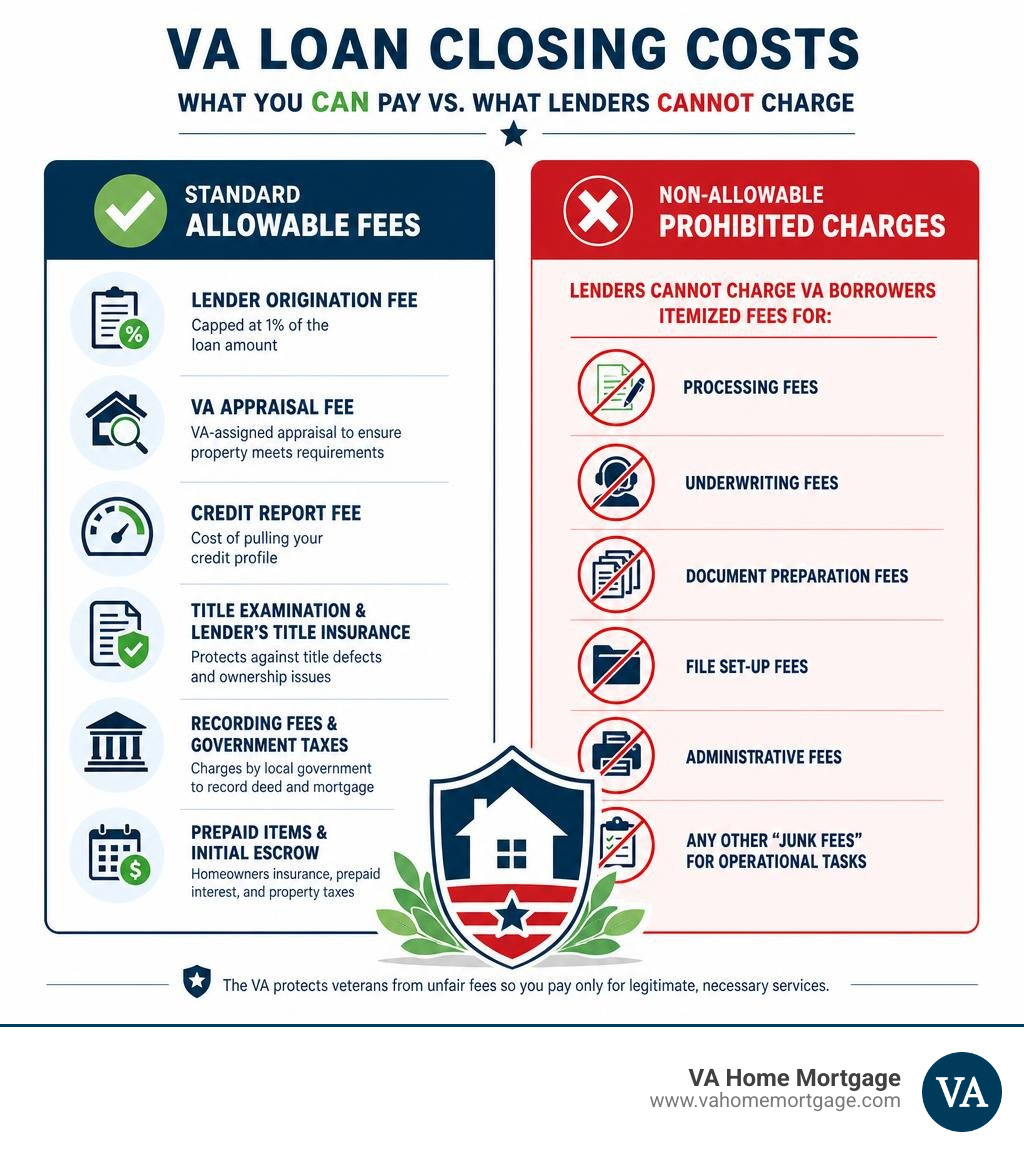
- Lender Origination Fee (Capped at 1%): The VA strictly regulates how much lenders can charge. A lender may charge a flat 1% origination fee to cover all overhead, processing, and administrative expenses, or itemize reasonable fees as long as the total does not exceed 1% of the loan amount.
- VA Appraisal Fee: Conducted by an independent, VA-assigned appraiser to ensure the property meets the Department of Veterans Affairs Minimum Property Requirements (MPRs) and reflects fair market value.
- Credit Report Fee: The actual cost of pulling your multi-bureau credit profile.
- Title Examination and Lender’s Title Insurance: Protects the lender against unrecorded liens, ownership disputes, or title defects.
- Recording Fees and Government Transfer Taxes: Charges levied by your local city or county clerk to officially record the new deed and mortgage.
- Prepaid Items and Initial Escrow: Advance collection of 12 months of homeowners insurance, prepaid daily mortgage interest from the date of closing to the end of the month, and a buffer for property taxes.
Non-Allowable Fees That Lenders Cannot Charge Veterans
The Department of Veterans Affairs protects military borrowers through strict “non-allowable” fee guidelines. If a lender charges a 1% origination fee, they are prohibited from charging you additional itemized “junk” fees for operational tasks.
Lenders cannot charge VA buyers itemized fees for:
- Document preparation or attorney fees charged directly by the lender
- Loan application or processing fees
- Underwriting or administrative review fees
- Escrow management charges or settlement closing fees (beyond reasonable title company fees)
- Mortgage broker fees or rate-lock fees
- Postage, courier, or notary charges
If an itemized non-allowable fee appears on your Closing Disclosure alongside an origination fee, the lender must either remove the fee, absorb it as an administrative cost, or credit the charge back to you prior to closing.
How to Calculate the VA Funding Fee and Exemption Rules
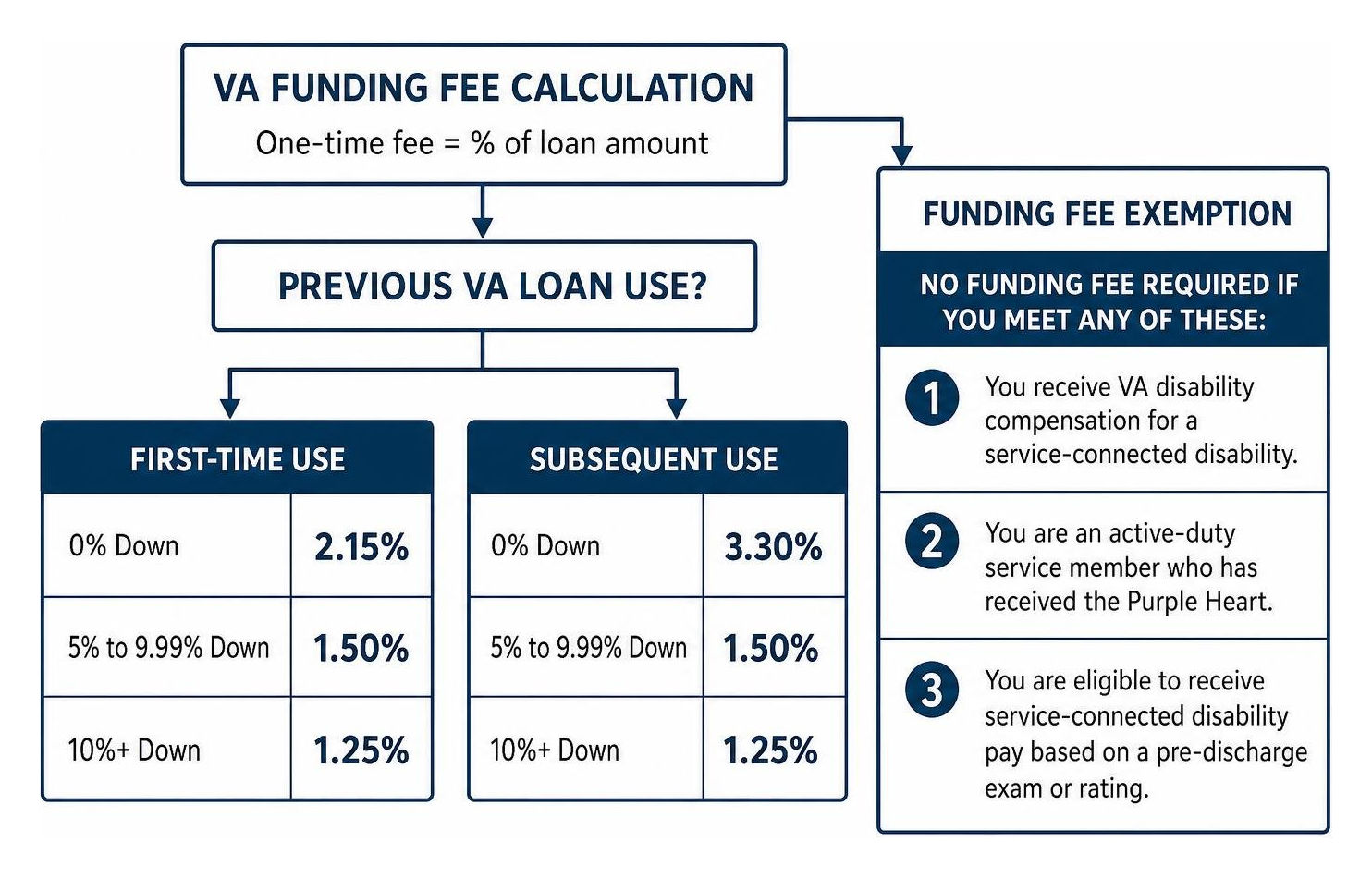
The VA funding fee is a one-time government charge mandated by federal law to support the loan guaranty program without requiring taxpayer subsidies. The fee percentage varies based on whether you have used your VA home loan entitlement previously and your down payment amount:
- First-Time Use (0% Down): 2.15% of the loan amount
- First-Time Use (5% to 9.99% Down): 1.50% of the loan amount
- First-Time Use (10%+ Down): 1.25% of the loan amount
- Subsequent Use (0% Down): 3.30% of the loan amount
- Subsequent Use (5% to 9.99% Down): 1.50% of the loan amount
- Subsequent Use (10%+ Down): 1.25% of the loan amount
Who Is Exempt from the Funding Fee?
You do not have to pay the VA funding fee if you meet any of the following criteria:
- You receive VA disability compensation for a service-connected disability.
- You are an active-duty service member who has received the Purple Heart.
- You are eligible to receive service-connected disability pay based on a pre-discharge exam or rating.
- You are a surviving spouse receiving Dependency and Indemnity Compensation (DIC).
Borrowers who have a pending disability claim at the time of closing can apply for a retroactive funding fee refund once the VA finalizes their service-connected rating.
Strategic Ways to Minimize Out-of-Pocket Cash at Closing

Veterans do not necessarily have to bring thousands of dollars to the closing table. By using established mortgage strategies, you can reduce or eliminate out-of-pocket cash needs.
1. Close Near the End of the Month
Mortgage interest is paid in arrears, but you must prepay per-diem interest from your funding date through the final day of your closing month.
- Closing on October 3rd requires you to prepay roughly 28 days of interest.
- Closing on October 29th requires you to prepay only 2 or 3 days of interest.
This single scheduling decision can reduce your upfront cash requirement by $500 to $2,000 depending on your loan size and interest rate. To stay updated on how interest calculations affect your loan balance, explore Understanding Current 30-Year VA Mortgage Rates Today.
2. Utilize Lender Credits
You can negotiate a lender credit to offset third-party settlement costs in exchange for accepting a slightly higher interest rate (for example, taking a rate 0.25% higher to receive a $3,000 credit toward title and escrow fees).
Leveraging the 4% Seller Concession Rule and Normal Closing Costs
One of the most powerful tools in a VA loan purchase is the seller’s ability to pay your settlement expenses. VA guidelines separate seller payments into two distinct categories:
- Standard/Normal Closing Costs (No VA Cap): The seller can pay 100% of standard closing costs, including title fees, recording taxes, appraisal, origination charges, and initial prepaid escrow reserves. There is no percentage limit on normal settlement fees.
- Seller Concessions (4% Maximum Cap): The VA allows the seller to contribute up to 4% of the reasonable value of the property toward extra items that provide a direct financial advantage to the buyer.
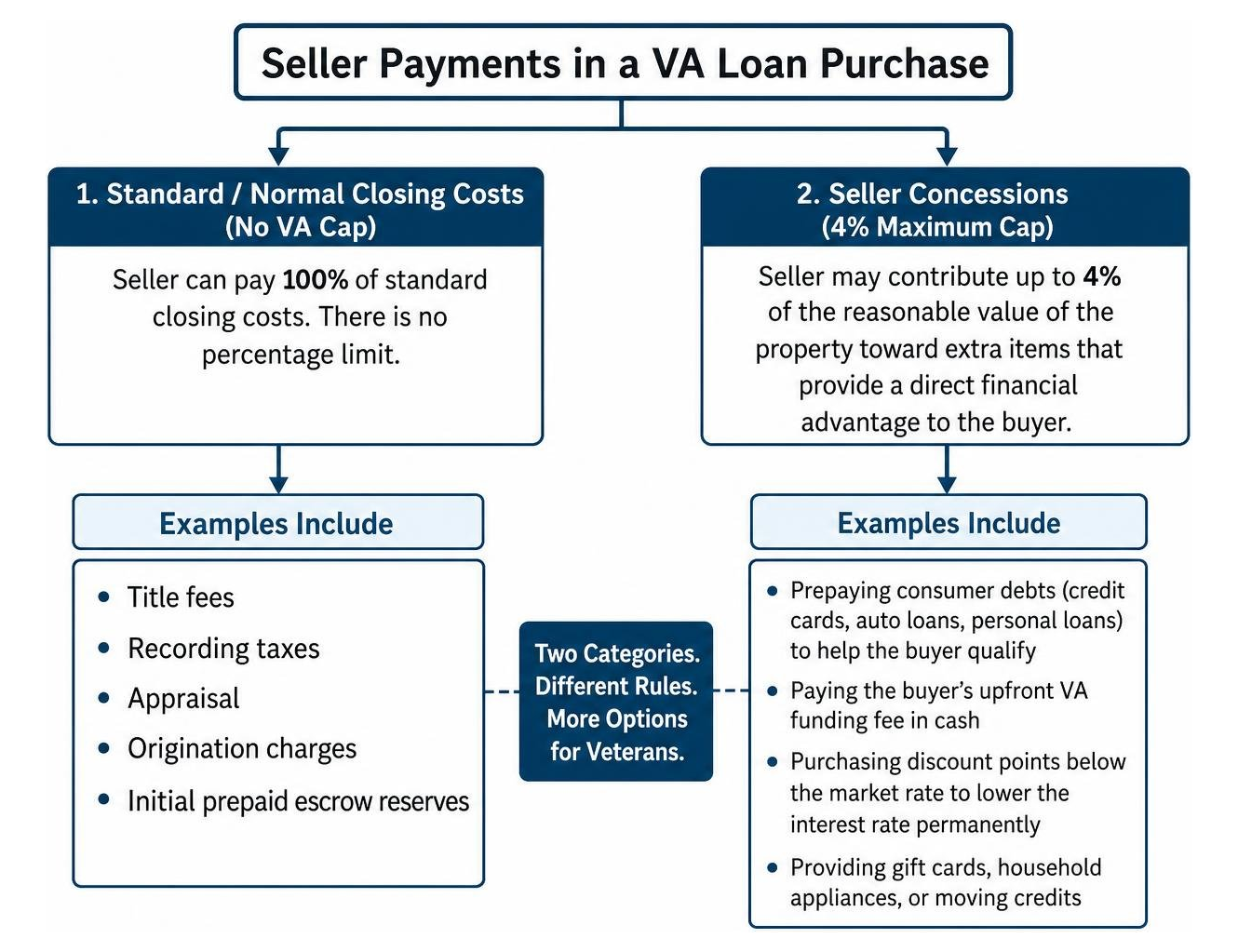
Items governed by the 4% seller concession limit include:
- Prepaying consumer debts (credit cards, auto loans, or personal loans) to help the buyer qualify
- Paying the buyer’s upfront VA funding fee in cash
- Purchasing discount points below the market rate to lower the interest rate permanently
- Providing gift cards, household appliances, or moving credits
For instance, on a $400,000 purchase, a seller could pay $9,000 in normal settlement charges and escrow reserves, plus up to $16,000 (4%) in additional concessions like paying off an existing auto loan balance or buying down interest rate points.
Shopping for Third-Party Settlement Providers and Lenders
Under federal RESPA rules, you have the legal right to shop for specific third-party services listed on Page 2, Section C of your Loan Estimate. This includes:
- Title search and examination companies
- Settlement and closing escrow agents
- Land survey providers
- Pest and termite inspection firms
Securing quotes from two or three title providers can lower your title insurance and settlement fees by several hundred dollars. Additionally, staying informed about your transaction milestones with Everything to Expect From Your VA Loan Closing Timeline ensures that third-party services are ordered without costly delays. To evaluate lenders that adhere strictly to VA guidelines, read Top VA Mortgage Lenders: Find the Best for You.
Real-World Case Scenarios for VA Loan Closing Costs

Seeing how settlement charges apply in practice helps clarify what you will actually owe at the closing table. Working alongside knowledgeable professionals is essential, which is Why Every Military Buyer Needs an Experienced Veteran Loan Specialist during negotiations.
Scenario 1: First-Time Active-Duty Buyer on a $300,000 Purchase
- Loan Amount: $300,000 (0% Down Payment)
- VA Funding Fee (2.15%): $6,450 (Financed into total loan balance of $306,450)
- Lender Origination (1%): $3,000
- Appraisal, Credit, and Third-Party Title Fees: $2,400
- Prepaids (Taxes, Homeowners Insurance, 5 days interest): $2,600
- Gross Settlement Costs: $8,000 (excluding funding fee)
- Negotiated Seller Contribution: $6,000
- Earnest Money Deposit Credited: $1,500
- Total Out-of-Pocket Cash at Closing: $500
Scenario 2: Disabled Veteran Purchasing a $450,000 Home
- Loan Amount: $450,000 (0% Down Payment)
- VA Funding Fee: $0 (100% Service-Connected Disability Exemption)
- Lender Origination: $0 (Lender credit package selected)
- Third-Party Title, Appraisal, and Recording Fees: $3,100
- Prepaids & Escrow Reserves (End-of-month closing): $3,400
- Total Settlement Charges: $6,500
- Lender Credit for Rate Selection: -$2,500
- Negotiated Seller Credit: -$4,000
- Total Out-of-Pocket Cash at Closing: $0 (Plus full refund of $1,000 earnest money deposit)
Frequently Asked Questions About VA Loan Closing Costs
Can a seller pay all of my average closing costs for a VA loan?
Yes. A seller can pay all customary and reasonable settlement expenses (such as title charges, escrow prepaids, appraisal, and origination) without any percentage limit. Additional concessions—such as paying down consumer debt or paying the funding fee in cash—are subject to the 4% concession limit.
Can I finance my closing costs on a VA purchase loan?
On a standard home purchase, you can only finance the VA funding fee into your loan balance. Other closing fees (title, appraisal, origination, escrow reserves) must be paid in cash at settlement, covered by seller concessions, or offset through lender credits.
Financing all closing costs into the loan balance is generally only allowed on refinance transactions. If you already own your home and are looking to adjust terms, see The Ultimate Guide to VA Home Mortgage Refinancing for cash-out and IRRRL financing structures.
How much cash do I actually need on closing day?
The actual cash you must bring on closing day depends on your purchase contract terms. If your seller covers closing costs and you finance the funding fee, your out-of-pocket cash at closing can be $0, and your earnest money deposit will be refunded to you.
If no seller credits are negotiated, you will typically need 2% to 3% of the purchase price in liquid reserves. To prepare your finances effectively, follow How to Start Your VA Home Loan Application in 7 Days.
Conclusion
Understanding the structure of VA loan closing costs ensures that you maximize the benefits of your earned military service. By combining zero-down financing with strategic seller concessions, funding fee exemptions, and month-end closing schedules, you can complete your home purchase with minimal out-of-pocket expenses.
Capital Home Mortgage provides direct in-house underwriting, full VA lending authority, and dedicated support for active-duty personnel, veterans, and military families. When you are ready to explore your financing options, apply for your zero-down military mortgage pre-approval today and take the next step toward homeownership with confidence.


