Can You Buy Vacant Land With a VA Loan?
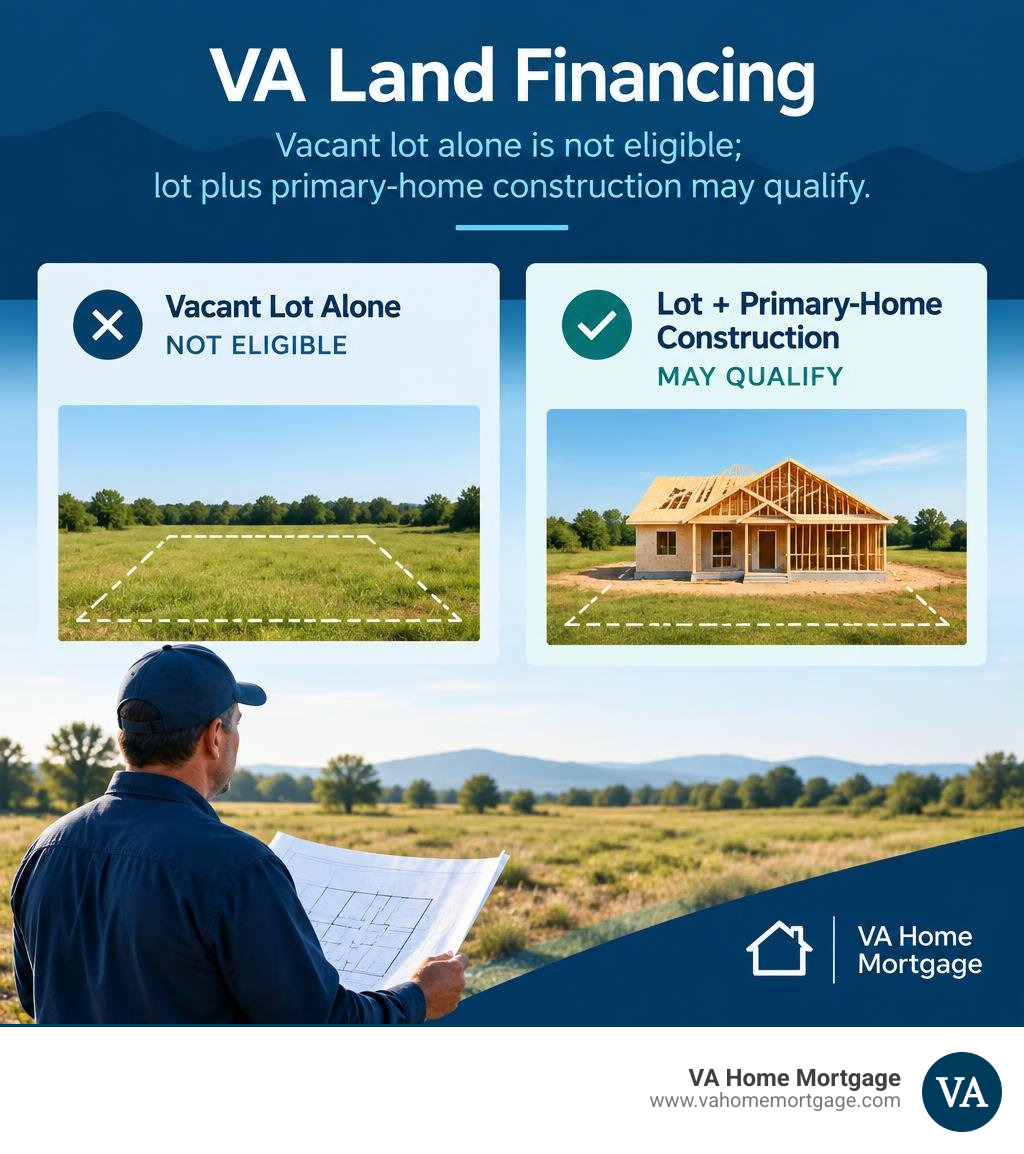
A VA loan cannot pay for vacant land by itself. If you are ready to build a home you will live in, a VA construction loan may let you finance the lot and the build together. Start by getting your Certificate of Eligibility and asking lenders whether they offer VA construction loans; not every VA lender does.
If you want to buy land now and build later, you will need another way to pay for the lot. A land loan, seller financing, or cash may be an option. You can explore VA financing for the home when you are ready to build.
I’m Dale Gremillion, a senior loan officer with more than 25 years of experience helping borrowers work through VA purchases and complex financing choices. Below, I’ll explain when a VA loan for vacant land is possible as part of a home build, and what to consider if you are not ready to build yet.
Simple VA loan for vacant land glossary:
- VA streamline refinance rates
- va mortgage near me
- va mortgage rates near me
The Reality of Using a VA Loan for Vacant Land in 2026
Purchasing raw dirt with the backing of your military benefits sounds like the ultimate dream. Many veterans imagine finding a quiet five-acre parcel, securing a government-backed mortgage with zero down payment, and holding the property until the timing feels right to build.
However, the Department of Veterans Affairs sets specific boundaries on how your hard-earned entitlement can be deployed. Understanding how the program evaluates raw real estate will save you months of planning delays.
Understanding VA Guidelines: Why a Pure VA Loan for Vacant Land Does Not Exist
The VA home loan program was created by Congress to ensure service members and veterans have access to safe, sanitary, and structurally sound housing. Because the mandate is rooted in personal shelter, the VA guarantees loans exclusively for primary residential dwellings.
A standalone parcel of raw land provides no shelter. As a result, there is no standalone VA loan for vacant land. The VA will not guarantee a mortgage on:
- Raw acreage or unimproved parcels without an active construction contract.
- Recreational tracts intended for hunting, camping, or seasonal getaways.
- Speculative land investments intended for future resale or subdivision development.
- Commercial or agricultural acreage without a residential build plan.
Veterans looking at property listings often encounter standard land financing advertisements, but those are private commercial or conventional instruments, not VA loans. If you want to use your VA entitlement to acquire ground, the land purchase must be directly attached to an immediate home build. For broader context on how military benefits translate to different property purchases, check the Can You Buy Land with a VA Loan? What Veterans Need to Know in 2026 – Land Landmodo Blogs – Landmodo guide.
VA One-Time Close Construction Loans: Combining Land and Build
While you cannot buy a vacant lot alone, you can finance both the lot and the construction of your primary home simultaneously using a VA One-Time Close (OTC) Construction Loan.
Under this single-closing framework, the lender finances the acquisition of the parcel (or pays off an existing lot balance) while establishing an escrow draw schedule to construct the home. You sign closing paperwork once before ground is broken, eliminating the risk, expense, and stress of securing a separate construction loan followed by a permanent mortgage refinance later.
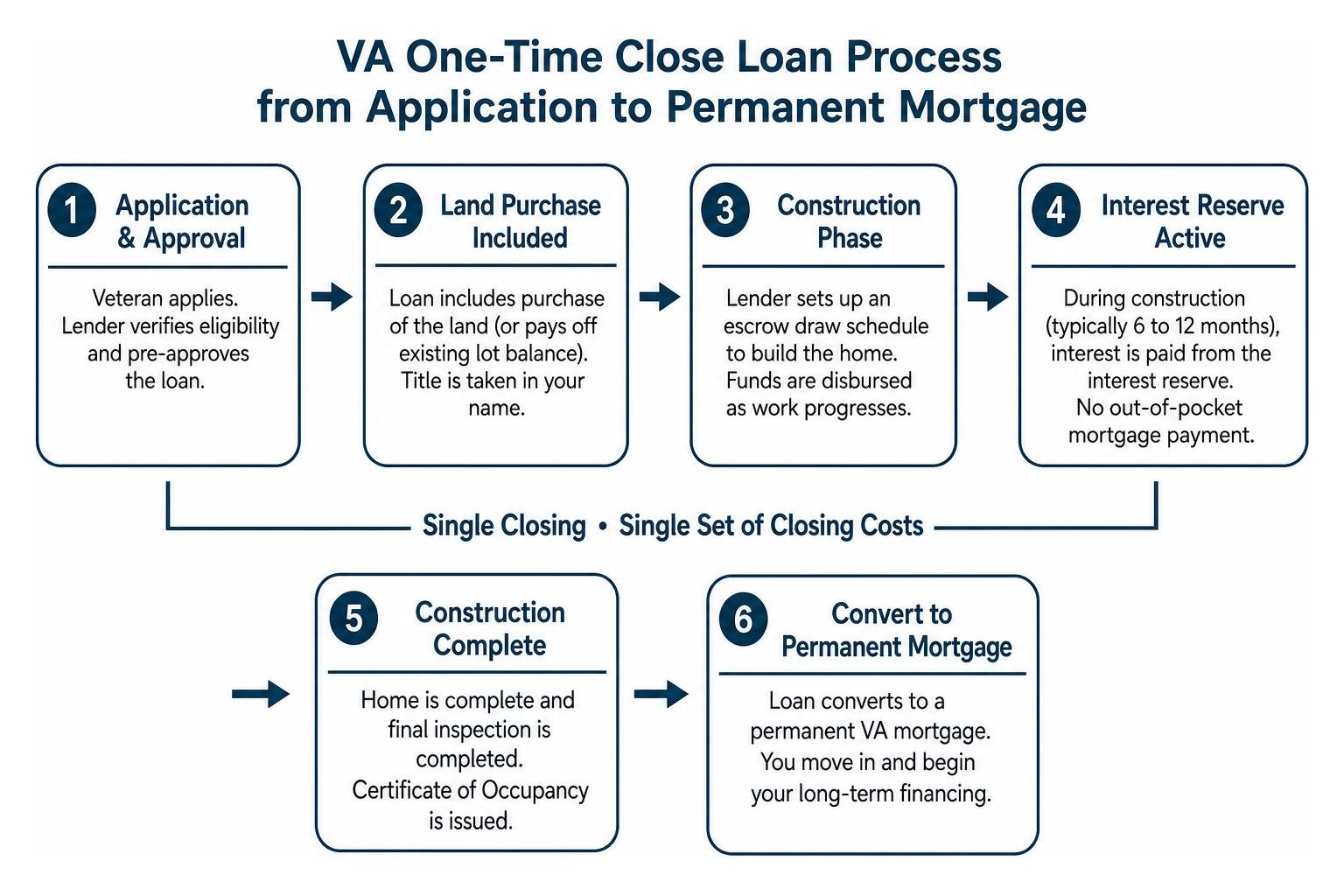
Here is why the one-time close construction structure is advantageous:
- Zero Down Payment Potential: Eligible veterans with full entitlement can finance 100% of the combined land purchase and construction costs, subject to the property’s finished appraised value.
- Single Set of Closing Costs: Because there is only one closing, you do not pay two rounds of lender fees, title policies, recording charges, or settlement fees.
- Interest Reserve Included: During the active building phase (typically 6 to 12 months), interest charges are rolled into an interest reserve account built into the loan, meaning you often have no out-of-pocket mortgage payment until the home is move-in ready.
- Immediate Rate Lock: Your long-term permanent interest rate is locked prior to the start of construction, shielding you from market fluctuations while your home is built.
Because construction lending involves extensive risk assessments and builder verifications, you need an experienced lender. We recommend following our step-by-step guide to finding a qualified VA loan officer to connect with a professional who actively closes OTC loans.
Property Eligibility and Land Buildability Standards
The VA will not approve financing on any arbitrary piece of dirt. The land you select must satisfy strict Minimum Property Requirements (MPRs) to ensure the completed home will be marketable, accessible, and safe.
Before entering into a land purchase contract tied to a VA construction loan, verify the following standards:
- Legal and Usable Access: The parcel must have permanent, continuous access via an improved public street or a dedicated private road governed by a legally binding maintenance agreement. Landlocked tracts do not qualify.
- Utility Availability: The building site must have immediate or planned access to potable water and safe electrical power. If connecting to municipal water and sewer is impossible, the lot must pass a professional soil percolation (perc) test to support a private septic system and water well.
- Zoning and Encroachments: The parcel must be zoned residential or agricultural-residential. It cannot be situated in an uninsurable flood zone, a designated coastal barrier zone, or within active runway clear zones.
- Manufactured Housing Affixation: If you are using an OTC loan to place a brand-new manufactured or modular home on the parcel, the unit must meet federal HUD construction safety standards and be permanently affixed to a continuous poured-concrete or engineered masonry foundation classified as real property.
Qualifying and Applying for Land and Build VA Financing
Securing a construction loan involves more documentation than purchasing an existing turn-key house. Underwriters must evaluate your personal creditworthiness, the financial viability of the general contractor, and the architectural feasibility of the blueprints.

Eligibility Criteria, Credit Benchmarks, and Builder Approval
To move forward with a VA construction-to-permanent loan, three distinct pillars must align: your military service entitlement, your financial profile, and your builder’s credentials.
- Certificate of Eligibility (COE): You must possess an active COE demonstrating qualifying service in the Army, Navy, Air Force, Marine Corps, Coast Guard, Space Force, Reserves, or National Guard. Surviving spouses of service members who died on active duty or from a service-connected disability are also eligible.
- Credit Score Thresholds: While the Department of Veterans Affairs does not establish an official minimum credit score, most lenders setting up construction loans look for a middle FICO score of 620 to 640. This threshold accommodates the added complexity of construction project administration.
- Debt-to-Income (DTI) and Residual Income: Lenders evaluate your monthly gross income against proposed housing payments and recurring debts. Beyond standard DTI ratios (often capped around 41–45%), you must meet the VA’s regional residual income requirements to ensure ample cash remains for daily living expenses.
- Builder Registration: You cannot act as your own general contractor (owner-builder) on a VA construction loan. You must hire an independent, licensed, and insured general contractor who is registered with the VA and holds an active VA Builder ID number (or is willing to complete the registration process).
If you are just getting organized, review our breakdown on how to start your VA home loan application in 7 days to gather the appropriate financial records, tax returns, and military forms.
What Happens During Construction Delays, Cost Overruns, and Milestones
Unlike standard purchase loans where funds are disbursed in full on the day of closing, construction funds are held in an escrow account and released in increments known as “draws.”
Each draw corresponds to completed construction phases verified by an independent VA inspector. This structure protects the veteran and lender from paying for incomplete work.
| Construction Phase | Milestones Verified by VA Inspector | Fund Release Purpose |
|---|---|---|
| Site Prep & Foundation | Excavation, footing pour, plumbing rough-in, slab completion | Pays lot site work and foundation sub-contractors |
| Framing & Enclosure | Wall framing, roof trusses, exterior sheathing, windows/doors | Covers framing labor, lumber packages, and dried-in shell |
| Mechanical Systems | HVAC ductwork, electrical wiring, interior plumbing lines | Disburses mechanical trade draws upon rough-in sign-off |
| Interior Finishes | Drywall, cabinetry, flooring, interior trim, paint | Pays finish carpenters, drywallers, and fixture suppliers |
| Final Completion | Final mechanical trim, appliances, Certificate of Occupancy | Releases remaining balance and builder contingency reserve |
Unforeseen weather conditions, supply chain bottlenecks, or municipal permitting delays can arise during custom builds. To shield veterans from cost overruns:
- Contingency Reserves: Most VA construction loans include a built-in 5% to 10% contingency reserve fund within the total financed amount to absorb unexpected price increases in building materials.
- Fixed-Price Contracts: VA guidelines generally require a “fixed-price” or “guaranteed maximum price” contract between the veteran and builder, preventing the contractor from passing arbitrary cost increases to the homebuyer.
- Builder’s Risk Insurance: The contractor must carry active builder’s risk and general liability insurance throughout the duration of construction until final occupancy is granted.
Strategic Alternatives When You Cannot Build Immediately
What if you find an incredible deal on a rural parcel today, but you are two years away from military retirement or not yet ready to finalize blueprints?
Planning When You Cannot Build Immediately
Because a VA loan cannot be used to simply hold raw land, you must look at non-VA initial financing structures, followed by a permanent VA takeout loan later.
- Short-Term Conventional Land Loans: Local community banks and agricultural credit unions offer lot loans. These typically require 20% to 50% down payments with shorter amortization schedules (5 to 15 years) and slightly higher interest rates than home mortgages.
- Owner/Seller Financing: In rural markets, sellers may agree to finance the purchase directly. You make monthly payments to the seller under a promissory note and deed of trust, bypassing institutional underwriting while securing the land.
- Cash Purchase: Buying an inexpensive unimproved parcel with personal savings secures the property immediately with zero financing costs.
Once you are ready to construct your home, you can roll your existing land into a VA construction loan. For deep dives into how loan structures work when transitioning property debt into long-term military mortgages, explore our dedicated VA Home Mortgage category or read the ultimate guide to VA home mortgage refinancing.
Frequently Asked Questions About Land and Construction Loans
Can I buy raw land with a VA loan to hold as an investment?
No. The VA home loan program is designed strictly to finance owner-occupied primary residences. Speculative real estate investments, commercial properties, and raw land held for appreciation are completely ineligible for VA loan guarantees. You must intend to occupy the newly constructed home as your personal residence within 60 days of project completion.
Can I put a manufactured home on vacant land using a VA loan?
Yes. You can use a VA One-Time Close loan to purchase a vacant parcel and install a brand-new manufactured home. The manufactured unit must be built according to Federal Manufactured Home Construction and Safety Standards (HUD Code), transport tags must remain intact until installation, and the unit must be permanently affixed to a foundation engineered to meet VA guidelines.
How does equity work if I already own the lot before building?
If you already own the land, you do not need to buy it again. Instead, your lender orders an appraisal that determines the future value of the land combined with the proposed home.
If you own the land free and clear, the full appraised value of that lot can count as your equity contribution, helping satisfy loan-to-value benchmarks. If you still have a balance on a conventional land loan or seller note, the VA construction loan will pay off that existing lien at closing and roll the balance into your new mortgage.
Conclusion
Navigating land acquisition as a military service member or veteran requires the right financing sequence. While the VA does not provide standalone loans for raw lots, the VA One-Time Close Construction Loan offers a path to finance land and custom home builds together with zero down payment, competitive rates, and no private mortgage insurance.
At Capital Home Mortgage, we are a direct VA mortgage lender with in-house underwriting and VA direct authority. Our team specializes in helping service members maximize their earned entitlement without the bureaucratic runaround. If you are ready to review your entitlement, analyze building plans, or structure your custom home build, start your application with Capital Home Mortgage today.