
Military Service Requirements for VA Loan Eligibility
To qualify for a VA home loan, you must meet minimum service requirements: at least 90 continuous days of active duty for current service members, 24 continuous months for post-1990 Veterans (or 90 days if discharged for a qualifying reason), or 6 creditable years in the National Guard or Reserves, along with an honorable discharge and lender credit/occupancy standards. Military service forms the bedrock of the VA home loan benefit. The Department of Veterans Affairs sets specific service thresholds depending on whether you served during wartime or peacetime, and whether you served on active duty, in the Selected Reserve, or with the National Guard.
Nearly 90% of VA-backed loans are closed without a down payment, making this benefit one of the most rewarding tools available to those who have worn the uniform. Reviewing the official guidelines on eligibility for VA home loan programs is the first step toward confirming that your service duration meets current federal standards.
The table below breaks down the minimum active duty and service duration thresholds across different eras:
| Era / Service Category | Time Period | Minimum Service Required |
|---|---|---|
| World War II | Sep 16, 1940 – Jul 25, 1947 | 90 total days active duty |
| Post-WWII Peacetime | Jul 26, 1947 – Jun 26, 1950 | 181 continuous days active duty |
| Korean War | Jun 27, 1950 – Jan 31, 1955 | 90 total days active duty |
| Post-Korean Peacetime | Feb 1, 1955 – Aug 4, 1964 | 181 continuous days active duty |
| Vietnam War | Aug 5, 1964 – May 7, 1975 | 90 total days active duty |
| Post-Vietnam Peacetime | May 8, 1975 – Aug 1, 1990 | 181 continuous days active duty |
| Gulf War / Current Era | Aug 2, 1990 – Present | 24 continuous months or 90 days active duty |
| Active Duty (Current) | Current Service | 90 continuous days |
| National Guard / Reserve | Any Era | 6 creditable years or 90 days non-training Title 10/32 |
Active Duty and Veteran Service Eras
For current active-duty service personnel, establishing eligibility is straightforward: completing at least 90 continuous days of service meets the VA threshold.
For Veterans who served in the post-1990 Gulf War era through to the present day, the VA generally requires 24 continuous months of active duty or the full period for which you were called or ordered to active duty (at least 90 days). For peacetime service prior to 1990, the standard is 181 continuous days of active service. Wartime eras such as World War II, Korea, and Vietnam require a minimum of 90 total days of active duty.
An honorable discharge or a separation under conditions other than dishonorable is necessary to claim your benefits. The primary document verifying this history is your DD Form 214 (specifically Member-4 or Service-2 copy), which documents your dates of entry and separation, total active service, and character of discharge.
National Guard and Reserve Service Guidelines
Members of the Selected Reserve and National Guard earn their VA home loan eligibility through two primary avenues:
- Six Creditable Years: Completing six years of honorable service in the Selected Reserve or National Guard, characterized by attending scheduled weekend drills and annual training periods.
- Active-Duty Deployment: Serving at least 90 days of non-training active duty under Title 10 federal orders, or qualifying Title 32 activations (such as full-time National Guard duty or federally funded disaster responses).
Documentation requirements differ slightly for Guard and Reserve members. National Guard personnel typically require NGB Form 22 (Report of Separation and Record of Service) or NGB Form 23 (Retirement Points Accounting Statement), alongside official discharge orders. Reservists usually provide an annual retirement points summary and proof of honorable discharge or ongoing honorable service.
Qualifying Service Exceptions and Discharge Discrepancies
If you served less than the standard minimum service duration, you may still qualify under specific statutory exceptions. The VA waives the minimum duration rules if you were discharged due to:
- A service-connected disability
- Hardship
- An early out authority (discharged early under 10 U.S.C. 1171)
- A reduction in force (RIF) or government convenience
- Certain medical conditions that existed before service (EPTS) or non-disabling conditions that interfered with your duties
If your discharge is characterized as Other Than Honorable (OTH) or Bad Conduct, you are not automatically locked out of the program forever. You can request a Character of Discharge review directly through the VA, or apply for a discharge upgrade through your military branch’s Board for Correction of Military Records (BCMR). If the VA determines your service was “other than dishonorable” for VA purposes, your loan eligibility can be granted.
Qualifying Spouses and Other Eligible Beneficiaries
VA home loan benefits extend beyond standard branch personnel to include several specialized groups and surviving family members. Eligible non-traditional beneficiaries include:
- Commissioned officers of the Public Health Service (PHS)
- Active officers of the National Oceanic and Atmospheric Administration (NOAA)
- Cadets at the U.S. Military, Air Force, or Coast Guard Academies, and Midshipmen at the U.S. Naval Academy
Understanding VA Loan Eligibility for Surviving Spouses
Surviving spouses of Veterans may access the VA loan benefit without paying any down payment or monthly mortgage insurance premiums. In addition, qualifying surviving spouses are completely exempt from paying the VA funding fee.
According to established VA buyer guidelines for eligibility, surviving spouses can qualify under several circumstances:
- You are the unremarried spouse of a Veteran who died in service or from a service-connected disability.
- You are the spouse of a service member listed as Missing in Action (MIA) or a Prisoner of War (POW) for more than 90 days.
- You are a surviving spouse receiving Dependency and Indemnity Compensation (DIC) benefits.
- You remarried after reaching age 57 (on or after December 16, 2003).
Surviving spouses must submit VA Form 26-1817 (Request for Determination of Loan Guaranty Eligibility – Unmarried Surviving Spouses), along with the Veteran’s DD-214, marriage license, and official death certificate.
How to Obtain and Restore Your Certificate of Eligibility (COE)
The Certificate of Eligibility (COE) is the official document issued by the VA confirming to lenders that you meet the minimum service standards for a VA-backed mortgage.

You can obtain your COE through several methods:
- Through Your VA Lender: Lenders connected to the VA’s automated Web LGY system can retrieve your COE in minutes if the VA has electronic records of your service.
- Online via VA.gov: You can log in using your secure credentials and apply directly through the housing portal.
- By Mail: You can print and mail VA Form 26-1880 (Request for a Certificate of Eligibility) along with copies of your military service records to the Atlanta Regional Processing Center.
When you are ready to assemble your documents, following a clear guide on applying for a VA COE helps avoid paperwork mistakes. You can also review the formal VA guidelines on Certificate of Eligibility for specialized document submission rules.
Restoring and Reusing Entitlement
A common myth is that the VA loan is a one-time benefit. In reality, your entitlement can be used repeatedly throughout your lifetime.
If you have full entitlement, the VA does not impose maximum loan limits, meaning you can borrow as much as an approved lender will qualify you for with 0% down.
If you previously used your entitlement to purchase a home, you can restore your full entitlement under the following conditions:
- Sale and Payoff: You sold the previous VA-financed home and paid the VA loan off in full.
- One-Time Restoration: You paid off the VA loan in full but still retain ownership of the property (allowed once per borrower).
- Loan Assumption: Another eligible Veteran assumes your existing VA loan and agrees to substitute their own entitlement for yours.
If you sell a home via a regular assumption to a non-Veteran or someone who does not substitute entitlement, your entitlement remains tied to that property until the loan is paid off in full.
Financial, Credit, and Property Standards for Approval

Meeting the service duration requirements to receive a COE proves military eligibility, but it does not guarantee loan approval. The Department of Veterans Affairs does not lend money directly to general borrowers; private lenders issue the loan while the VA backs a percentage of it against default. Consequently, you must also satisfy basic financial underwriting criteria.
When preparing your finances, working with an expert by finding a qualified VA loan officer ensures you understand both government rules and lender credit guidelines. Understanding the process also helps manage your closing timeline expectations from application to final funding.
Key VA financial requirements include:
- Residual Income: Unlike other standard mortgage programs that focus primarily on the debt-to-income (DTI) ratio, the VA enforces strict residual income standards. Residual income is the amount of net income left over each month after paying the mortgage, taxes, utilities, and consumer debt, calculated based on family size and geographic region.
- Debt-to-Income (DTI) Ratio: While the VA benchmark is a 41% DTI, higher ratios are routinely approved when supported by compensating factors such as strong residual income, excellent credit, or significant cash reserves.
- Primary Residence Rule: The home must be occupied as your primary residence. Borrowers must generally occupy the property within 60 days of closing, although active deployments and spouse occupancy satisfy this requirement.
Lender Underwriting Standards vs. VA Loan Eligibility
The VA itself does not establish a hard minimum credit score requirement. However, individual mortgage lenders implement “lender overlays” to manage risk. Most VA lenders look for a minimum credit score of 620, although borrowers with scores below this threshold may qualify through automated underwriting or comprehensive manual underwriting.
Navigating these dual layers of approval is simpler when you follow a structured plan for starting your VA home loan application. It is also wise to prepare for standard settlement expenses by understanding VA loan closing costs, which can be paid by the buyer, covered via seller concessions (up to 4%), or credited by the lender.
VA Loan Types and Property Eligibility
VA loans can be issued in 15-year or 30-year fixed terms, as well as adjustable-rate structures, across several core programs:
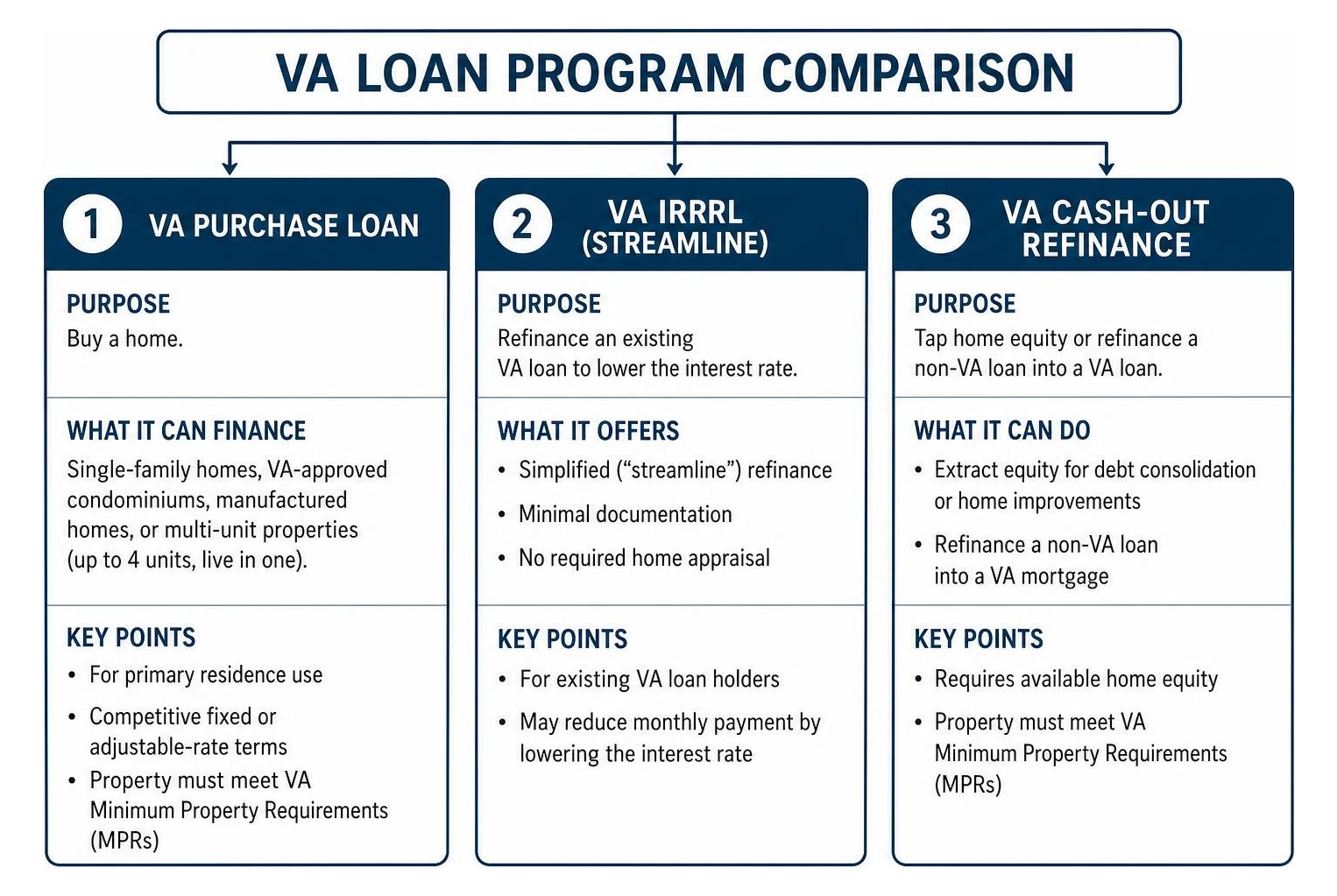
- VA Purchase Loan: Designed for purchasing single-family homes, VA-approved condominiums, manufactured homes, or multi-unit properties (up to 4 units, provided you live in one). Learn how this works when buying a home with a VA purchase loan.
- Interest Rate Reduction Refinance Loan (IRRRL): A streamline refinance allowing you to lower your monthly interest rate with minimal documentation and no required home appraisal.
- VA Cash-Out Refinance: Allows you to extract home equity for debt consolidation or home improvements, or refinance a non-VA loan into a VA mortgage. Review the full terms in the VA refinance eligibility guidelines.
Every property financed with a VA loan must meet the VA’s Minimum Property Requirements (MPRs) to ensure the structure is safe, sound, and sanitary.
Borrowers also pay a one-time VA funding fee, which ranges from 1.25% to 3.3% depending on down payment size and prior use. This fee can be financed into the loan amount and is completely waived for Veterans receiving VA disability compensation for a service-connected disability, Purple Heart recipients serving on active duty, and eligible surviving spouses.
Frequently Asked Questions About VA Mortgage Guidelines
Can I qualify for a VA loan if I have an other-than-honorable discharge?
Yes, it is possible. While an Honorable discharge grants automatic eligibility provided service duration requirements are met, an Other Than Honorable (OTH) discharge requires additional review.
You can apply for a Character of Discharge review through the VA. If the adjudicating official finds that your service was honorable for VA administrative purposes, your COE will be issued. Alternatively, you can apply to your service branch’s Discharge Review Board or Board for Correction of Military Records (BCMR) for a formal discharge upgrade.
Are there maximum loan limits if I have full entitlement?
No. Following the passage of the Blue Water Navy Vietnam Veterans Act, there are no maximum loan limits for borrowers who have full VA loan entitlement.
This means you can purchase a home at any price point without making a down payment, provided you have sufficient income and credit to qualify for the monthly mortgage payment. Conforming loan limits only apply if you have remaining secondary (bonus) entitlement after purchasing another home with an active VA loan.
Can the children of a deceased Veteran use their parent’s VA home loan benefit?
No. The VA home loan benefit is strictly non-transferable to dependent children. It is reserved solely for eligible Veterans, active-duty service members, National Guard and Reserve personnel, and qualifying surviving spouses.
Conclusion
The VA home loan program remains one of the most advantageous mortgage solutions in the lending industry, providing eligible service members with unmatched financial benefits including 0% down payment, no monthly private mortgage insurance (PMI), and competitive interest rates.
At Capital Home Mortgage, we operate as a direct VA mortgage lender with VA direct authority and fully in-house underwriting. Our team handles every step of your military home financing directly, delivering fast turnarounds, streamlined approvals, and personalized guidance from application to closing.
Whether you are looking to purchase your first home, tap into your equity, or lower your interest rate through a streamline refinance, our specialists are ready to help. Check your eligibility and get pre-approved today with the team at VA Home Mortgage.